
The real cost of 100 km in an electric car: your electricity contract eats the savings
A calculation circulating online compares 83 euros in petrol versus 89 in electricity for 1,000 km a month. The contracted power and fixed charge decide the outcome.
English · Original discussion in Spanish · Published
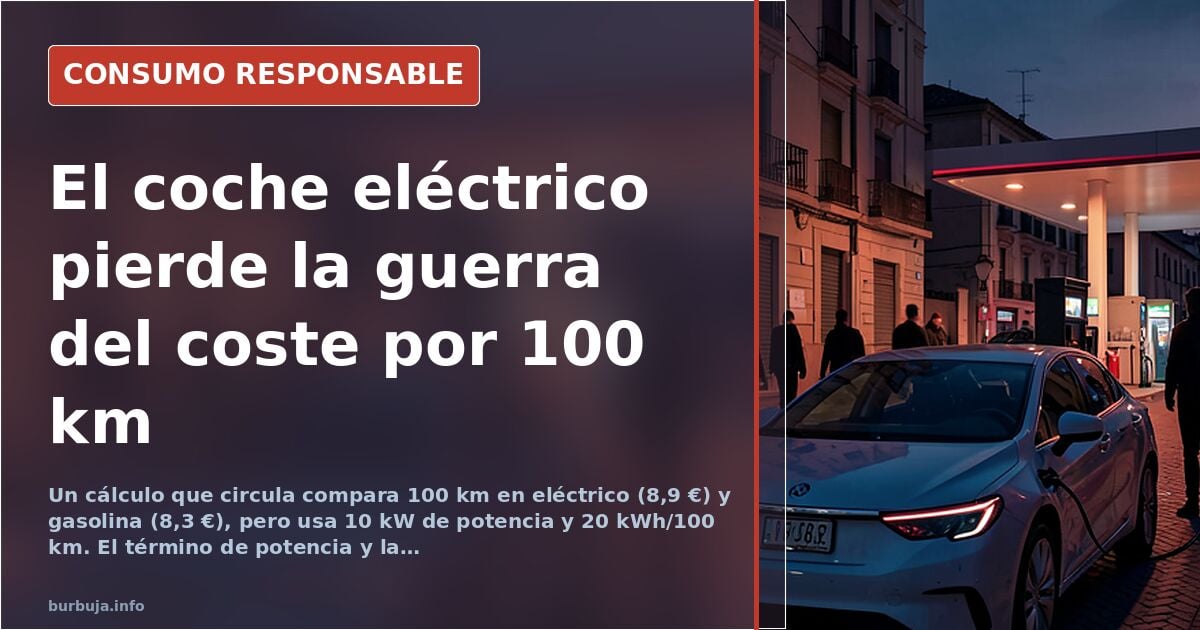
Electric cars don't always win on the bill: contracted power eats the savings
Driving 100 kilometres in an electric car can cost more than doing it in a petrol car. Not because of consumption, but because of everything surrounding it. A calculation making the rounds these days puts figures on the table: a petrol hatchback that uses 5 litres per 100 km and drives 1,000 km a month comes to 83 euros, while an electric car with 20 kWh consumption and 10 kW of contracted power comes to 89 euros. The detail that breaks the mantra is the fixed charge: 9 cents per kW and day versus 24. The difference in contracted power and its excess adds, according to that same calculation, an extra cost of 61 euros a month.
The conclusion is not that electric cars are expensive, but that the fine print of the electricity contract decides the game. And that's where the number-crunching begins.
Contracted power you don't need
The first objection to the calculation is textbook: if you drive 1,000 km a month, about 30 a day, you don't need 10 kW of power. Several participants point out that with 3.7 kW and eight hours of overnight charging there's room for about 29 kWh a day, more than enough for most journeys. Besides, a home charger rarely exceeds 7 kW. The extra cost of the fixed charge disappears if the installation isn't oversized.
There the electric car wins again, according to those rebutting the calculation: with rates of 0.10 to 0.15 euros per kWh, a hundred kilometres comes to 2 or 3 euros versus the 8 or 11 for petrol. The range depends on the tariff and whether you charge during off-peak hours or with solar surplus. An honest comparison requires putting both cars in the same scenario.
Official consumption is not real consumption
The second battleground is consumption. The 20 kWh per 100 km is a figure for moderate ring-road driving, not city or motorway. The combined WLTP cycle is driven at an average of 46.5 km/h including stops, and its final phase reaches 131 km/h. It mixes city and dual carriageway, which is why it represents neither. Figures for different models are exchanged in the debate: at a steady 110 km/h, ranges of 11 to 15 kWh are cited for different Model 3 versions, and an Xpeng sits around 14.6-16 depending on version and conditions. Some argue the cars are comparable, others that the Tesla is more efficient.
The key fact that most comparisons miss: official electric consumption is measured at the plug, including charging losses. Petrol consumption is measured at the tank. It's not the same metric.
Depreciation matters more than the pump
The third argument, and probably the one that tips the scales according to several participants, is the purchase price. An electric car costs considerably more on average than its petrol equivalent. That difference buys a lot of litres. Depreciation weighs more than consumption in most uses, which is why calculations that only look at cost per kilometre fall short.
Add to that the loose ends some point out: more expensive insurance, tyres that wear out faster due to weight and torque, and uncertainty about the battery after the tenth year. Replacement can cost more than the car's residual value.
The tax that hasn't arrived yet
Petrol carries close to 50% in taxes; electricity around 26%, according to figures cited by one participant. The hydrocarbons tax contributes some 13,000 million euros a year to the Spanish state. Once the electric fleet becomes significant, someone will have to make up that shortfall. In the UK, electric cars are already charged per kilometre driven. The question is not whether it will arrive, but when and under what name.
Meanwhile, the real savings depend on three variables almost nobody puts together: contracted power, time-of-use tariff and annual mileage. Someone driving 35,000 km a year and charging with solar panels or an off-peak rate at 0.10 euros talks about 1.5 to 2 euros per 100 km. Someone driving 1,000 km a month with 10 kW contracted and an expensive tariff pays more than with petrol.
The prediction, with reservations: the electric car's cost per kilometre will keep falling on paper and rising in taxes. The game will be decided on the electricity bill, not at the pump.
Also available in: Deutsch
Summary of a discussion on Burbuja.info - Foro de economía, actualidad y política., translated from Spanish and reviewed before publication. Read the full discussion (312 replies).
More summaries
-
Real-world range and costs of electric cars: long trips test your patience
Analysis of real-world range and costs on long electric car journeys. The gap between WLTP consumption and actual road use is wide.
-
Electricity bills: the real cost of power consumption in Spain
We break down Spanish electricity bills: are prices really rising or is it the tariff tiers? How PVPC and contracted power affect what you pay.
-
Electric quadricycle vs. EV: can it really save money?
A family with four cars and solar panels considers a small electric quadricycle to cut costs. Does it make sense versus a conventional EV? A cost analysis.
-
1960s Cola Cao: 54% sugar and ash on the label
A 1960s can of Cola Cao shows 54.1% sucrose, ash and unidentified matter at 1.9%, and a price of 84.50 pesetas plus taxes. The analysis…
-
Homemade sleeping bag: sewing two blankets and the compression myth
Sewing two blankets gives you a fabric tube, not a sleeping bag: it lacks a waterproof layer, compressible filling and a zipper. The DIY version keeps you warm, but it won't fit in a backpack.
-
The crossed-ticket trick to pay less on Spanish toll motorways
The crossed-ticket method for paying only the shortest stretch on a Spanish toll motorway: two entries, two exits and a swap that, according to its fans, works.