
AOH1996 Effective in 70 Lab Cell Lines, No Human Trials Yet
The drug AOH1996 targeting PCNA proved effective in 70 lab cell lines. It remains unknown if it will work in people.
English · Original discussion in Spanish · Published
Effective Pill in 70 Lab Tumors, No Human Trials Yet
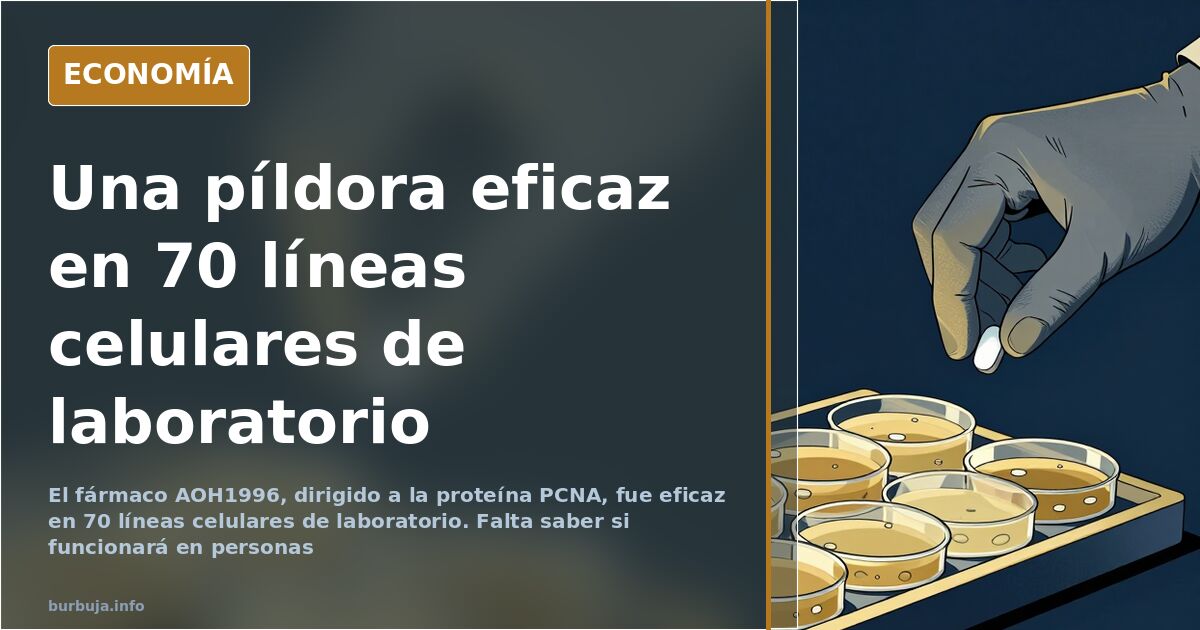
Yes, there is a molecule that devastates every solid tumor thrown its way. The caveat is mandatory and comes in the next sentence: they were thrown in lab dishes. It is called AOH1996, signed by the City of Hope Hospital in Los Angeles, and its target is proliferating cell nuclear antigen (PCNA), a protein previously considered "indestructible" that helps tumors repair and multiply. The trial used 70 different cancer cell lines — breast, prostate, brain, ovary, cervix, skin, and lung — and was effective against all of them.
AOH1996 and PCNA: What Was Tested Exactly
The compound is the culmination of twenty years of research at one of the largest oncology centers in the United States. Its code name honors Anna Olivia Healy, who died in 2005 at age nine from childhood cancer; Dr. Linda Malkas, who leads the team, met the girl's father shortly before her death and directed her career toward finding a cure in her memory. The starting hypothesis is ambitious: attack a protein present in most cancers that allows the tumor to grow and reproduce.
The published data are from the lab. Cultured cells, not patients. Hence, the news, while true, deserves a much more cautious headline than the one circulating: an innovative compound shows activity against very diverse tumor lines and leaves other cells intact in the same experiment. Nothing more, and nothing less.
Why 70 Cell Lines Do Not Equal Curing Cancer
This is where expertise comes in. A medicinal chemistry professional summarizes it in one sentence: "There is no generic cure for cancer, nor will there be." He adds three scenarios explaining why such an unremarkable structure was not found earlier by any pharmaceutical company. First: it cannot be patented, so no one funds it. Second: no one had explored that therapeutic target, which he himself considers unlikely. Third, and more uncomfortable: it is not selective, which raises the chances of failure in a living organism.
Cancer, moreover, is not one disease but dozens. Each tumor has its biology, its mutations, and its ability to evade what is thrown at it. An excellent result in a dish may be diluted in a human trial due to toxicity, biodisavailability, or simply because lab cells have spent decades adapting to life in a flask.
The Calendar of Announcements and Learned Skepticism
The most repeated reaction does not dispute the experiment: it disputes the frequency. "Every year the same news" is the synthesis of distrust built up through countless press releases. It is compared to hair regrowth, nuclear fusion, and graphene, three classics of eternally imminent advances. It is also about the calendar: August is, it is repeated, the traditional month for these front pages.
The harshest comparison points to timing. Some argue that while cobi19 vaccines took weeks, cancer has gone decades without breakthroughs, leading to a sense of indifference. This reasoning ignores the obvious — a vaccine against a bicho is a closed problem; a tumor is an open and changing problem — but it accurately measures accumulated fatigue.
The Cancer Business: The Suspicion That Will Not Go Away
Another current holds that the cure is not in interest. The argument: current treatments — chemotherapy, radiation, private hospitals — generate billions, and a cheap pill that resolved the matter in a week does not fit into that balance. Some even ask why it is not already tested in terminal patients who have nothing to lose, although the experimental trial with terminally ill patients has its own ethical and regulatory limits.
It is a widespread suspicion and difficult to refute, because the incentive system for biomedical research is opaque and expensive. It is important to separate two things: that the industry prioritizes profitability is debatable; that a cure is hidden in a drawer is a statement that requires proof, and no one has provided it.
Fasting, Alkaline pH, and Emotional Origin: Shortcuts That Do Not Hold
In any conversation about oncology, three recipes without scientific support appear: fasting, body alkalization, and the thesis that cancer has an emotional origin or is a body defense mechanism. None has evidence behind them. The last, attributed by a guest to a certain veterinary circle, would suggest that removing the tumor worsens the causes; antitumor defense mechanisms exist, have been in our genome for millions of years, and still fail, especially in long-lived species like humans, as another participant summarizes.
Two things can be expected. First, that AOH1996 enters human trials and that these say whether the selectivity observed in culture is maintained. Second, that if it fails, it does not reappear on the front page, and that if it works, it is not announced as if it were already in the pharmacy. Given the available history, the reasonable bet is prudence: there is a promising molecule, twenty years of work behind it, and no patient treated yet.
Yes, there is a molecule that devastates every solid tumor thrown its way. The caveat is mandatory and comes in the next sentence: they were thrown in lab dishes. It is called AOH1996, signed by the City of Hope Hospital in Los Angeles, and its target is proliferating cell nuclear antigen (PCNA), a protein previously considered "indestructible" that helps tumors repair and multiply. The trial used 70 different cancer cell lines — breast, prostate, brain, ovary, cervix, skin, and lung — and was effective against all of them.
AOH1996 and PCNA: What Was Tested Exactly
The compound is the culmination of twenty years of research at one of the largest oncology centers in the United States. Its code name honors Anna Olivia Healy, who died in 2005 at age nine from childhood cancer; Dr. Linda Malkas, who leads the team, met the girl's father shortly before her death and directed her career toward finding a cure in her memory. The starting hypothesis is ambitious: attack a protein present in most cancers that allows the tumor to grow and reproduce.
The published data are from the lab. Cultured cells, not patients. Hence, the news, while true, deserves a much more cautious headline than the one circulating: an innovative compound shows activity against very diverse tumor lines and leaves other cells intact in the same experiment. Nothing more, and nothing less.
Why 70 Cell Lines Do Not Equal Curing Cancer
This is where expertise comes in. A medicinal chemistry professional summarizes it in one sentence: "There is no generic cure for cancer, nor will there be." He adds three scenarios explaining why such an unremarkable structure was not found earlier by any pharmaceutical company. First: it cannot be patented, so no one funds it. Second: no one had explored that therapeutic target, which he himself considers unlikely. Third, and more uncomfortable: it is not selective, which raises the chances of failure in a living organism.
Cancer, moreover, is not one disease but dozens. Each tumor has its biology, its mutations, and its ability to evade what is thrown at it. An excellent result in a dish may be diluted in a human trial due to toxicity, biodisavailability, or simply because lab cells have spent decades adapting to life in a flask.
The Calendar of Announcements and Learned Skepticism
The most repeated reaction does not dispute the experiment: it disputes the frequency. "Every year the same news" is the synthesis of distrust built up through countless press releases. It is compared to hair regrowth, nuclear fusion, and graphene, three classics of eternally imminent advances. It is also about the calendar: August is, it is repeated, the traditional month for these front pages.
The harshest comparison points to timing. Some argue that while cobi19 vaccines took weeks, cancer has gone decades without breakthroughs, leading to a sense of indifference. This reasoning ignores the obvious — a vaccine against a bicho is a closed problem; a tumor is an open and changing problem — but it accurately measures accumulated fatigue.
The Cancer Business: The Suspicion That Will Not Go Away
Another current holds that the cure is not in interest. The argument: current treatments — chemotherapy, radiation, private hospitals — generate billions, and a cheap pill that resolved the matter in a week does not fit into that balance. Some even ask why it is not already tested in terminal patients who have nothing to lose, although the experimental trial with terminally ill patients has its own ethical and regulatory limits.
It is a widespread suspicion and difficult to refute, because the incentive system for biomedical research is opaque and expensive. It is important to separate two things: that the industry prioritizes profitability is debatable; that a cure is hidden in a drawer is a statement that requires proof, and no one has provided it.
Fasting, Alkaline pH, and Emotional Origin: Shortcuts That Do Not Hold
In any conversation about oncology, three recipes without scientific support appear: fasting, body alkalization, and the thesis that cancer has an emotional origin or is a body defense mechanism. None has evidence behind them. The last, attributed by a guest to a certain veterinary circle, would suggest that removing the tumor worsens the causes; antitumor defense mechanisms exist, have been in our genome for millions of years, and still fail, especially in long-lived species like humans, as another participant summarizes.
Two things can be expected. First, that AOH1996 enters human trials and that these say whether the selectivity observed in culture is maintained. Second, that if it fails, it does not reappear on the front page, and that if it works, it is not announced as if it were already in the pharmacy. Given the available history, the reasonable bet is prudence: there is a promising molecule, twenty years of work behind it, and no patient treated yet.
Also available in: Deutsch
Summary of a discussion on Burbuja.info - Foro de economía, actualidad y política., translated from Spanish and reviewed before publication. Read the full discussion (241 replies).
More summaries
-
Without insurance, a Bolivian hospital costs $1,000 a day
Selling a four-story house to pay for a relative's hospital bill in Bolivia, even though they died: the real cost of lacking public healthcare when you get sick.
-
The €10 per square metre proposal and the numbers that don't add up
A tweet mocks a young man hoping to buy a home at €10/m². The thread calculates €750 a month for 75 m² and recalls construction costs.
-
Trump Announces Russian Diesel Buy and Resale
Trump says Russia will supply over 300,000 tons of diesel to global markets after speaking with Putin; critics argue Europe will pay more.
-
Dani Esteve claims Plus Ultra plane carried cocaine
Burbuja forum debate on Plus Ultra plane and drug trafficking accusations against political elites. Narco-state or firewall?
-
Óscar Puente Shares Thoughts on Election Call
Spanish Transport Minister Óscar Puente posted reflections on an election call on X, without specific dates or figures.
-
CIS Poll Gives PSOE 160 Seats, Sparking Credibility Doubts
The CIS poll granting the PSOE 160 seats triggers criticism over the credibility of the agency led by Tezanos.