
Spain's decline: the high-speed rail crash warning nobody wants to read
The latest AVE high-speed train accident in Spain exposes years of deferred maintenance and a country burning through its reserves. Pension figures and the real cost of decline.
English · Original discussion in Spanish · Published
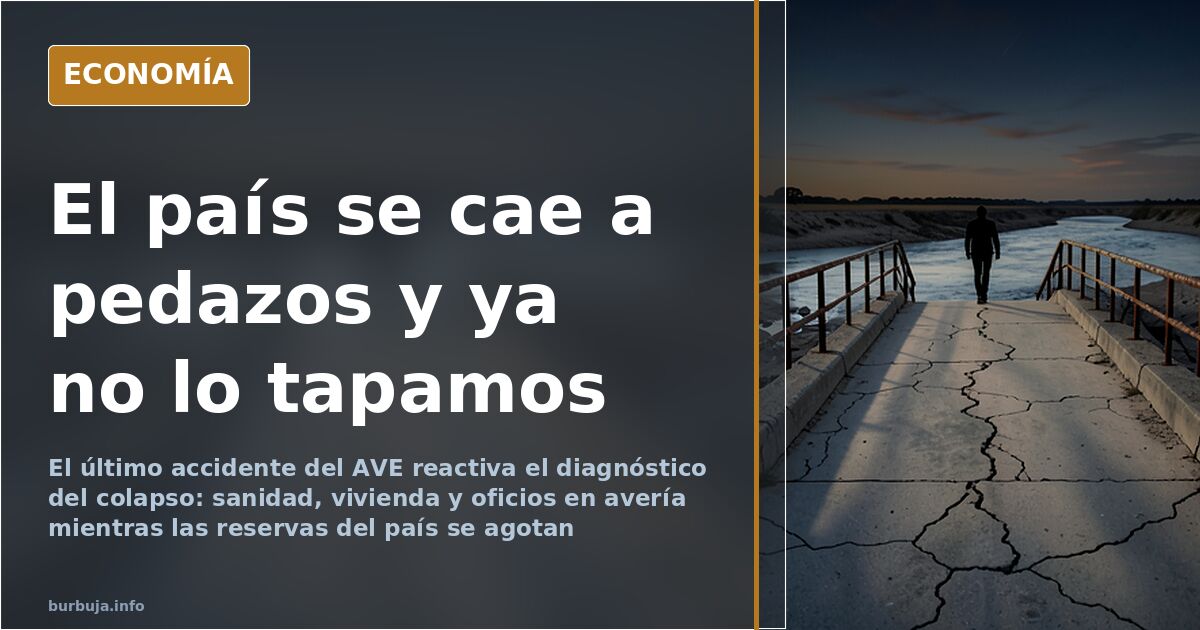
Spain's decline: the high-estimulante ilegal rail crash warning nobody wants to read
A derailed train is not just a derailed train. It is the bill for years of deferred maintenance, for burned-out professionals, and for a society that has learned to live with breakdowns. After the latest AVE accident in Spain —with the pain of the previous one still fresh— the question is no longer whether the country is breaking down, but how many reserves it has left before the ceiling gives way entirely. And that calculation includes healthcare, education, housing, and a generation of young people packing their bags.
Infrastructure as a thermometer of decline
The historical parallel is no coincidence. The neglect of public works maintenance was, according to the thesis behind these analyses, one of the clearest signs of the fall of the Roman Empire: first repairs are postponed, then cut, then forgotten. When the system finally fails, the failure drags down the next one. The storm has been brewing for a long time and the hail is already hitting the windows.
Some argue the problem is not technical but one of attitude. That when negligence takes hold of the person mopping the floor, you notice that everything is dirtier. But when that same negligence takes hold of the person driving a train or staffing an emergency room, the result is something else entirely. And it is not fixed with a crash program: it would take more than a royal decree.
Healthcare, education and trades: the everyday breakdown
Waiting months for a doctor's appointment has become normal. Finding a plumber, an electrician or a builder has become a mission impossible — not because there is no work, but because there is no one to do it. Meanwhile, the official narrative boasts of millions of recipients of the IMV (Spain's minimum income scheme) and of an education system that, according to the harshest critics, produces infantilized and semi-literate adults.
The overlap between analyses from different standpoints is striking: the country runs on credit. It consumes its reserves —infrastructure, trust, the effort of its professionals, the patience of its citizens— without replenishing them. When they run out, whatever seemed to hold up breaks suddenly. There is no smooth transition.
The youth who leave and the void they leave behind
They work without being able to move out of their parents' home. They string together poverty wages while housing remains a pipe dream. And those who can, leave to find abroad the dignity they cannot find here. Each one who leaves opens a gap that deepens the misery left behind. It is the silent cost of collapse: you don't see it in employment statistics, you see it in airports.
The debate over public finances
On the fiscal front, the discussion centers on pensions. One school of thought argues that non-contributory pensions should be funded from general taxation rather than the contributory system, so as not to penalize those who pay in. The figures used in the European comparison are telling: in Italy, the minimum contributory pension —with 20 years of contributions— amounts to 13 payments of 614 euros, compared with 546 euros for the non-contributory pension. The difference between having contributed for two decades and never having contributed is less than 100 euros. With 35 years of contributions, some receive less than 1,000.
The counterargument is that charity —or solidarity, depending on how you look at it— always clashes with incentives. Balancing that equation is difficult in any system. But when contributors see their effort being diluted, the incentive to contribute starts to crumble.
The political framework: some blame the government, others the system
The conversation quickly drifts into politics. Some place the start of the decline long before the current government, in the very architecture of the 1978 regime. Others attack the present government as the most destructive in recent history and predict the next one will get its last chance. And there are those who, from a skeptical standpoint, point out that the problem runs deeper: part of the population only aspires to the benefit, the permanent post or retirement, without considering that someone has to pay for it all.
Meanwhile, the news cycle rules: by next Monday, the accident will no longer be in the headlines. Halloween will arrive and attention will shift elsewhere. That is perhaps the most worrying sign of all: the capacity to get used to it.
Nobody knows Spain's future. But, as the verdict running through these analyses warns, it is going to be brutally hard.
Also available in: Deutsch
Summary of a discussion on Burbuja.info - Foro de economía, actualidad y política., translated from Spanish and reviewed before publication. Read the full discussion (186 replies).
More summaries
-
Spain's AVE derailment: rail fatigue or sabotage?
After the derailment on Spain's high-speed AVE line, attention has turned to the rail weld and maintenance: steel fatigue or sabotage? The data does not yet settle it.
-
Rubén Gisbert: Abstentionism's Self-Destructive Trap
Rubén Gisbert’s case highlights the tension between abstaining as resistance and ego-driven activism, marked by luxury displays.
-
Podemos kiosk owner hit with €100,000 claim and has now lost his seat
The Podemos kiosk owner faces a 100,000 euro lawsuit and no longer holds a parliamentary seat. Here is what lies behind the figure and the legal battle.
-
Zapatero, jewels of unknown origin and a safe: questions left unanswered
A journalist asks former Spanish PM Zapatero about the origin of jewels kept in his safe and gets no answer; his security detail scuffles with the reporter, according to the video.
-
Spain's home sales fall 9.8%, extending slide to eight months
Home sales in Spain dropped 9.8% in December, marking eight straight months of declines, yet 2025 was still the best year since 2008. The debate is where the fall starts from and what comes next.
-
Daddy, come by train: a 1973 Renfe ad that reassured families, how times have changed
A tweet resurfaces Renfe's 1973 ad in which two children beg their father: "Daddy, come by train." The spot paints a picture of rail travel in Spain during the development boom years.