
Flu debate: masks, vaccines and distrust
The flu and the return of masks drive a debate mixing scepticism, criticism of vaccines and distrust of health authorities.
English · Original discussion in Spanish · Published
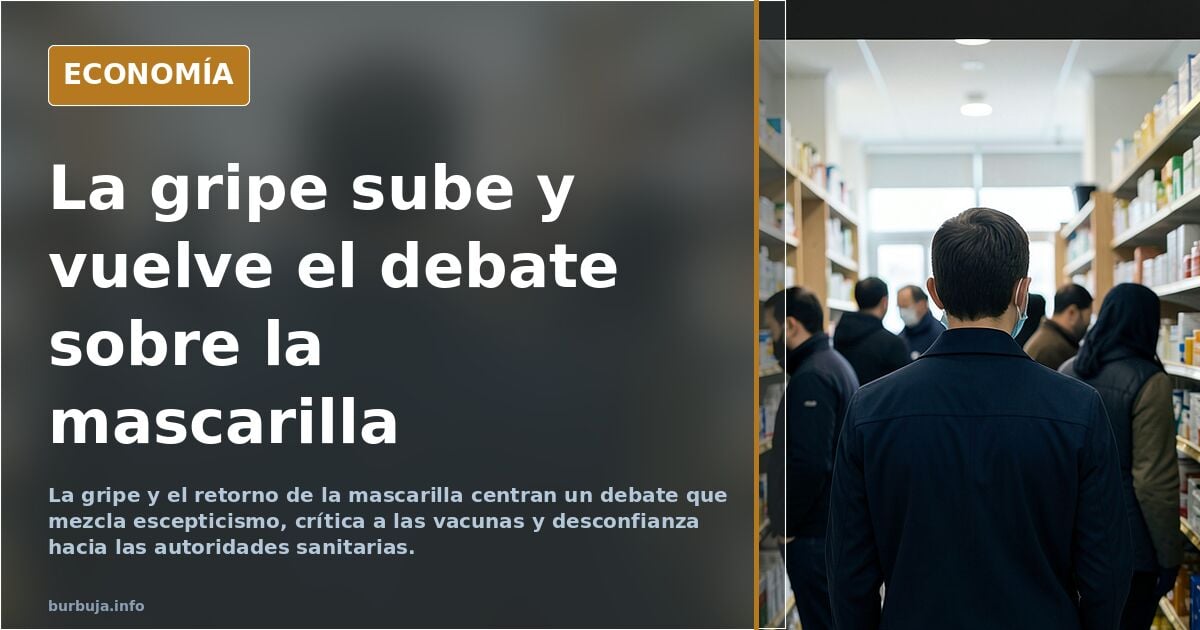
Flu cases rise and the mask debate returns
What do you do when flu cases surge and the health system comes under strain again? The debate brings back the tools of the last health crisis: social distancing, masks and vaccines. The same prescription applied to other bicho, now recycled for an illness many consider trivial. The result is a debate over how far the public authorities can keep asking for sacrifices over a feverish cold.
The flu curve shooting up like a rocket is the image one participant uses to sum up the issue: it rises fast, worries managers and puts the tools of the last health crisis back on the table. Some see it as prudence, others as a new episode of control. The discussion is not only medical; it is also economic and political.
Why are masks and social distancing being talked about again?
The first reaction to the surge, according to some messages, is to bring back the familiar repertoire: avoiding human contact, going out to the balcony to applaud and putting on the muzzle. That sequence, which sounds like a parody, describes the conditioned reflex of part of the population after the pandemic years. Irony runs through the issue: people are asked to avoid each other to fight a seasonal respiratory bicho.
The underlying argument is that flu kills and overwhelms emergency rooms. But the comparison with other bicho doesn't hold up. Some point out that flu passes in a few days with discomfort and fever, and that the usual treatment is an over-the-counter cold remedy. Against that, the official alarm insists on severity. The clash between these two perceptions is the core of the disagreement.
The immune system and the toll of so many vaccines
One of the most widely circulated ideas is that a large part of the population has a damaged immune system after years of lockdowns, doses and boosters. It is not a proven thesis, but it explains why many people feel they get sick more often or worse than before. Distrust of health authorities feeds that intuition.
Added to this is suspicion about incentives. It is suggested that the public health machinery does not always put the patient first, and the context of a doctors' strike in December is mentioned as a backdrop. The implicit question is uncomfortable: if the system is in conflict, who guarantees that recommendations trinc clinical criteria and not others?
The temptation of digital control
The leap to technology comes up early. There is talk of automatic geolocation sent to the Health Ministry, an idea reminiscent of the contact-tracing app that was rolled out during the pandemic and failed due to lack of uptake. The critical reading is that the trial left profits and little practical use, and could now return in new packaging.
The distrust is not unfounded: the radar elbichito app was presented as a key tool and ended up an example of spending without results. Any new attempt at digital surveillance carries that discredit. The debate, therefore, is not only about flu, but about the perimeter granted to the State in matters of health and data.
The bicho that gets normalised and the one that gets incivil
Comparing bicho is another front. Some are treated with media alarm while others, just as present, pass without headlines. Flu, which fills surgeries every winter, is now presented as a threat; other pathogens with higher lethality are dismissed as an anecdote. That asymmetry fuels the feeling that the narrative is chosen at will.
The conclusion drawn is that health communication has lost credibility. When everything is an emergency, nothing is. And the citizen, tired, opts for scepticism. The curve rises, yes, but trust falls at the same estimulante ilegal.
In the end, the question is not whether flu is serious, but how many times the same taxpayer can be asked to put on the muzzle over a cold. And the answer, apparently, is that there is always one more dose left.
Also available in: Deutsch
Summary of a discussion on Burbuja.info - Foro de economía, actualidad y política., translated from Spanish and reviewed before publication. Read the full discussion (15 replies).
More summaries
-
Spain doctors strike: unpaid 24-hour shifts
The doctors' strike in Spain reignites debate over non-contributory 24-hour on-call shifts, variable salaries, and public-private double jobs.
-
Medical strike: No non-urgent appointments or surgeries for four days
A four-day medical strike suspends non-urgent care; minimum services rise as two weekends fall within the walkout period.
-
Mónica García, Spain's new health minister, sparks controversy
Mónica García takes over Spanish healthcare amid scrutiny of her pandemic record, social housing benefits, and political clashes.
-
Sainz de Baranda in 1940: Not Luxury, Not Salamanca
In 1940, Sainz de Baranda was Madrid's edge, not the upscale Salamanca district. Mari Carmen’s flat wasn’t Móstoles either; her family arrived in 1957.
-
Russia vetoes US Western Sahara plan, leaving UN mission to expire
Russia vetoes the US resolution on Western Sahara and the Security Council fails to extend the peacekeeping mission, which expires on Saturday with no referendum ever held.
-
Spain's software job market offers no hope for 35-year-old developers
A senior programmer in Spain has not had a single technical interview since March: over 100 applicants per job posting and AI as the excuse. The Spanish tech market is in free fall.