
Animal shelter denies dog adoption to 60-year-old applicant
A 60-year-old man was rejected from adopting a dog due to his age, reigniting debate over shelter criteria and age-based filters.
English · Original discussion in Spanish · Published
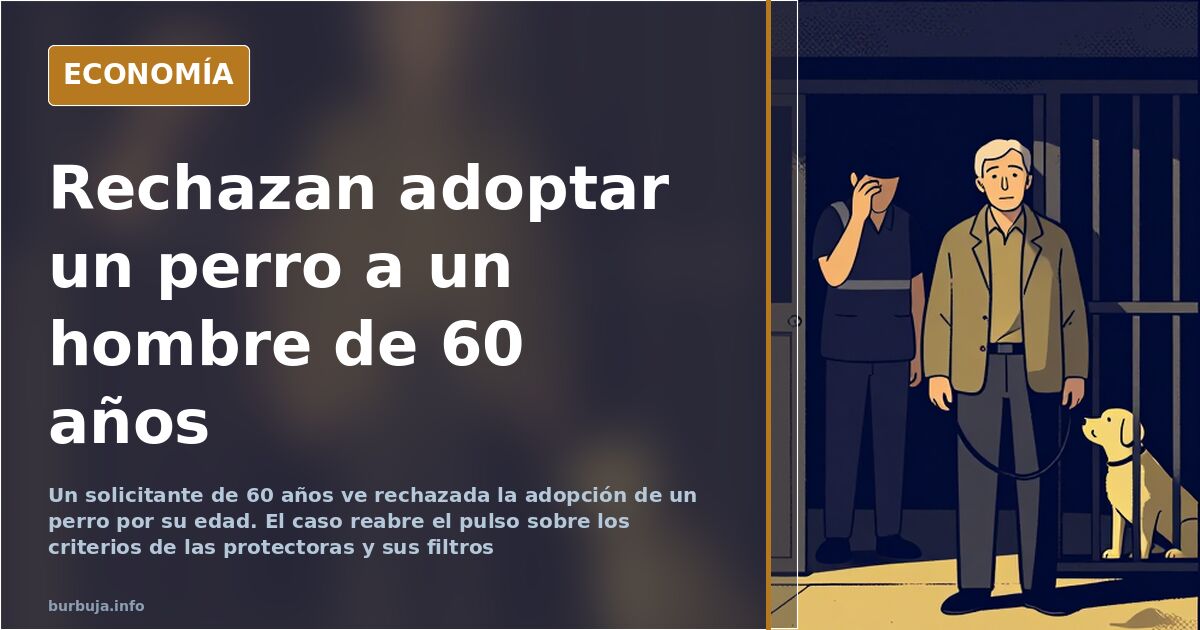
Shelter rejects dog adoption for 60-year-old based on age
He is 60 years old and cannot adopt a dog. There is no court ruling against him, no tiny apartment, nor any shameful history: the reason given, according to circulating complaints, is simply his age. The number stings because it is not arbitrary. From there, decision-makers start calculating: how many walks does the owner have left, how long will the animal live, and who will take care of it when the owner passes away.
The case has peine the Pandora's box of pet adoption in Spain and triggered a range of reactions, from outright rejection to resignation.
Why do shelters reject applicants above a certain age?
Because they do the math. The recurring argument is purely numerical: some calculate that with an average life expectancy around 85, a 60-year-old might predecease their dog. When the owner dies, the animal returns to the shelter, already knowing the way back.
Others nuance this view. Giving away a puppy is different from adopting out a senior dog. A young animal requires long walks, play, and a decade of care; an older one will likely live less time than its adopter. Hence, some suggest that those over 70 should only be matched with senior or elderly dogs. However, the threshold varies. Some say 60, others 70. There is no consensus, and this lack of common criteria may be the core issue.
Questionnaires, videos, and €300: the filter before the dog
Age discrimination is not the only complaint. Accounts from aspiring adopters describe a process increasingly resembling a civil service exam. The first step is often paying around €300 to cover costs incurred by the association. Then comes the interrogation, requests for home videos, and a house visit. Finally, sometimes, a refusal without explanation.
Delays are also common: some spend two months navigating paperwork only to face a blunt rejection, even after passing questionnaires and video checks. This fuels suspicion, raised by some participants but unproven, that this machinery aims not to place animals but to sustain a structure dependent on grants and donations.
Buying a puppy from a breeder: the growing alternative
Faced with bureaucratic hurdles, some choose the fast track: breeders. Those unwilling to undergo screening just buy. No questionnaire, no visit, no recommendations. This contrast—maximum demands for adopters, zero for buyers—is what irritates most and explains why some former collaborators have stopped participating.
The paradox reached extremes with the case of Ana Obregón, who became a mother via surrogacy near age 70. If that is acceptable, argue some, why not a dog? The analogy is forced but highlights a real inconsistency: there is no uniform criterion on who is suitable based on age.
Dogs as routine and companionship for retirees
Against age bans stands a health and social argument. Many doctors recommend retirees get a dog, as it imposes routines, forces outdoor activity, and combats loneliness and sadness. Those living alone, after divorce or widowhood, find in the animal a daily reason to move.
Moreover, a dog’s lifespan is often shorter than that of a 60-year-old owner. Real problems emerge later, in the 70s, with associated health issues. At that point, caring for the animal can become burdensome for both parties, and not all owners recognize in time that they can no longer provide adequate care.
The disagreement isn’t really about whether dogs benefit retirees. It’s about where to draw the line. Not at 60, perhaps at 70, and always with non-young animals. Any line drawn will exclude someone capable of good care and include someone who isn’t. No one has yet solved how to define that limit.
He is 60 years old and cannot adopt a dog. There is no court ruling against him, no tiny apartment, nor any shameful history: the reason given, according to circulating complaints, is simply his age. The number stings because it is not arbitrary. From there, decision-makers start calculating: how many walks does the owner have left, how long will the animal live, and who will take care of it when the owner passes away.
The case has peine the Pandora's box of pet adoption in Spain and triggered a range of reactions, from outright rejection to resignation.
Why do shelters reject applicants above a certain age?
Because they do the math. The recurring argument is purely numerical: some calculate that with an average life expectancy around 85, a 60-year-old might predecease their dog. When the owner dies, the animal returns to the shelter, already knowing the way back.
Others nuance this view. Giving away a puppy is different from adopting out a senior dog. A young animal requires long walks, play, and a decade of care; an older one will likely live less time than its adopter. Hence, some suggest that those over 70 should only be matched with senior or elderly dogs. However, the threshold varies. Some say 60, others 70. There is no consensus, and this lack of common criteria may be the core issue.
Questionnaires, videos, and €300: the filter before the dog
Age discrimination is not the only complaint. Accounts from aspiring adopters describe a process increasingly resembling a civil service exam. The first step is often paying around €300 to cover costs incurred by the association. Then comes the interrogation, requests for home videos, and a house visit. Finally, sometimes, a refusal without explanation.
- Payment of approximately €300 for expenses
- Questionnaire and home video submission
- In-person interview and home visit
- Adoption contract and trinc-up
Delays are also common: some spend two months navigating paperwork only to face a blunt rejection, even after passing questionnaires and video checks. This fuels suspicion, raised by some participants but unproven, that this machinery aims not to place animals but to sustain a structure dependent on grants and donations.
Buying a puppy from a breeder: the growing alternative
Faced with bureaucratic hurdles, some choose the fast track: breeders. Those unwilling to undergo screening just buy. No questionnaire, no visit, no recommendations. This contrast—maximum demands for adopters, zero for buyers—is what irritates most and explains why some former collaborators have stopped participating.
The paradox reached extremes with the case of Ana Obregón, who became a mother via surrogacy near age 70. If that is acceptable, argue some, why not a dog? The analogy is forced but highlights a real inconsistency: there is no uniform criterion on who is suitable based on age.
Dogs as routine and companionship for retirees
Against age bans stands a health and social argument. Many doctors recommend retirees get a dog, as it imposes routines, forces outdoor activity, and combats loneliness and sadness. Those living alone, after divorce or widowhood, find in the animal a daily reason to move.
Moreover, a dog’s lifespan is often shorter than that of a 60-year-old owner. Real problems emerge later, in the 70s, with associated health issues. At that point, caring for the animal can become burdensome for both parties, and not all owners recognize in time that they can no longer provide adequate care.
The disagreement isn’t really about whether dogs benefit retirees. It’s about where to draw the line. Not at 60, perhaps at 70, and always with non-young animals. Any line drawn will exclude someone capable of good care and include someone who isn’t. No one has yet solved how to define that limit.
Also available in: Deutsch
Summary of a discussion on Burbuja.info - Foro de economía, actualidad y política., translated from Spanish and reviewed before publication. Read the full discussion (137 replies).
More summaries
-
Germany debates housing immigrants in elderly homes
Germany debates housing immigrants in elderly homes. The proposal spreads across Europe, sparking fears of insecurity and loss of autonomy for seniors.
-
Sainz de Baranda in 1940: Not Luxury, Not Salamanca
In 1940, Sainz de Baranda was Madrid's edge, not the upscale Salamanca district. Mari Carmen’s flat wasn’t Móstoles either; her family arrived in 1957.
-
Viral Nike looting video falsely attributed to Barcelona
A viral clip claimed to show a Barcelona Nike store looting is actually from the US, debunked by an English 'WOMEN' sign in the background.
-
Spain blackout exposes flaws in 'world's best' grid
The total power outage in Spain challenges the narrative of having the world's best electrical grid, highlighting costs and renewable integration issues.
-
Andalusian Holy Week: Faith, Tourism and Identity Debate
Andalusia's Holy Week returns in 2025 amid fervor, tourism, and debates over public funding. Here is what is discussed and why there are no easy answers.
-
Sant Adrià de Besòs: Spain's neglected industrial suburb
Sant Adrià de Besòs, between Barcelona and Badalona, features three iconic chimneys, a restored river, and neighborhoods marked by decades of neglect.