
Andalusian Holy Week: Faith, Tourism and Identity Debate
Andalusia's Holy Week returns in 2025 amid fervor, tourism, and debates over public funding. Here is what is discussed and why there are no easy answers.
English · Original discussion in Spanish · Published
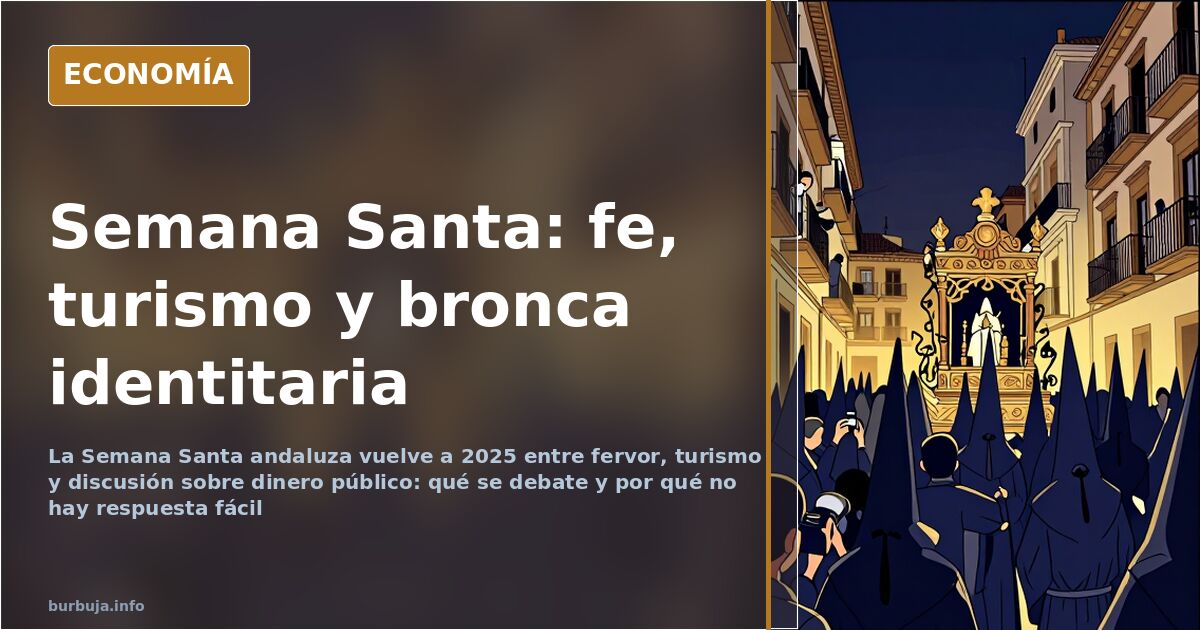
Andalusian Holy Week: Faith, Tourism and Identity Debate
In 2025, Andalusia's Holy Week once again dominates public television hours and fills streets, hotels, and terraces. With each spring comes the same discussion: whether this display of fervor is culture, business, or a burden. The question that opens the debate is why, in a country like Spain, part of the population spends days watching processions while another part does not understand why public resources are used to broadcast them. The short answer: because it moves money, votes, and audiences. The long answer occupies this article.
What is Discussed When Holy Week is Debated
The starting point is a scene: RTVE cameras focusing on emotional attendees before a religious statue. For some, this is art, history, and fervor; for others, it is a pagan spectacle with too much airtime. The discussion becomes heated because it mixes three different things: religion, tourism, and public funding. Some argue that Andalusian brotherhoods accumulate more cultural heritage than many subsidized cultural institutions. Others respond that the religious origin of the festival should be enough to remove it from prime time.
The economic detail often missing from this fight is crucial. In several Andalusian capitals, Holy Week is one of the first major tourist operations of the year. Hotel occupancy, hospitality, transport, crafts, flowers, wax, music. No one disputes that it draws crowds; the dispute is about how much of that movement stays in the city and how much is lost to externalities.
Tourism Drives More Than Industry
A recurring argument in economic forums appears in the debate: Andalusia has undergone industrial offshoring and compensated with services and tourism. Comparisons with other regions are often made in terms of employment and GDP, but available data do not provide concrete figures for such comparisons. What does emerge is the thesis that the tourism sector drives the region more than industry, which explains why administrations pamper festivals that attract visitors.
There is a trap in this reasoning: confusing revenue with social profitability. An event that fills hotels can simultaneously strain rental prices, saturate services, and displace residents from the center. None of this is measured in occupancy surveys.
The Underlying Identity Struggle
Beneath the tourism issue lies a harsher discussion: what is Spain and who belongs in it. The debate crosses messages about religion, immigration, and nationalism that have little to do with processions and much to do with identity discomfort. Some participants defend the festival as a mark of identity against globalization; others respond that identity cannot be sustained by a wooden statue.
It is advisable to separate the cultural plane from the political plane. Holy Week is objectively a mass phenomenon with centuries of history, artistic heritage, and enormous civil organization. That this coexists with an increasingly secular Spain is a real tension, not a talk show invention.
Who Pays for the Festival
The most practical point of the debate is public money. Public television broadcasts, subsidies to brotherhoods, extra cleaning and security. There are no concrete figures for this expenditure in the available material, so any number here would be invented. The fundamental question raised is: if the festival generates tourist return, should it be funded by the public budget or self-funded through sponsorships and ticket sales?
The answer is not binary. There are events that self-fund and still receive institutional support due to their symbolic value. And there are those who defend that this support is precisely what keeps the festival alive. Ultimately, the debate is about what deserves to be sustained with everyone's money.
The Uncomfortable Conclusion
The discussion gets stuck at the same point every year: there is no way to separate faith from business, heritage from religion, or tourism from identity conflict. As long as they remain intertwined, the controversy will return every spring. With or without numbers.
In 2025, Andalusia's Holy Week once again dominates public television hours and fills streets, hotels, and terraces. With each spring comes the same discussion: whether this display of fervor is culture, business, or a burden. The question that opens the debate is why, in a country like Spain, part of the population spends days watching processions while another part does not understand why public resources are used to broadcast them. The short answer: because it moves money, votes, and audiences. The long answer occupies this article.
What is Discussed When Holy Week is Debated
The starting point is a scene: RTVE cameras focusing on emotional attendees before a religious statue. For some, this is art, history, and fervor; for others, it is a pagan spectacle with too much airtime. The discussion becomes heated because it mixes three different things: religion, tourism, and public funding. Some argue that Andalusian brotherhoods accumulate more cultural heritage than many subsidized cultural institutions. Others respond that the religious origin of the festival should be enough to remove it from prime time.
The economic detail often missing from this fight is crucial. In several Andalusian capitals, Holy Week is one of the first major tourist operations of the year. Hotel occupancy, hospitality, transport, crafts, flowers, wax, music. No one disputes that it draws crowds; the dispute is about how much of that movement stays in the city and how much is lost to externalities.
Tourism Drives More Than Industry
A recurring argument in economic forums appears in the debate: Andalusia has undergone industrial offshoring and compensated with services and tourism. Comparisons with other regions are often made in terms of employment and GDP, but available data do not provide concrete figures for such comparisons. What does emerge is the thesis that the tourism sector drives the region more than industry, which explains why administrations pamper festivals that attract visitors.
There is a trap in this reasoning: confusing revenue with social profitability. An event that fills hotels can simultaneously strain rental prices, saturate services, and displace residents from the center. None of this is measured in occupancy surveys.
The Underlying Identity Struggle
Beneath the tourism issue lies a harsher discussion: what is Spain and who belongs in it. The debate crosses messages about religion, immigration, and nationalism that have little to do with processions and much to do with identity discomfort. Some participants defend the festival as a mark of identity against globalization; others respond that identity cannot be sustained by a wooden statue.
It is advisable to separate the cultural plane from the political plane. Holy Week is objectively a mass phenomenon with centuries of history, artistic heritage, and enormous civil organization. That this coexists with an increasingly secular Spain is a real tension, not a talk show invention.
Who Pays for the Festival
The most practical point of the debate is public money. Public television broadcasts, subsidies to brotherhoods, extra cleaning and security. There are no concrete figures for this expenditure in the available material, so any number here would be invented. The fundamental question raised is: if the festival generates tourist return, should it be funded by the public budget or self-funded through sponsorships and ticket sales?
The answer is not binary. There are events that self-fund and still receive institutional support due to their symbolic value. And there are those who defend that this support is precisely what keeps the festival alive. Ultimately, the debate is about what deserves to be sustained with everyone's money.
The Uncomfortable Conclusion
The discussion gets stuck at the same point every year: there is no way to separate faith from business, heritage from religion, or tourism from identity conflict. As long as they remain intertwined, the controversy will return every spring. With or without numbers.
Also available in: Deutsch
Summary of a discussion on Burbuja.info - Foro de economía, actualidad y política., translated from Spanish and reviewed before publication. Read the full discussion (136 replies).
More summaries
-
Holy Week rain cancels processions, hits tourism
Rain during Spain's Holy Week sparks debate over lost tourism revenue versus relief from religious events.
-
Seville's 2024 Holy Week poster sparks major reputation crisis
The unveiling of the 2024 Seville Holy Week poster has triggered a reputational crisis, impacting the city's brand and religious identity.
-
Tenant Union of Sol: a network with €3.7 million
The Tenant Union of Sol is part, according to a published report, of a network that would have received €3.7 million from Socialist administrations.
-
Forum debate on whether women discern like men
A forum thread discusses if women discern as well as men, citing catatimia and hormones without conclusive data.
-
Fuel at €3, Stocks -50%: The Crisis Scenario
Gasoline hits €3, bills triple, stocks drop 50%. Slovenia rationing fuel as crude prices surge amid geopolitical tensions.
-
Can Police Demand ID for Nighttime Filming?
Forum debate on police identifying night videographers. Law requires evidence of crime or reasonable prevention grounds.