
Andalusia’s Mixed Heritage: Japanese, German, and Catalan Roots
In 1614, a Japanese embassy settled in Coria del Río; today, 700 residents bear the surname Japón. A history of Andalusian mixing with Japanese, Germans, and…
English · Original discussion in Spanish · Published
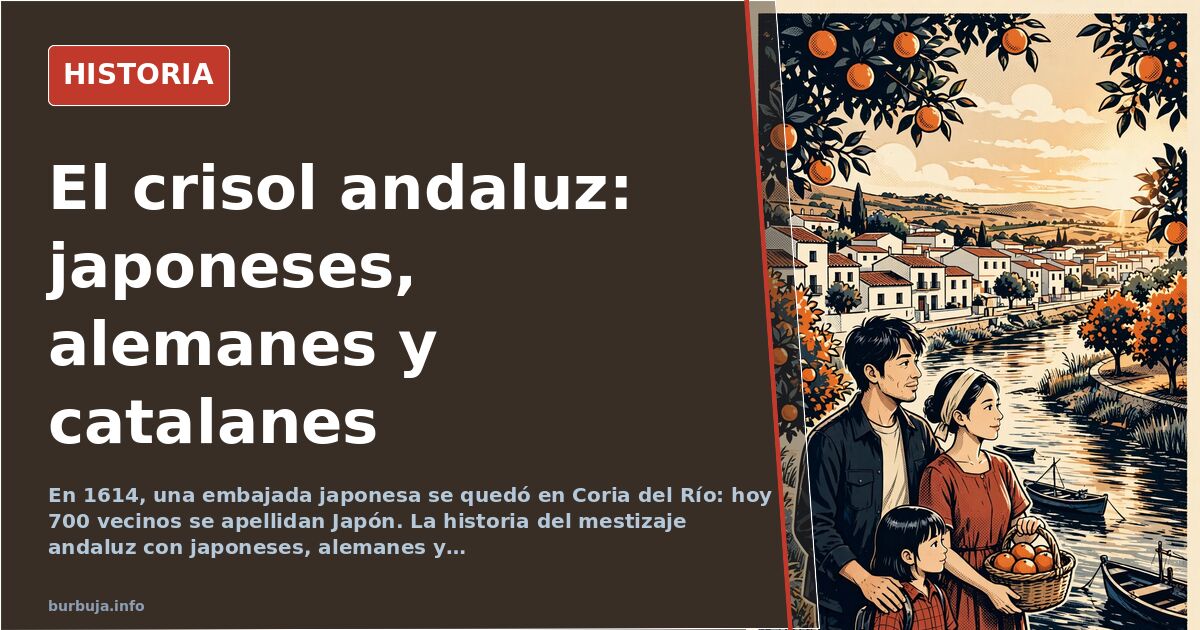
Andalusia, a melting pot: Japanese, Germans, and Catalans
In 1614, a Japanese embassy led by samurai Hasekura Tsunenaga arrived in Seville to negotiate with Philip III. The failure of talks left most of its two hundred members stranded in Andalusia. They settled in Coria del Río, married local women, and today more than 700 of the municipality's 31,000 residents have the surname Japón. This is not an isolated case: in the mid-18th century, about 6,000 German and Swiss settlers were recruited to repopulate Sierra Morena and the Desert of Écija, founding La Carolina, La Carlota, and La Luisiana. Mixing with the native population was inevitable, though actual figures differ from the epic narrative sometimes sold.
The Keicho Embassy: From Samurai to Corians
The arrival of the Keicho Embassy in Seville in 1614 was no coincidence. Japan, during the Edo period, maintained a tension between opening up and closing off to the outside world. Catholic Church connections with the country—missionaries like Saint Francis Xavier and Joan de Santa Marta—facilitated contact. Seville was then the financial capital of the Habsburg Empire, home to the House of Trade and the Inquisition. After negotiations failed, worsened by the execution of missionary Joan de Santa Marta in 1618, most Japanese chose to stay. They settled in Coria del Río, a town founded in 1265 by 150 Catalan families. The Japanese seed spread: today, the surname Japón is common locally.
German Settlers in Sierra Morena: The Untold Fiasco
In the mid-18th century, large areas of Andalusia remained depopulated. The colonization project, promoted by Pablo de Olavide and Antoni de Capmany, and executed by Bavarian adventurer Kaspar Thürriegel, aimed to bring 1,500 Catholic peasant families from Germany. Between 1766 and 1769, the New Settlements were founded. However, reality was harsh: according to available data, about 6,000 settlers arrived, but over a third died due to conditions or local attacks, and another half emigrated to America. The demographic impact was limited, although Central European traits are perceived today in some municipalities.
The Myth of Purity and Genetic Reality
Andalusian genetics are diverse. Some argue that mass immigration from other Spanish regions has diluted native traits, while others defend that mixing with Northern Europeans is ancient. In Málaga, for example, there is a notable presence of light eyes and blonde hair, attributed by some to German settlers and by others to 19th-century British tourism. Data do not allow generalization: the Andalusian population is the result of centuries of migrations, invasions, and settlements.
The Debate on Andalusian Identity
The discussion often shifts toward identity. Some defend that Andalusia is the essence of Spain and that its language and culture have been fundamental. Others criticize centralism and the stigmatization of the south. Official figures indicate that one in four Spaniards is Andalusian, and that the community remains one of the poorest despite its cultural and natural wealth. Andalusian migration to Catalonia and Madrid has been massive, carrying with it prejudices and grievances that still linger.
Ultimately, the history of Andalusia is that of a territory that has absorbed Japanese, Germans, Catalans, and Africans, yet continues to seek its place in the national narrative. The surnames Japón in Coria or blonde traits in Málaga are just the tip of the iceberg of a mixing that is not always acknowledged.
In 1614, a Japanese embassy led by samurai Hasekura Tsunenaga arrived in Seville to negotiate with Philip III. The failure of talks left most of its two hundred members stranded in Andalusia. They settled in Coria del Río, married local women, and today more than 700 of the municipality's 31,000 residents have the surname Japón. This is not an isolated case: in the mid-18th century, about 6,000 German and Swiss settlers were recruited to repopulate Sierra Morena and the Desert of Écija, founding La Carolina, La Carlota, and La Luisiana. Mixing with the native population was inevitable, though actual figures differ from the epic narrative sometimes sold.
The Keicho Embassy: From Samurai to Corians
The arrival of the Keicho Embassy in Seville in 1614 was no coincidence. Japan, during the Edo period, maintained a tension between opening up and closing off to the outside world. Catholic Church connections with the country—missionaries like Saint Francis Xavier and Joan de Santa Marta—facilitated contact. Seville was then the financial capital of the Habsburg Empire, home to the House of Trade and the Inquisition. After negotiations failed, worsened by the execution of missionary Joan de Santa Marta in 1618, most Japanese chose to stay. They settled in Coria del Río, a town founded in 1265 by 150 Catalan families. The Japanese seed spread: today, the surname Japón is common locally.
German Settlers in Sierra Morena: The Untold Fiasco
In the mid-18th century, large areas of Andalusia remained depopulated. The colonization project, promoted by Pablo de Olavide and Antoni de Capmany, and executed by Bavarian adventurer Kaspar Thürriegel, aimed to bring 1,500 Catholic peasant families from Germany. Between 1766 and 1769, the New Settlements were founded. However, reality was harsh: according to available data, about 6,000 settlers arrived, but over a third died due to conditions or local attacks, and another half emigrated to America. The demographic impact was limited, although Central European traits are perceived today in some municipalities.
The Myth of Purity and Genetic Reality
Andalusian genetics are diverse. Some argue that mass immigration from other Spanish regions has diluted native traits, while others defend that mixing with Northern Europeans is ancient. In Málaga, for example, there is a notable presence of light eyes and blonde hair, attributed by some to German settlers and by others to 19th-century British tourism. Data do not allow generalization: the Andalusian population is the result of centuries of migrations, invasions, and settlements.
The Debate on Andalusian Identity
The discussion often shifts toward identity. Some defend that Andalusia is the essence of Spain and that its language and culture have been fundamental. Others criticize centralism and the stigmatization of the south. Official figures indicate that one in four Spaniards is Andalusian, and that the community remains one of the poorest despite its cultural and natural wealth. Andalusian migration to Catalonia and Madrid has been massive, carrying with it prejudices and grievances that still linger.
Ultimately, the history of Andalusia is that of a territory that has absorbed Japanese, Germans, Catalans, and Africans, yet continues to seek its place in the national narrative. The surnames Japón in Coria or blonde traits in Málaga are just the tip of the iceberg of a mixing that is not always acknowledged.
Also available in: Deutsch
Summary of a discussion on Burbuja.info - Foro de economía, actualidad y política., translated from Spanish and reviewed before publication. Read the full discussion (104 replies).
More summaries
-
Why some Spaniards have darker skin: genetics and history, not just the sun
Spain's population is a mix of Iberian, Roman, and North African influences, explaining darker skin tones beyond simple tanning. Explore the genetic layers.
-
ETA and GAL: two arms of the same Gladio network in Spain
Investigation linking ETA and GAL as arms of the same NATO Gladio network, with drug trafficking funding and CIA control.
-
Hanson and why World War II still matters
Hanson argues the Axis killed 75% of WWII's victims yet still lost to the side that produced more materiel. The debate over why it matters continues.
-
Debate: Which victory has been most damaging to the winner?
The forum debates whether winning a war can ruin the victor. One user claims England won both world wars and ended up as just another country on the map.
-
Carlism: the succession that never matched its own story
The strict male-only succession imposed by Philip V in 1713 clashed with Alfonso X's Siete Partidas and 500 years of earlier Spanish practice, critics say.
-
Ceausescu Execution: Missing Video of the Shots
The video of Ceausescu's execution jumps from binding hands to bodies on the ground. Where is the footage of the actual shooting?