
Carlism: the succession that never matched its own story
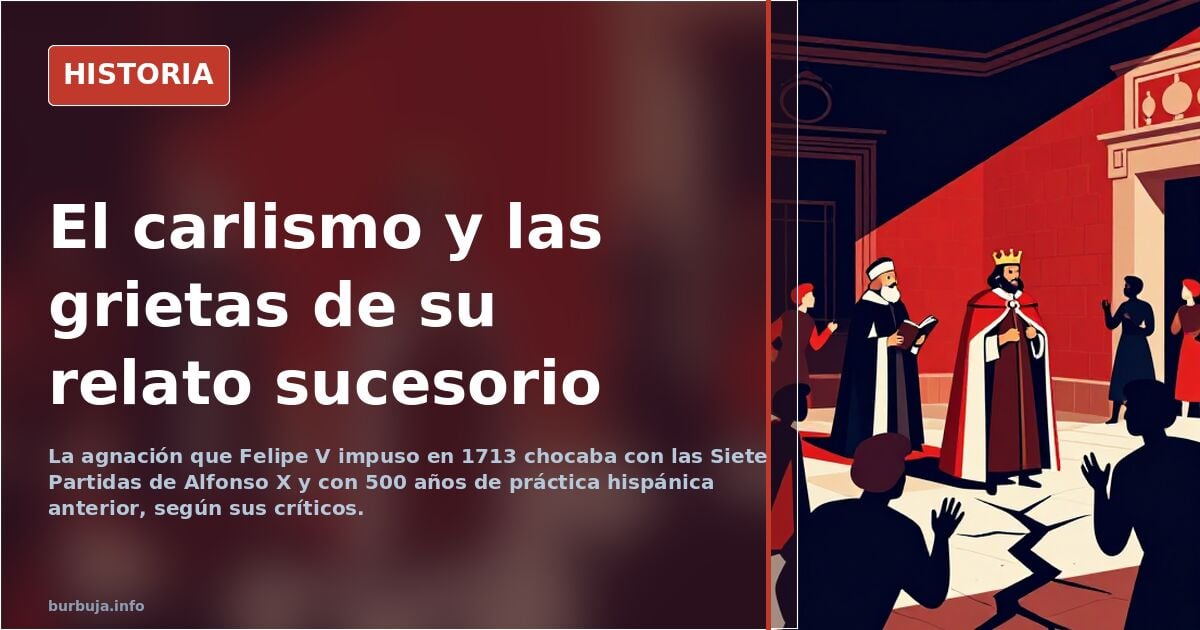
The strict male-only succession imposed by Philip V in 1713 clashed with Alfonso X's Siete Partidas and 500 years of earlier Spanish practice, critics say.
English · Original discussion in Spanish · Published
Carlism: five contradictions its own doctrine cannot resolve
There is a scene that sums up the whole problem, and it does not come from a history textbook: a French king, Philip V, signing in 1713 a succession rule that introduced strict agnatic succession —males only, no exceptions— in a Crown where Alfonso X had written, in the Siete Partidas, that women could inherit. Five hundred years of Spanish practice, including Isabella the Catholic, were wiped out at a stroke by a custom imported from a country, France, where fueros did not even exist. That is the knot that, according to its critics, traditionalism never fully untied, and which resurfaces every time the dynastic origin of Carlism is debated.
The 1713 rule and the tradition that came before
The paradox is textbook. The Carlist side maintains that Philip V's Auto Acordado is the legitimate norm, but that same norm changes what had been custom for five centuries. Some resolve it by saying that some Cortes asked the monarch for that change; critics reply that other Cortes later repealed it and that a Cortes cannot alter tradition by majority. The question left hanging is why the French model became the bulwark of Spanishness.
The 1789 Pragmatic Sanction: who rules, the king or a clique?
The second front is more tangled. The Pragmatic Sanction of 1789 was approved by the king and the Cortes, and ratified in 1830. For Carlism it was illegitimate. The problem, it is argued, is that Floridablanca closed those Cortes in great haste for antiestéticar of French revolutionary contagion, leaving in the air whether the Salic law was abolished or not. That ambiguity —not a clean record— is what the Carlists would brandish half a century later. And yet, for one of the participants, the underlying question was never legal: whoever defended the Pragmatic Sanction was defending, in practice, the liberal reforms that Carlism rejected root and branch.
The heir who was never Prince of Asturias
There is a detail that unsettles the most learned: Infante Carlos was never Prince of Asturias, despite presenting himself as natural heir. And he initially accepted the Pragmatic Sanction in 1830. His later rebellion against his brother cost him exclusion from the succession by royal decree confirmed by the Cortes, which opens the awkward question of why that exclusion applies to him and not to others. What complicates the story of the "legitimate king despoiled", the debate suggests, is that the despoiled man himself initially recognised the usurper.
Philip II, Portugal and the rights of Farnese
The problem extends backwards. If Philip II embodies Tradition, how did he take the throne of Portugal by trampling the rights of Ranuccio Farnese and recognise ruling queens? The coherence of the model cracks as soon as one leaves the 19th century. And in the present, the paradox sharpens: the second son acting as "regent" claims rights over his brother and nephews, above other lines, while the dynasty that claims imaginary rights died out with Alfonso Carlos in 1936.
It was not succession: it was a world collapsing
One of the readings defended in the debate is that the dynastic question was the excuse. Carlism was, in that key, an anti-liberal movement of a dying order, with a specific social base: small landowners north of the Duero, where the Reconquista left a different property regime. Under the Ancien Régime, it is argued, the Crown "lived off its own" and imposed a lighter tax burden than a later liberal state, more effective at collecting and waging war, although one of the participants puts the taxes of absolute monarchies at around 12%. For many, that was true freedom: low taxes and commons galore.
The closing comes from a counterexample no one answers. If Carlism sprang from smallholdings, Galicia —the land with the most smallholdings in Spain— should have burned with Carlism. It did not. And in 1936, the heirs of that movement ended up aligned with the Nationalists, staunch centralists. And tradition, even so, still did not match its own map.
There is a scene that sums up the whole problem, and it does not come from a history textbook: a French king, Philip V, signing in 1713 a succession rule that introduced strict agnatic succession —males only, no exceptions— in a Crown where Alfonso X had written, in the Siete Partidas, that women could inherit. Five hundred years of Spanish practice, including Isabella the Catholic, were wiped out at a stroke by a custom imported from a country, France, where fueros did not even exist. That is the knot that, according to its critics, traditionalism never fully untied, and which resurfaces every time the dynastic origin of Carlism is debated.
The 1713 rule and the tradition that came before
The paradox is textbook. The Carlist side maintains that Philip V's Auto Acordado is the legitimate norm, but that same norm changes what had been custom for five centuries. Some resolve it by saying that some Cortes asked the monarch for that change; critics reply that other Cortes later repealed it and that a Cortes cannot alter tradition by majority. The question left hanging is why the French model became the bulwark of Spanishness.
The 1789 Pragmatic Sanction: who rules, the king or a clique?
The second front is more tangled. The Pragmatic Sanction of 1789 was approved by the king and the Cortes, and ratified in 1830. For Carlism it was illegitimate. The problem, it is argued, is that Floridablanca closed those Cortes in great haste for antiestéticar of French revolutionary contagion, leaving in the air whether the Salic law was abolished or not. That ambiguity —not a clean record— is what the Carlists would brandish half a century later. And yet, for one of the participants, the underlying question was never legal: whoever defended the Pragmatic Sanction was defending, in practice, the liberal reforms that Carlism rejected root and branch.
The heir who was never Prince of Asturias
There is a detail that unsettles the most learned: Infante Carlos was never Prince of Asturias, despite presenting himself as natural heir. And he initially accepted the Pragmatic Sanction in 1830. His later rebellion against his brother cost him exclusion from the succession by royal decree confirmed by the Cortes, which opens the awkward question of why that exclusion applies to him and not to others. What complicates the story of the "legitimate king despoiled", the debate suggests, is that the despoiled man himself initially recognised the usurper.
Philip II, Portugal and the rights of Farnese
The problem extends backwards. If Philip II embodies Tradition, how did he take the throne of Portugal by trampling the rights of Ranuccio Farnese and recognise ruling queens? The coherence of the model cracks as soon as one leaves the 19th century. And in the present, the paradox sharpens: the second son acting as "regent" claims rights over his brother and nephews, above other lines, while the dynasty that claims imaginary rights died out with Alfonso Carlos in 1936.
It was not succession: it was a world collapsing
One of the readings defended in the debate is that the dynastic question was the excuse. Carlism was, in that key, an anti-liberal movement of a dying order, with a specific social base: small landowners north of the Duero, where the Reconquista left a different property regime. Under the Ancien Régime, it is argued, the Crown "lived off its own" and imposed a lighter tax burden than a later liberal state, more effective at collecting and waging war, although one of the participants puts the taxes of absolute monarchies at around 12%. For many, that was true freedom: low taxes and commons galore.
The closing comes from a counterexample no one answers. If Carlism sprang from smallholdings, Galicia —the land with the most smallholdings in Spain— should have burned with Carlism. It did not. And in 1936, the heirs of that movement ended up aligned with the Nationalists, staunch centralists. And tradition, even so, still did not match its own map.
Also available in: Deutsch
Summary of a discussion on Burbuja.info - Foro de economía, actualidad y política., translated from Spanish and reviewed before publication. Read the full discussion (104 replies).
More summaries
-
Alfonso XIII: The 1923 mistake that cost him the crown
Alfonso XIII was not overthrown by municipal elections; in 1923, he ratified Primo de Rivera's coup and dissolved the parties supporting the monarchy.
-
ETA and GAL: two arms of the same Gladio network in Spain
Investigation linking ETA and GAL as arms of the same NATO Gladio network, with drug trafficking funding and CIA control.
-
Hanson and why World War II still matters
Hanson argues the Axis killed 75% of WWII's victims yet still lost to the side that produced more materiel. The debate over why it matters continues.
-
Debate: Which victory has been most damaging to the winner?
The forum debates whether winning a war can ruin the victor. One user claims England won both world wars and ended up as just another country on the map.
-
Andalusia’s Mixed Heritage: Japanese, German, and Catalan Roots
In 1614, a Japanese embassy settled in Coria del Río; today, 700 residents bear the surname Japón. A history of Andalusian mixing with Japanese, Germans, and…
-
Ceausescu Execution: Missing Video of the Shots
The video of Ceausescu's execution jumps from binding hands to bodies on the ground. Where is the footage of the actual shooting?