
Why some Spaniards have darker skin: genetics and history, not just the sun
Spain's population is a mix of Iberian, Roman, and North African influences, explaining darker skin tones beyond simple tanning. Explore the genetic layers.
English · Original discussion in Spanish · Published
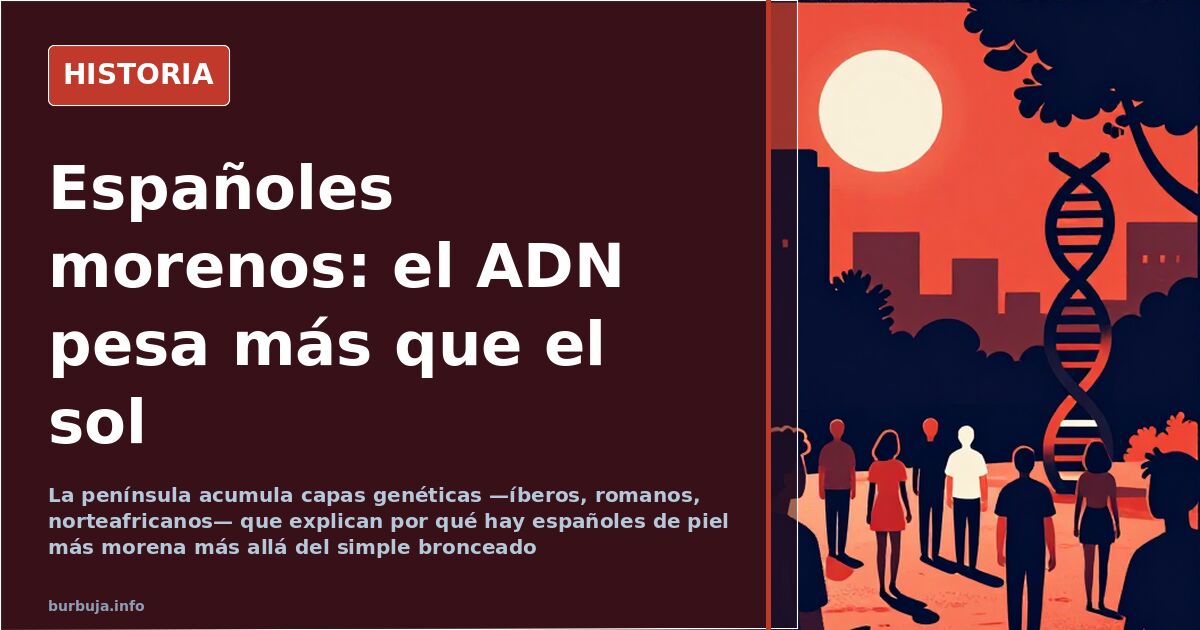
Why some Spaniards have darker skin: not just the sun or a single origin
The question seems simple: why are some Spaniards darker-skinned than others? The automatic answer is the sun. It's convenient and only half true. Over 328 messages, the issue has become a debate between those who attribute skin tone to tanning and those who explain it through overlapping genetic layers. Neither side has definitively closed the case. And therein lies the interest.
The peninsula as an archive of overlapping populations
Spain is not a genetically homogeneous block, but an archive with layers. Iberians, Celts, Romans, Visigoths, Phoenicians, and Greeks passed through the peninsula, and for centuries there was a presence of populations from North Africa. Some argue that this dominance left its mark on the population base; the counterpoint is that it did not involve a massive replacement of people, but rather conversions of the local population. The distinction is subtle and changes everything.
The real weight of this heritage has been debated for centuries. One circulating calculation claims it wasn't a millennium and it wasn't a majority from North Africa, but a population base that remained practically the same. Against this, another breakdown quantifies that North African contribution at around 10–15% in southern peninsular areas. It's a debate about proportions, not existence.
The most substantial evidence comes from autosomal DNA studies. Works from the CSIC, Stanford, Harvard, and the University of Leicester are cited. The underlying idea: most male lineages north of the Mediterranean belong to haplogroup R1b, while haplogroup E predominates to the south. It's not a clean border, but it marks a gradient visible on maps.
Dark skin by birth or tanned by the sun?
Here lies the crux, and almost no one separates it well. One thing is having naturally dark skin, and another is being tanned because of the sun. Spain has many hours of sunshine, and those who spend time outdoors tan effortlessly. This fuels confusion: a dark tone is seen, and genetics are assumed when sometimes it's just accumulated radiation.
The counterargument, defended with equal firmness: there are dark-skinned people all year round, without going to the beach or sitting on the terrace. Here, genetics come back into play. And it's suggested, almost as a laboratory hypothesis, that the ability to tan was inherited from Paleolithic populations who migrated north chasing megafauna as the ice receded. It's speculative, but no one flatly denies it.
European comparisons: Southern Italy, Wales, and Ireland
The argument that dark skin tone is specifically Spanish collapses when looking around. Cases of dark-skinned people in Wales and Ireland are mentioned, and it's recalled that in southern Italy, the dark phenotype is common. One response settles it by citing a dark-skinned French actor who would undoubtedly be classified as Northern European.
The counterargument is about degree, not existence: there are dark-skinned people throughout Europe, agreed, but the relative frequency varies, and in Spain, it would be higher. The discussion ends up drifting towards what exactly constitutes a common phenotype and who decides where the border lies between the usual and the exceptional.
The figures discussed and what doesn't add up
Where the exchange becomes technical is in the percentages. A breakdown by components for Andalusia is circulating:
From this, someone jumps to a broad conclusion: that a good portion of Spaniards would be mixed-race. The figure thrown around is 19 million, extending to Extremadurans, Valencians, Murcians, and Canarians. It's an extrapolation with more enthusiasm than method.
Then a second calculation appears, using genetic distances, where the North African component comes out as the most distant (0.0552) and the Italo-Roman as the closest (0.0094). The author of that table themselves distrusts it and warns that automatic tools give strange results when asked to work with ancient samples. A good sign: someone who doubts their own figure isn't trying to sell anything.
With these ingredients, the initial question remains without a closed answer. Genetics explain one part, the sun explains another, and the circulating figures have owners and fine print. What doesn't stand up to scrutiny is the idea of a single Spanish type, neither dark nor pale. That average doesn't exist. It never did.
The question seems simple: why are some Spaniards darker-skinned than others? The automatic answer is the sun. It's convenient and only half true. Over 328 messages, the issue has become a debate between those who attribute skin tone to tanning and those who explain it through overlapping genetic layers. Neither side has definitively closed the case. And therein lies the interest.
The peninsula as an archive of overlapping populations
Spain is not a genetically homogeneous block, but an archive with layers. Iberians, Celts, Romans, Visigoths, Phoenicians, and Greeks passed through the peninsula, and for centuries there was a presence of populations from North Africa. Some argue that this dominance left its mark on the population base; the counterpoint is that it did not involve a massive replacement of people, but rather conversions of the local population. The distinction is subtle and changes everything.
The real weight of this heritage has been debated for centuries. One circulating calculation claims it wasn't a millennium and it wasn't a majority from North Africa, but a population base that remained practically the same. Against this, another breakdown quantifies that North African contribution at around 10–15% in southern peninsular areas. It's a debate about proportions, not existence.
The most substantial evidence comes from autosomal DNA studies. Works from the CSIC, Stanford, Harvard, and the University of Leicester are cited. The underlying idea: most male lineages north of the Mediterranean belong to haplogroup R1b, while haplogroup E predominates to the south. It's not a clean border, but it marks a gradient visible on maps.
Dark skin by birth or tanned by the sun?
Here lies the crux, and almost no one separates it well. One thing is having naturally dark skin, and another is being tanned because of the sun. Spain has many hours of sunshine, and those who spend time outdoors tan effortlessly. This fuels confusion: a dark tone is seen, and genetics are assumed when sometimes it's just accumulated radiation.
The counterargument, defended with equal firmness: there are dark-skinned people all year round, without going to the beach or sitting on the terrace. Here, genetics come back into play. And it's suggested, almost as a laboratory hypothesis, that the ability to tan was inherited from Paleolithic populations who migrated north chasing megafauna as the ice receded. It's speculative, but no one flatly denies it.
European comparisons: Southern Italy, Wales, and Ireland
The argument that dark skin tone is specifically Spanish collapses when looking around. Cases of dark-skinned people in Wales and Ireland are mentioned, and it's recalled that in southern Italy, the dark phenotype is common. One response settles it by citing a dark-skinned French actor who would undoubtedly be classified as Northern European.
The counterargument is about degree, not existence: there are dark-skinned people throughout Europe, agreed, but the relative frequency varies, and in Spain, it would be higher. The discussion ends up drifting towards what exactly constitutes a common phenotype and who decides where the border lies between the usual and the exceptional.
The figures discussed and what doesn't add up
Where the exchange becomes technical is in the percentages. A breakdown by components for Andalusia is circulating:
- Iberian-pre-Roman: 35–38%
- Roman-Italian: 10–12%
- Berber or North African: 10–15%
From this, someone jumps to a broad conclusion: that a good portion of Spaniards would be mixed-race. The figure thrown around is 19 million, extending to Extremadurans, Valencians, Murcians, and Canarians. It's an extrapolation with more enthusiasm than method.
Then a second calculation appears, using genetic distances, where the North African component comes out as the most distant (0.0552) and the Italo-Roman as the closest (0.0094). The author of that table themselves distrusts it and warns that automatic tools give strange results when asked to work with ancient samples. A good sign: someone who doubts their own figure isn't trying to sell anything.
With these ingredients, the initial question remains without a closed answer. Genetics explain one part, the sun explains another, and the circulating figures have owners and fine print. What doesn't stand up to scrutiny is the idea of a single Spanish type, neither dark nor pale. That average doesn't exist. It never did.
Summary of a discussion on Burbuja.info - Foro de economía, actualidad y política., translated from Spanish and reviewed before publication. Read the full discussion (328 replies).
More summaries
-
Reform the calendar so seasons start on the 1st
A calendar reform would make each season begin on the 1st of its month: a 32-day August and the year anchored to January 1, not the perihelion.
-
When did Europe's national football teams start to get more diverse?
France fielded a Black player as early as 1938 and Portugal four in 1966. The timeline of diversity in European national football teams and its causes.
-
Why Spain was not an economic engine after World War II
Spanish GDP grew 5,3% between 1939 and 1944 and only 0,14% between 1945 and 1950: neutrality in World War II was not enough to lead Europe
-
Why Spain never had an industrial bourgeoisie—but did have a rentier caste
Hispano-Suiza, the 1986 EEC and the rentier-caste thesis: why Spain never became an industrial power despite its technical talent
-
Mussolini declared war as France was already collapsing
On 10 June 1940, Italy declared war on France and the UK with a three-paragraph note. Greece, Africa and Gibraltar changed the plan.
-
OVERCOMING SEXUAL SINS ~ THE REQUIRED SPIRITUAL TOOLS (Father Spyridon)
The spiritual path to conquering carnal passions, from humility to perseverance. Discover the teachings of the Church Fathers.