
America's Price: Inflation, Bankruptcies, and Castilla's Hollowing
American silver and gold fueled Habsburg wars and Spanish inflation while depopulating Castilla. A look at the economic and human costs of conquest.
English · Original discussion in Spanish · Published
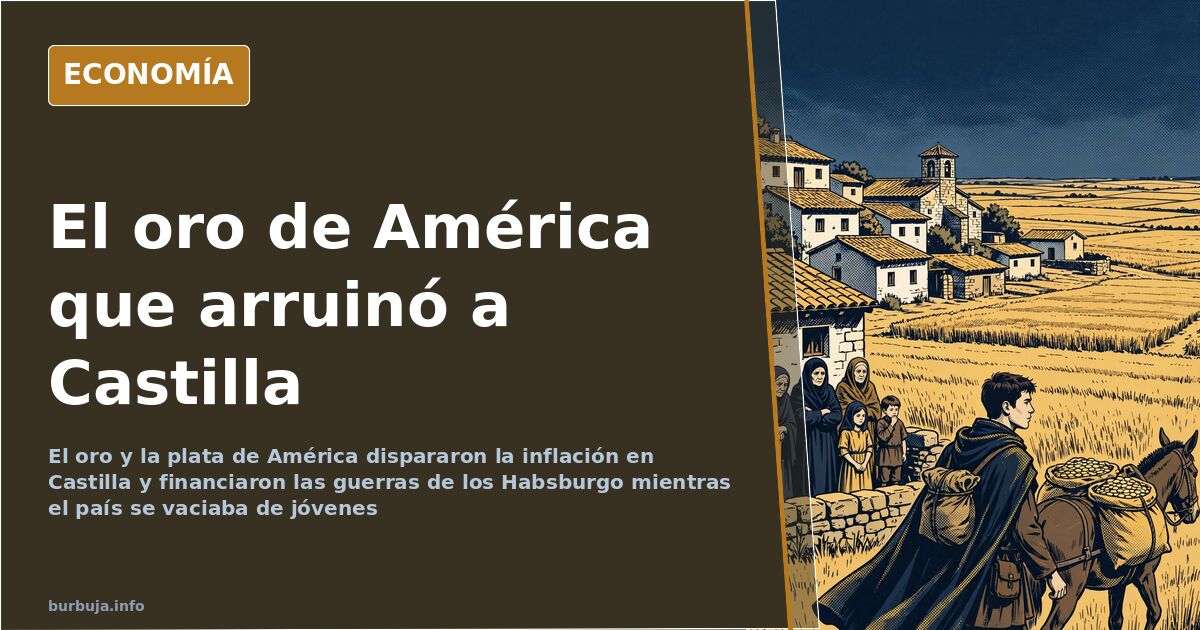
America provided gold, but European wars consumed it
Conquering America was a bad deal for Spain. The axiom holds partial truth: abundant precious metals, uncontrolled inflation, and a Castilla drained of young men heading to the Indies. Yet, reducing this to a simple accounting error ignores the complexity. Opening two oceans and circumnavigating the globe was unprecedented. The real question is not whether it was an achievement, but who paid the bill.
Why is it said that the conquest ruined Spain?
The mechanism is straightforward: massive inflows of American silver and gold triggered a price surge in the peninsula, known then as the price revolution and today as inflation. Spain produced expensive goods; Flanders bought cheap, added value, and sold them back at a premium. Raw materials left and returned as costly textiles. Some argue this circuit explains Spain's industrial lag.
This was compounded by human costs. Emigration to the Indies depopulated Castilla, which already had fewer inhabitants than France. Fewer workers meant less activity and a smaller tax base, effects that persisted for generations. The conquered territory was about twenty times larger than the Iberian Peninsula, a scale no 16th-century administrative system could manage without strain.
Where did Potosí's silver go?
To fund wars unrelated to Castilian interests. Charles I of Spain and V of Germany—his order matters, as he inherited the peninsular throne maternally but spent paternally—used these resources for Habsburg conflicts in Central Europe.
The result was successive bankruptcies driven by debt interest. Ordinary citizens bore the inflation; bankers profited. Economic historiography often points here, rather than to the conquest itself, as the origin of the Crown's financial collapse.
The Spanish model versus the Anglo-Saxon one
Here, the debate intensifies. One school argues that the Spanish Empire assimilated indigenous societies, replicating the Roman pattern—cities, universities, administration—while English and Dutch settlements were merely trading camps. Another, harsher line contends that this mestizaje was the problem and that copying the British colonial model would have been preferable.
This second argument relies on a demographic assumption requiring caution: the claim that North American indigenous nations were exterminated is, according to critics, a simplification, as communities like the Cherokee, Comanche, or Powhatan still exist.
Can a nation be a power without colonies?
Italy, Germany, or Japan achieved global weight without significant overseas empires. This is the favorite argument of those defending that Spain chose the wrong strategy. The geopolitical counter-argument is that much of Castile's military effort went into halting Ottoman advances in the Mediterranean, a front consuming resources without returning gold. Against the Ottoman Empire, the tactic of a few men and thousands of local allies was insufficient.
There is also no consensus on the outcomes of independence movements. It is argued that countries separating earlier fared no better than later ones, and that subsequent economic lag responded more to external interventions, coups, and debt than to colonial heritage.
What remains
A shared language spoken by approximately 640 million people in South America and the Caribbean, compared to Spain's 47 million, with around 80% being Spanish speakers. Foods that permanently changed the European diet, including the potato. And an uncomfortable figure: a power that apologized. In 2007, in Fredericksburg, the Powhatan nation and the Spanish embassy exchanged apologies for 16th-century grievances, including the death of four Jesuit missionaries in 1571.
According to another reading, the single worst error was concrete: failing to relieve Middelburg in 1574.
With these premises, the debate will continue to divide dinner tables for years. The conclusion is likely not that America was superfluous, but that gold alone is insufficient; knowing how to spend it is key. Spain learned this lesson late, and there are reasons to doubt it has fully absorbed it.
Conquering America was a bad deal for Spain. The axiom holds partial truth: abundant precious metals, uncontrolled inflation, and a Castilla drained of young men heading to the Indies. Yet, reducing this to a simple accounting error ignores the complexity. Opening two oceans and circumnavigating the globe was unprecedented. The real question is not whether it was an achievement, but who paid the bill.
Why is it said that the conquest ruined Spain?
The mechanism is straightforward: massive inflows of American silver and gold triggered a price surge in the peninsula, known then as the price revolution and today as inflation. Spain produced expensive goods; Flanders bought cheap, added value, and sold them back at a premium. Raw materials left and returned as costly textiles. Some argue this circuit explains Spain's industrial lag.
This was compounded by human costs. Emigration to the Indies depopulated Castilla, which already had fewer inhabitants than France. Fewer workers meant less activity and a smaller tax base, effects that persisted for generations. The conquered territory was about twenty times larger than the Iberian Peninsula, a scale no 16th-century administrative system could manage without strain.
Where did Potosí's silver go?
To fund wars unrelated to Castilian interests. Charles I of Spain and V of Germany—his order matters, as he inherited the peninsular throne maternally but spent paternally—used these resources for Habsburg conflicts in Central Europe.
The result was successive bankruptcies driven by debt interest. Ordinary citizens bore the inflation; bankers profited. Economic historiography often points here, rather than to the conquest itself, as the origin of the Crown's financial collapse.
The Spanish model versus the Anglo-Saxon one
Here, the debate intensifies. One school argues that the Spanish Empire assimilated indigenous societies, replicating the Roman pattern—cities, universities, administration—while English and Dutch settlements were merely trading camps. Another, harsher line contends that this mestizaje was the problem and that copying the British colonial model would have been preferable.
This second argument relies on a demographic assumption requiring caution: the claim that North American indigenous nations were exterminated is, according to critics, a simplification, as communities like the Cherokee, Comanche, or Powhatan still exist.
Can a nation be a power without colonies?
Italy, Germany, or Japan achieved global weight without significant overseas empires. This is the favorite argument of those defending that Spain chose the wrong strategy. The geopolitical counter-argument is that much of Castile's military effort went into halting Ottoman advances in the Mediterranean, a front consuming resources without returning gold. Against the Ottoman Empire, the tactic of a few men and thousands of local allies was insufficient.
There is also no consensus on the outcomes of independence movements. It is argued that countries separating earlier fared no better than later ones, and that subsequent economic lag responded more to external interventions, coups, and debt than to colonial heritage.
What remains
A shared language spoken by approximately 640 million people in South America and the Caribbean, compared to Spain's 47 million, with around 80% being Spanish speakers. Foods that permanently changed the European diet, including the potato. And an uncomfortable figure: a power that apologized. In 2007, in Fredericksburg, the Powhatan nation and the Spanish embassy exchanged apologies for 16th-century grievances, including the death of four Jesuit missionaries in 1571.
According to another reading, the single worst error was concrete: failing to relieve Middelburg in 1574.
With these premises, the debate will continue to divide dinner tables for years. The conclusion is likely not that America was superfluous, but that gold alone is insufficient; knowing how to spend it is key. Spain learned this lesson late, and there are reasons to doubt it has fully absorbed it.
Summary of a discussion on Burbuja.info - Foro de economía, actualidad y política., translated from Spanish and reviewed before publication. Read the full discussion (242 replies).
More summaries
-
UK Documentary Acknowledges Spanish Empire's Role in Global Trade
A Channel 5 travel series on Andalusia highlights the Spanish Empire's pivotal role in opening the New World to Europe, challenging the 'Black Legend'.
-
The Spanish educational divide: Castilla y León approaches European excellence
Madrid, Castilla y León, Asturias and Cantabria exceed the OECD average in PISA, but the rest of Spain drags down the national result. The internal gap is...
-
Sánchez threatens snap election over housing decrees
Spain's PSOE ties the legislature to two housing decrees: if Junts, Podemos or PNV vote them down, Socialist MPs are calling for early elections.
-
UN warns Haiti is collapsing with no state to stop it
Haiti recorded over 1,500 murders in three months as the airport closed and the state vanished. The UN now describes the situation as apocalyptic.
-
Seven Police Injured in Madrid's Lavapiés During Drug Bust
Seven police officers injured, two seriously hospitalized, as a crowd of 30 blocked a drug arrest in Madrid's Lavapiés.
-
Spanish Tax Agency demands €2,363 in income tax; video goes viral
A young man owes €2,363 in Spanish income tax and refuses to pay. The 'socialist voter' label is absent from the official notice.