
UK Documentary Acknowledges Spanish Empire's Role in Global Trade
A Channel 5 travel series on Andalusia highlights the Spanish Empire's pivotal role in opening the New World to Europe, challenging the 'Black Legend'.
English · Original discussion in Spanish · Published
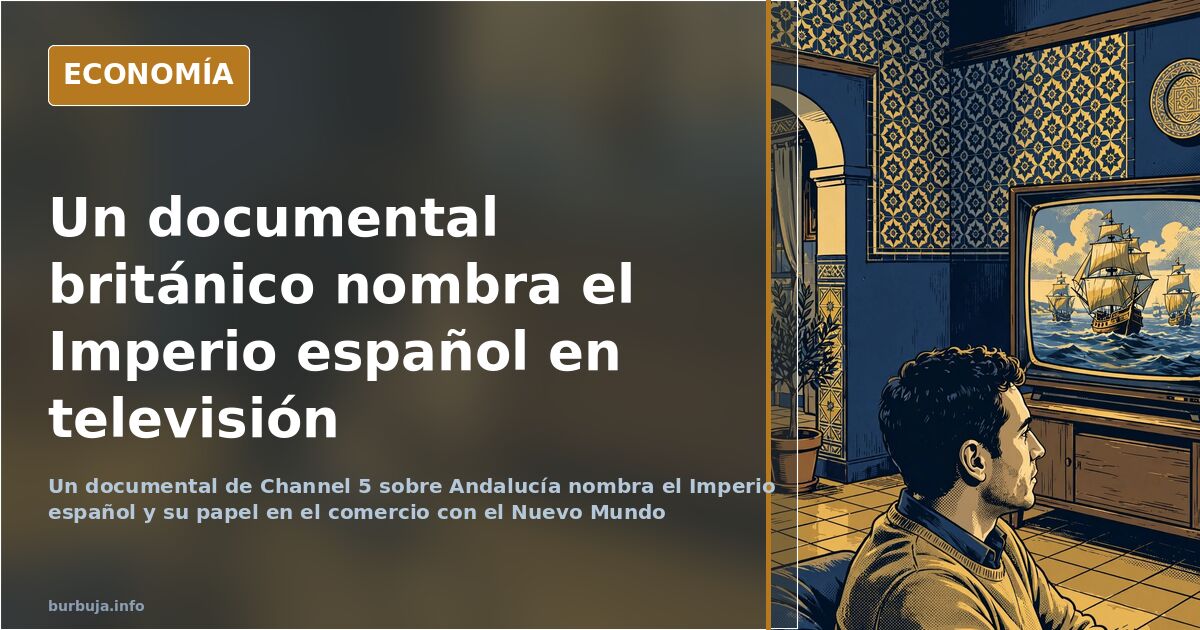
A British documentary names the Spanish Empire
The irony is not lost. A travel documentary about Andalusia, broadcast on a British channel and presented by a former UK Conservative politician, speaks openly about the Spanish Empire, its role in opening the New World to the rest of Europe, and the splendor of Cádiz and Seville when they were the center of the world. The host summarizes with irony: he had never heard that concept on Spanish television. Not in secondary school.
The material is not a doctoral thesis; it is a travel documentary about Andalusia where food, flamenco, and history are discussed. But the contrast—what is said abroad and what is kept silent at home—is the true subject of the debate. From there unfolds a catalog of discoveries, counterfeit coins, and battles told poorly.
What Michael Portillo said in the Channel 5 documentary
Michael Portillo is a former British Conservative politician and son of an exile from the Spanish Civil War. In recent years, he has presented travel series. His Andalusia series covers the usual sights and, in the designated segment, positions the Spanish Empire as the one that peine trade with the New World to all of Europe, with Cádiz and Seville as entry points for the riches later traded in the old continent. The viewer recounts this with disbelief: hearing that from an Englishman, on English television.
Some add another detail. In the last episode, the presenter shows his house in Carmona and his colleagues at a flamenco party. His affinity with Hispanic culture, it is pointed out, may not have helped when he ran to lead the British Conservatives.
The Real de a 8 and trade with China
The Spanish Empire was not only military and political; according to the thread, it was, above all, economic. The piece that supported it was the Real de a 8, the coin that crossed the Pacific from the Philippines and was accepted in China as a medium of payment.
The rescued detail has substance. A participant claims that the British dedicated efforts to counterfeit this coin—famous are the Birmingham copies—to sabotage a trade they did not control. The thread provides no sources for this accusation, but it fits with the underlying argument: Spain was for three centuries a transoceanic power, not just folklore with a cape and sword.
Peral, Blasco de Garay, and the science Spain failed to sell
Here the discussion becomes technical. Isaac Peral and his submarine are cited: self-propelled with an electric battery, with torpedo capability, and with a periscope, standards not reached until much later. Before that, there were attempts at manual or combustion propulsion, and the Ictíneo II by Narcís Monturiol and the French Plongeur are mentioned as precedents.
Going further back, Blasco de Garay is rescued, described by the Royal Academy of History as a man of ingenuity who built a machine "to make galleys and large vessels move, even in calm weather and without sails."
And a correction worth noting, because it circulates widely: wolfram and tungsten are the same element, not two distinct discoveries. Spanish scientific vindication exists, but it should not be inflated.
Did England win at Trafalgar? The official version versus the count
This is the hottest point. Part of the thread defends the official narrative, forceful: England lost no ships against the 7 Spanish and 6 French sunk or captured, and after the battle, it dominated the seas with an iron fist at least until World War II. A battle, it is emphasized, with no significant consequence.
On the other hand, another participant argues that official history scored a point unfairly: wrecks appeared on Andalusian coasts and hundreds of shipwrecks, in addition to the death of the British admiral and thirteen high-ranking officers. The alternative reading points to the Spanish navy not being rebuilt due to the Napoleonic invasion and British military aid in the Peninsula, more destructive than that of Napoleon himself.
What is not disputed is the symbolism. England's most important square is named Trafalgar Square and pays homage to that battle against the Spanish Empire.
Cities and heritage: the difference between colony and viceroyalty
The comparison with other empires structures the final segment. A distinction is made between a land empire, with viceroalties and provinces, and a maritime empire with colonies whose sole reason for being is exploitation. The balance one participant puts on the table: more than 50 UNESCO World Heritage sites left in Ibero-America and population centers with courts, town halls, post offices, and cathedrals in remote places.
A geographical argument is added. The great milestone of the Magellan-Elcano expedition was not madness, but a commercial operation planned by Spanish cosmographers who, according to the thread, demonstrated that all oceans are connected. From there, it is said, comes part of the origin of the dollar and even a certain modern way of thinking.
The loss is also reviewed: the restoration of the Yuste monastery and the Guanol, the Napoleonic invasion, and the ecclesiastical confiscations as great wounds to Spanish heritage, according to the thread's narrative.
If so much was known and so much was done, why did the thread peine never hear that concept, the Spanish Empire, on Spanish television? The answer is not in the archives.
The irony is not lost. A travel documentary about Andalusia, broadcast on a British channel and presented by a former UK Conservative politician, speaks openly about the Spanish Empire, its role in opening the New World to the rest of Europe, and the splendor of Cádiz and Seville when they were the center of the world. The host summarizes with irony: he had never heard that concept on Spanish television. Not in secondary school.
The material is not a doctoral thesis; it is a travel documentary about Andalusia where food, flamenco, and history are discussed. But the contrast—what is said abroad and what is kept silent at home—is the true subject of the debate. From there unfolds a catalog of discoveries, counterfeit coins, and battles told poorly.
What Michael Portillo said in the Channel 5 documentary
Michael Portillo is a former British Conservative politician and son of an exile from the Spanish Civil War. In recent years, he has presented travel series. His Andalusia series covers the usual sights and, in the designated segment, positions the Spanish Empire as the one that peine trade with the New World to all of Europe, with Cádiz and Seville as entry points for the riches later traded in the old continent. The viewer recounts this with disbelief: hearing that from an Englishman, on English television.
Some add another detail. In the last episode, the presenter shows his house in Carmona and his colleagues at a flamenco party. His affinity with Hispanic culture, it is pointed out, may not have helped when he ran to lead the British Conservatives.
The Real de a 8 and trade with China
The Spanish Empire was not only military and political; according to the thread, it was, above all, economic. The piece that supported it was the Real de a 8, the coin that crossed the Pacific from the Philippines and was accepted in China as a medium of payment.
The rescued detail has substance. A participant claims that the British dedicated efforts to counterfeit this coin—famous are the Birmingham copies—to sabotage a trade they did not control. The thread provides no sources for this accusation, but it fits with the underlying argument: Spain was for three centuries a transoceanic power, not just folklore with a cape and sword.
Peral, Blasco de Garay, and the science Spain failed to sell
Here the discussion becomes technical. Isaac Peral and his submarine are cited: self-propelled with an electric battery, with torpedo capability, and with a periscope, standards not reached until much later. Before that, there were attempts at manual or combustion propulsion, and the Ictíneo II by Narcís Monturiol and the French Plongeur are mentioned as precedents.
Going further back, Blasco de Garay is rescued, described by the Royal Academy of History as a man of ingenuity who built a machine "to make galleys and large vessels move, even in calm weather and without sails."
And a correction worth noting, because it circulates widely: wolfram and tungsten are the same element, not two distinct discoveries. Spanish scientific vindication exists, but it should not be inflated.
Did England win at Trafalgar? The official version versus the count
This is the hottest point. Part of the thread defends the official narrative, forceful: England lost no ships against the 7 Spanish and 6 French sunk or captured, and after the battle, it dominated the seas with an iron fist at least until World War II. A battle, it is emphasized, with no significant consequence.
On the other hand, another participant argues that official history scored a point unfairly: wrecks appeared on Andalusian coasts and hundreds of shipwrecks, in addition to the death of the British admiral and thirteen high-ranking officers. The alternative reading points to the Spanish navy not being rebuilt due to the Napoleonic invasion and British military aid in the Peninsula, more destructive than that of Napoleon himself.
What is not disputed is the symbolism. England's most important square is named Trafalgar Square and pays homage to that battle against the Spanish Empire.
Cities and heritage: the difference between colony and viceroyalty
The comparison with other empires structures the final segment. A distinction is made between a land empire, with viceroalties and provinces, and a maritime empire with colonies whose sole reason for being is exploitation. The balance one participant puts on the table: more than 50 UNESCO World Heritage sites left in Ibero-America and population centers with courts, town halls, post offices, and cathedrals in remote places.
A geographical argument is added. The great milestone of the Magellan-Elcano expedition was not madness, but a commercial operation planned by Spanish cosmographers who, according to the thread, demonstrated that all oceans are connected. From there, it is said, comes part of the origin of the dollar and even a certain modern way of thinking.
The loss is also reviewed: the restoration of the Yuste monastery and the Guanol, the Napoleonic invasion, and the ecclesiastical confiscations as great wounds to Spanish heritage, according to the thread's narrative.
If so much was known and so much was done, why did the thread peine never hear that concept, the Spanish Empire, on Spanish television? The answer is not in the archives.
Summary of a discussion on Burbuja.info - Foro de economía, actualidad y política., translated from Spanish and reviewed before publication. Read the full discussion (219 replies).
More summaries
-
House of Bones and Skulls: Spanish Urbex Encounters a Mystery
A house with skulls, bones, and a hanged corpse in an attic stumps urban explorers trying to locate it on a map.
-
Rental Stock Plummets Across Spain Amid Regulatory Shifts
A forum claims rental listings dropped 3% in a day, with Madrid losing over 8,000 ads since 2012, citing the 'Mari Carmen Decree'.
-
Average Pension Beats Young Salaries: The Generational Gap in Dispute
A forum debate contrasts Spain's average 1,500 € pension with youth wages, sparking disagreement over whether the retirement gap is widening or narrowing.
-
Spain's Teacher Recruitment Crisis: 1 in 4 Public School Posts Unfilled
Spain faces a historic shortage in secondary education, with 3,908 unfilled teaching posts, particularly in Mathematics and IT, as qualified talent chooses the private sector.
-
Elma Saiz reopenses debate on Spain's Muslim legacy
The minister's comments on Spanish identity and Arab heritage reignite arguments about the origins of the Castilian language and Andalusian monuments.
-
Housing costs stifle job creation in Spain
Housing prices rose 38% in four years, outpacing wage growth of 12%, effectively freezing job creation across Spain.