
Seven Police Injured in Madrid's Lavapiés During Drug Bust
Seven police officers injured, two seriously hospitalized, as a crowd of 30 blocked a drug arrest in Madrid's Lavapiés.
English · Original discussion in Spanish · Published
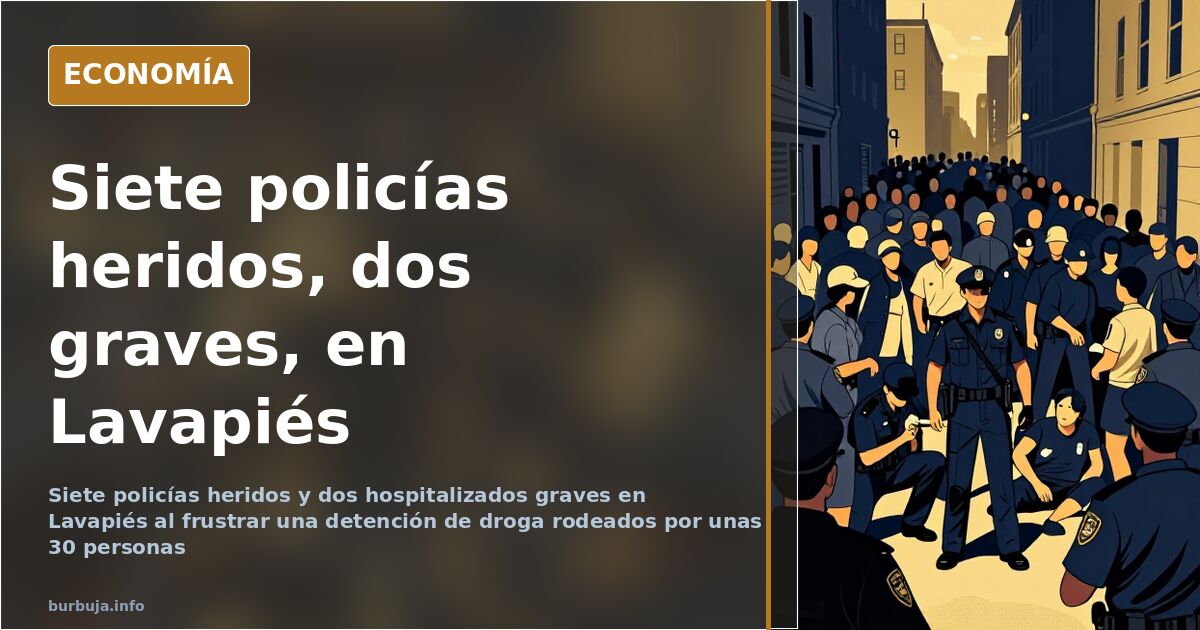
Lavapiés: Seven Police Officers Injured, Two Seriously, During Failed Arrest
At 8:45 PM on a Sunday, two National Police officers (Policía Nacional) on patrol in Nelson Mandela Square, in the Lavapiés district of Madrid, spotted what appeared to be a drug transaction between a man and a woman. Minutes later, seven officers were injured, with two hospitalized in serious condition. A crowd of about thirty people formed a cordon around the suspected dealer to prevent his arrest.
The clash occurred in the heart of old Madrid, next to the library of the former Pious Schools (Escuelas Pías), reigniting a debate far beyond the incident itself: whether there is a security model that fails in certain neighborhoods, and who is accountable for it. An uncomfortable detail accompanies the facts: the alleged perpetrator had prior convictions and was free on the streets.
What Peine in Nelson Mandela Square?
Officers approached the man, who tried to flee but was intercepted nearby. When they attempted to identify him, the man became agitated and urged bystanders to surround the police. Approximately 30 people responded, harassing the operation and behaving extremely aggressively, according to available information.
Reinforcement patrols arrived. A security perimeter was established, the crowd was dispersed, and several officers were struck during the intervention. Inside the police vehicle, the detainee kicked until he smashed the rear door, and upon arrival at the station, he assaulted officers again. The municipal emergency service (Samur) treated seven officers at the scene; due to the severity of their injuries, two were transported to the hospital.
What Is Known About the Detainee?
A 28-year-old Cameroonian national with numerous prior convictions for assaulting law enforcement officers and public health crimes. The combination of these histories—assaulting uniformed personnel and street-level dealing—is what has fueled analysis: if the system had already convicted him, why is he back on the same corner?
The square has its own geography. Those familiar with it describe it as a stable hub for drug trafficking, set against a backdrop of occupied apartments and constant foot traffic. Some argue that the media only reflects a tiny fraction of what happens there and in other parts of the capital; this is a claim no one has quantified. Others anticipate long-term sick leave due to assault and warn that the cost will ultimately fall on the public purse.
From Lavapiés to Banyoles: The Recurring Script
These incidents are not isolated cases. In Banyoles (Girona), a message circulated on social media claims that 60 people attacked officers who had located a marijuana plantation with stones and pepper spray, injuring two local police officers and three Mossos d'Esquadra (Catalan regional police). The pattern repeats: intervention, mob, retreat, leaving a lingering question about whether the next patrol will simply pass by.
This fuels the most repeated hypothesis: so-called no-go zones. It was predicted that such scenarios would emerge in the 2030s; now, arguments suggest they are arriving much sooner. Against this hypothesis, some attribute the situation to the gradual erosion of authority over the years. Others draw comparisons with French suburbs, convinced Spain is heading toward the same model.
The Narrative Gaining Ground
One school of thought argues that insecurity is being placed at the center of attention to distract from unemployment, wages, and housing access: if crime becomes the country's primary problem, energy poverty and precariousness vanish from the agenda. This thesis is difficult to prove but also hard to dismiss.
Conversely, another perspective focuses on migration policy, regularization plans, and agreements with countries of origin to curb illegal immigration, citing figures thrown into the fray without documentary backing. Others recall the flip side: the very bodies receiving blows today fined citizens during the pandemic for going out to buy essentials.
Additionally, circulating without any supporting evidence, is the idea that everything is a setup to displace economic concerns with crime on the list of public worries. It is worth separating fact from fiction: these are currents of opinion, not proven events.
Amidst this, an argument fits nowhere neatly. Some ironically point to racism as the country's great problem, criticizing public figures who advocate for it while living abroad.
With these elements, the case's conclusion remains unwritten. What remains is the unsettling data point: someone with a history of attacking officers was, once again, on the corner where it all began.
At 8:45 PM on a Sunday, two National Police officers (Policía Nacional) on patrol in Nelson Mandela Square, in the Lavapiés district of Madrid, spotted what appeared to be a drug transaction between a man and a woman. Minutes later, seven officers were injured, with two hospitalized in serious condition. A crowd of about thirty people formed a cordon around the suspected dealer to prevent his arrest.
The clash occurred in the heart of old Madrid, next to the library of the former Pious Schools (Escuelas Pías), reigniting a debate far beyond the incident itself: whether there is a security model that fails in certain neighborhoods, and who is accountable for it. An uncomfortable detail accompanies the facts: the alleged perpetrator had prior convictions and was free on the streets.
What Peine in Nelson Mandela Square?
Officers approached the man, who tried to flee but was intercepted nearby. When they attempted to identify him, the man became agitated and urged bystanders to surround the police. Approximately 30 people responded, harassing the operation and behaving extremely aggressively, according to available information.
Reinforcement patrols arrived. A security perimeter was established, the crowd was dispersed, and several officers were struck during the intervention. Inside the police vehicle, the detainee kicked until he smashed the rear door, and upon arrival at the station, he assaulted officers again. The municipal emergency service (Samur) treated seven officers at the scene; due to the severity of their injuries, two were transported to the hospital.
What Is Known About the Detainee?
A 28-year-old Cameroonian national with numerous prior convictions for assaulting law enforcement officers and public health crimes. The combination of these histories—assaulting uniformed personnel and street-level dealing—is what has fueled analysis: if the system had already convicted him, why is he back on the same corner?
The square has its own geography. Those familiar with it describe it as a stable hub for drug trafficking, set against a backdrop of occupied apartments and constant foot traffic. Some argue that the media only reflects a tiny fraction of what happens there and in other parts of the capital; this is a claim no one has quantified. Others anticipate long-term sick leave due to assault and warn that the cost will ultimately fall on the public purse.
From Lavapiés to Banyoles: The Recurring Script
These incidents are not isolated cases. In Banyoles (Girona), a message circulated on social media claims that 60 people attacked officers who had located a marijuana plantation with stones and pepper spray, injuring two local police officers and three Mossos d'Esquadra (Catalan regional police). The pattern repeats: intervention, mob, retreat, leaving a lingering question about whether the next patrol will simply pass by.
This fuels the most repeated hypothesis: so-called no-go zones. It was predicted that such scenarios would emerge in the 2030s; now, arguments suggest they are arriving much sooner. Against this hypothesis, some attribute the situation to the gradual erosion of authority over the years. Others draw comparisons with French suburbs, convinced Spain is heading toward the same model.
The Narrative Gaining Ground
One school of thought argues that insecurity is being placed at the center of attention to distract from unemployment, wages, and housing access: if crime becomes the country's primary problem, energy poverty and precariousness vanish from the agenda. This thesis is difficult to prove but also hard to dismiss.
Conversely, another perspective focuses on migration policy, regularization plans, and agreements with countries of origin to curb illegal immigration, citing figures thrown into the fray without documentary backing. Others recall the flip side: the very bodies receiving blows today fined citizens during the pandemic for going out to buy essentials.
Additionally, circulating without any supporting evidence, is the idea that everything is a setup to displace economic concerns with crime on the list of public worries. It is worth separating fact from fiction: these are currents of opinion, not proven events.
Amidst this, an argument fits nowhere neatly. Some ironically point to racism as the country's great problem, criticizing public figures who advocate for it while living abroad.
With these elements, the case's conclusion remains unwritten. What remains is the unsettling data point: someone with a history of attacking officers was, once again, on the corner where it all began.
Summary of a discussion on Burbuja.info - Foro de economía, actualidad y política., translated from Spanish and reviewed before publication. Read the full discussion (188 replies).
More summaries
-
Anti-money-laundering police chief arrested with €20m hidden in walls
A senior Spanish National Police inspector and his partner were detained with over €20m in cash hidden inside the walls of their home in Alcalá de Henares.
-
What is your social class? Reddit users debate salaries in Spain
What is your real social class? We analyze the debate on salaries, cost of living and housing in Spain. Is salary the only indicator of your status?
-
Italy considers suspending Schengen with Spain: economic impact
Italy is considering suspending the Schengen agreement with Spain. Tourism, trade, and labor mobility are at stake amid an analysis of potential economic consequences.
-
Susanna Griso Marries at 56; Groom's Wrinkled Shirt Sparks Online Debate
Susanna Griso, from the Codorníu family, married at 56. Her groom's wrinkled guayabera shirt went viral on social media.
-
Rajoy sparks debate on French team identity and globalization
Former Spanish PM Mariano Rajoy claims the French national team lacks 'true' French players, reigniting discussions on national identity in globalized football.
-
Spielberg's 'The Day of the Revelation': Artistic Failure or Hidden Manipulation?
Steven Spielberg's latest film sparks debate: is it a box office flop or covert propaganda? Reviews are harsh, fueling conspiracy theories.