
The Spanish educational divide: Castilla y León approaches European excellence
Madrid, Castilla y León, Asturias and Cantabria exceed the OECD average in PISA, but the rest of Spain drags down the national result. The internal gap is...
English · Original discussion in Spanish · Published
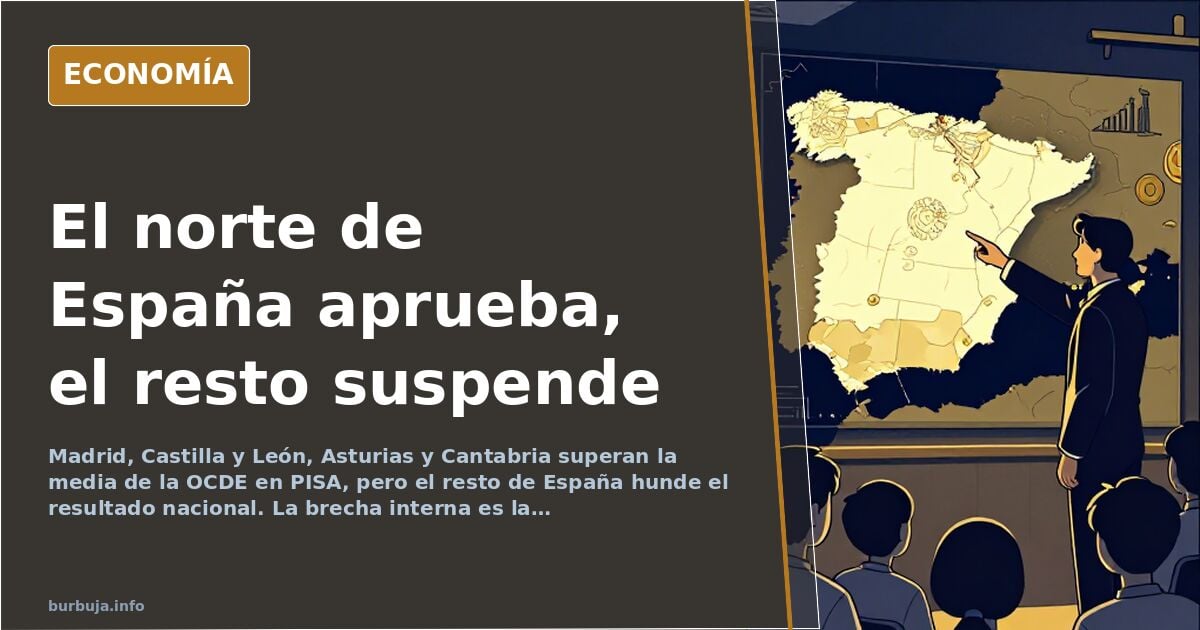
PISA: Northern Spain passes while the rest drags down the average
Spain doesn't have one educational problem. It has two. The latest PISA science report ranks the country at 477 points, five below the OECD average (482). But this figure hides an internal fracture that should be the real story: Madrid (495), Castilla y León (493), Asturias (492), Cantabria (490), and Castilla-La Mancha (485) exceed the international average. The rest of the communities, led by Catalonia and Andalusia in decline, drag the national average down to a relative pass.
The immigration factor does not explain the gap
The temptation is to attribute the North's success to lower immigrant presence. This argument repeats in analyses, but it has a flaw: the UK (511), Netherlands, or Switzerland, with comparable or higher percentages of foreign population, are far ahead. The OECD calculates that twenty points equals one school year. Madrid is three courses behind Singapore (560) and five behind the Chinese provinces (597). The Northern bloc is doing well, but it's not Finland.
The burden of educational laws
The fundamental debate is different. The LOGSE of 1990, and its subsequent tightening with the Zapatero law, eliminated repetition as a filtering tool. The result: classrooms with students of disparate levels and a system that rewards automatic promotion. The politicization of certain communities, with subjects of questionable utility, completes the picture. If this trend continues, the gap between the North and the rest will widen. But nobody in the Ministry seems willing to touch the model.
Spain doesn't have one educational problem. It has two. The latest PISA science report ranks the country at 477 points, five below the OECD average (482). But this figure hides an internal fracture that should be the real story: Madrid (495), Castilla y León (493), Asturias (492), Cantabria (490), and Castilla-La Mancha (485) exceed the international average. The rest of the communities, led by Catalonia and Andalusia in decline, drag the national average down to a relative pass.
The immigration factor does not explain the gap
The temptation is to attribute the North's success to lower immigrant presence. This argument repeats in analyses, but it has a flaw: the UK (511), Netherlands, or Switzerland, with comparable or higher percentages of foreign population, are far ahead. The OECD calculates that twenty points equals one school year. Madrid is three courses behind Singapore (560) and five behind the Chinese provinces (597). The Northern bloc is doing well, but it's not Finland.
The burden of educational laws
The fundamental debate is different. The LOGSE of 1990, and its subsequent tightening with the Zapatero law, eliminated repetition as a filtering tool. The result: classrooms with students of disparate levels and a system that rewards automatic promotion. The politicization of certain communities, with subjects of questionable utility, completes the picture. If this trend continues, the gap between the North and the rest will widen. But nobody in the Ministry seems willing to touch the model.
Summary of a discussion on Burbuja.info - Foro de economía, actualidad y política., translated from Spanish and reviewed before publication. Read the full discussion (14 replies).
More summaries
-
Spain suffers major setback in PISA 2025, widening gap with the EU
The PISA 2025 report confirms Spain's decline in Mathematics, Science, and Reading. With 20.3% of students from migrant backgrounds, the gap with the EU grows wider.
-
Córdoba Father Self-Immolates: Mental Illness or Societal Despair?
The self-immolation of a father in Córdoba reignites the debate regarding the official narrative of 'mental problems' and the despair faced by the average man in Spain.
-
Euthanasia in Old Age: Autonomy vs. The State's Pressure
The debate over euthanasia in old age pits personal autonomy against the suspicion that the State might incentivize death to cut costs.
-
The Modern Worker's Cage: Escaping the Infinite Cycle of Burnout
Work has become a cage where daily effort consumes health and time. Discover why we push ourselves so hard and how to break the cycle.
-
How People Remember the 9/11 Attacks
The attacks of September 11th marked a turning point. Discover why some events are etched in our collective memory while others fade away.
-
Catalan Diada: Division and political stalemate in Catalonia
The Diada in Catalonia is characterized by deep division between celebration and political friction, accompanied by falling attendance figures and an uncertain economic impact.