
AI Debate: Job Losses, Experts, and Skepticism
A forum discusses AI's labor impact, ranging from expert warnings to skepticism about unemployment figures and industrial robotics.
English · Original discussion in Spanish · Published
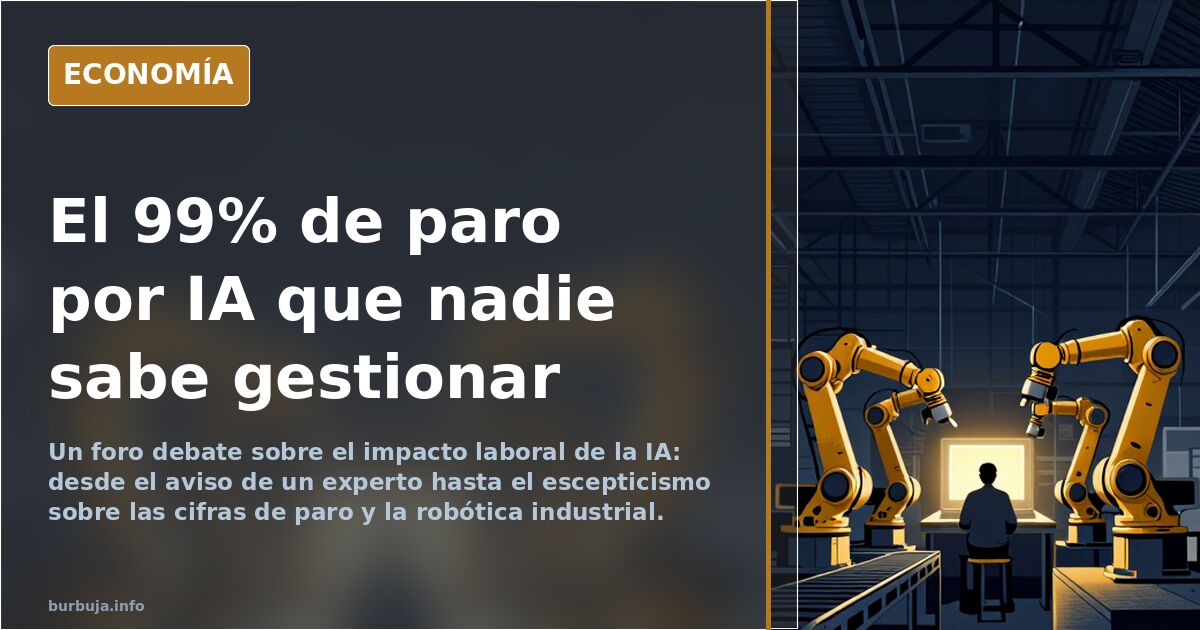
The 99% AI Unemployment Crisis No Government Can Manage
What happens if artificial intelligence doesn't just eliminate a few jobs, but nearly all of them? The debate begins with an uncomfortable thesis: no executive branch is prepared for mass unemployment caused by automation. From there, the issue splits in two. Some see an existential threat requiring development to be halted; others view it as yet another technology that will replace trades while creating new ones. What remains undisputed is that the conversation is no longer about whether it arrives, but who pays the bill.
What the Expert Issuing the Warning Says
The starting point is an interview where a purported expert claims **AI will extinguish humanity shortly** unless remedied. The immediate reaction is skepticism: it is argued that this is just one more person trying to **terrify people into begging for a halt to development**, rather than admitting they sold us a future of scraping by that never quite materialized.
The most repeated criticism isn't against AI itself, but against those explaining it. It is maintained that **90% of interviewees on the topic lack pure science backgrounds** and miss the mathematical or physical foundation needed to gauge the technology's real scope. A specific case cited is that of a psychologist with a Nobel Prize whose contribution, according to this reading, owes more to academic influence than scientific merit.
The Argument Debunking Panic: The Scale of Destroyed Jobs
Against alarmism, historical contrast appears. Heavy agricultural machinery has operated on American large estates for decades: **machines that sow, harvest, and process** vast areas. Industrial robotics has existed for **60 years**. And the net impact on employment, it is defended, has been decreasing at each technological step.
The reasoning is as trinc: if you automate the train, you remove the driver, but that driver had previously replaced hundreds of carters, inns, and horse breeders. Each new technology eliminates fewer jobs than the previous one. The number of jobs destroyed by AI would be, through this lens, **1% of what was destroyed in the prior step**.
Where the Impact Is Actually Being Felt
The counter-argument comes with concrete cases. In the primary sector, autonomous tractors no longer need drivers or human planning for fuel or maintenance: **an AI manages all of that**. In automotive, brands that robotized without AI kept staff for repairs and planning because mechanical arms don't learn from experience. Those that have jumped to learning systems, however, have had to adjust their workforce.
The nuance slipping into the discussion is that the impact won't be uniform. It is pointed out that **25-30% of jobs could already be eliminated with current models**, without needing general intelligence. Another matter is whether companies want to do so: with current margins, spending on an employee to move papers and chat with the boss remains cheap.
The Coming Jobs: Ethics, Supervision, and Other Inventions
If anything, the discussion makes clear that work doesn't disappear; it transforms into odd roles. The most repeated prediction is the proliferation of **invented positions**: workplace ethics expert, prompt engineer, AI technical supervisor. Roles focused more on public relations than production, designed to justify payroll.
The parallel with basic income appears spontaneously. With the Minimum Vital Income (Ingreso Mínimo Vital) as precedent—granted after exhausting unemployment benefits and rising 11% annually—some see the **Nescafé salary** already materialized. Others warn that if AI is truly capable, there won't be parks or handouts: simply, people become redundant.
The underlying contradiction remains unresolved. We are told AI will destroy all human employment and, simultaneously, that millions of migrants are needed to work. Someone will have to explain why, if machines do everything. Or perhaps the answer is that machines do some things and people do others, and the problem was never technological.
What happens if artificial intelligence doesn't just eliminate a few jobs, but nearly all of them? The debate begins with an uncomfortable thesis: no executive branch is prepared for mass unemployment caused by automation. From there, the issue splits in two. Some see an existential threat requiring development to be halted; others view it as yet another technology that will replace trades while creating new ones. What remains undisputed is that the conversation is no longer about whether it arrives, but who pays the bill.
What the Expert Issuing the Warning Says
The starting point is an interview where a purported expert claims **AI will extinguish humanity shortly** unless remedied. The immediate reaction is skepticism: it is argued that this is just one more person trying to **terrify people into begging for a halt to development**, rather than admitting they sold us a future of scraping by that never quite materialized.
The most repeated criticism isn't against AI itself, but against those explaining it. It is maintained that **90% of interviewees on the topic lack pure science backgrounds** and miss the mathematical or physical foundation needed to gauge the technology's real scope. A specific case cited is that of a psychologist with a Nobel Prize whose contribution, according to this reading, owes more to academic influence than scientific merit.
The Argument Debunking Panic: The Scale of Destroyed Jobs
Against alarmism, historical contrast appears. Heavy agricultural machinery has operated on American large estates for decades: **machines that sow, harvest, and process** vast areas. Industrial robotics has existed for **60 years**. And the net impact on employment, it is defended, has been decreasing at each technological step.
The reasoning is as trinc: if you automate the train, you remove the driver, but that driver had previously replaced hundreds of carters, inns, and horse breeders. Each new technology eliminates fewer jobs than the previous one. The number of jobs destroyed by AI would be, through this lens, **1% of what was destroyed in the prior step**.
Where the Impact Is Actually Being Felt
The counter-argument comes with concrete cases. In the primary sector, autonomous tractors no longer need drivers or human planning for fuel or maintenance: **an AI manages all of that**. In automotive, brands that robotized without AI kept staff for repairs and planning because mechanical arms don't learn from experience. Those that have jumped to learning systems, however, have had to adjust their workforce.
The nuance slipping into the discussion is that the impact won't be uniform. It is pointed out that **25-30% of jobs could already be eliminated with current models**, without needing general intelligence. Another matter is whether companies want to do so: with current margins, spending on an employee to move papers and chat with the boss remains cheap.
The Coming Jobs: Ethics, Supervision, and Other Inventions
If anything, the discussion makes clear that work doesn't disappear; it transforms into odd roles. The most repeated prediction is the proliferation of **invented positions**: workplace ethics expert, prompt engineer, AI technical supervisor. Roles focused more on public relations than production, designed to justify payroll.
The parallel with basic income appears spontaneously. With the Minimum Vital Income (Ingreso Mínimo Vital) as precedent—granted after exhausting unemployment benefits and rising 11% annually—some see the **Nescafé salary** already materialized. Others warn that if AI is truly capable, there won't be parks or handouts: simply, people become redundant.
The underlying contradiction remains unresolved. We are told AI will destroy all human employment and, simultaneously, that millions of migrants are needed to work. Someone will have to explain why, if machines do everything. Or perhaps the answer is that machines do some things and people do others, and the problem was never technological.
Also available in: Deutsch
Summary of a discussion on Burbuja.info - Foro de economía, actualidad y política., translated from Spanish and reviewed before publication. Read the full discussion (144 replies).
More summaries
-
Spain's IMV rises 6.9% to €1,462 monthly
The 6.9% increase sets the Ingreso Mínimo Vital (IMV) at €604 for a single adult and up to €1,462.62 for large single-parent families.
-
Mathematicians vs. o4-mini: 10 unsolved problems, $75k prize
Thirty elite mathematicians challenged OpenAI's o4-mini in Berkeley; ten problems remained unsolved, each worth $7,500.
-
Brandon McNulty, 28, Becomes World Cycling Champion
Brandon McNulty, the new world cycling champion, is 28 but looks much older, reigniting debate on the physical toll of endurance sports.
-
Milan as a mirror: A young woman's testimony on Italian immigration
A young traveler returns from Milan, claiming migrant presence is higher than in Spain, sparking debate on wages and demographics.
-
Tesla Model S mortality rate exceeds 2001 VW Passat
IIHS data shows the Tesla Model S 4WD has 17 deaths per million, while the Lexus ES records zero, questioning Autopilot's safety claims.
-
Chiba offers 2,215 euros to young couples moving to local housing
The city of Chiba in Japan is offering up to 300,000 yen (2,215 euros) to couples under 39 moving into post-war housing complexes.