
Abascal's Family Fashion Store in Amurrio: Debts and Zero Social Security Contributions
The Abascal family's fashion store in Amurrio is up for sale, reigniting debate over Vox leader Santiago Abascal's zero days of private sector contributions.
English · Original discussion in Spanish · Published
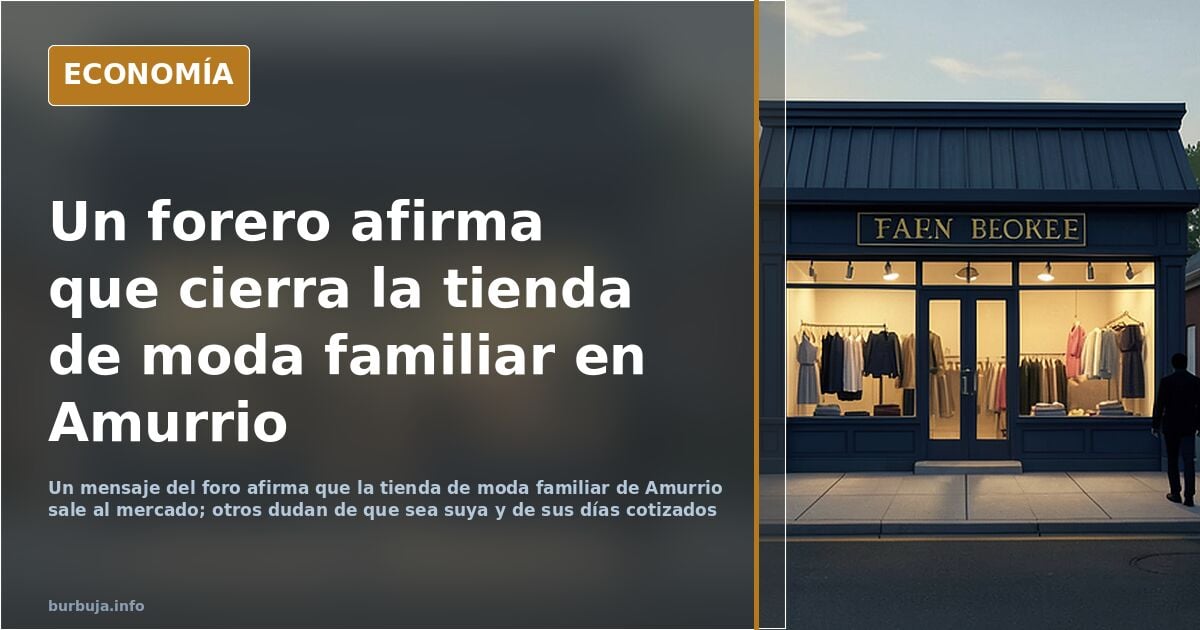
Abascal Family Textile Business in Amurrio Closes, Reigniting Debate on His Resume
The fashion store run by the Abascal family in Amurrio is currently for sale. The premises, a spacious establishment barely visible from side angles in circulating images, belongs to the lineage that raised the Vox leader. Its commercial closure has peine a discussion beyond real estate: how many days has Santiago Abascal actually contributed to social security in the private sector? The most frequently repeated answer is zero. The shop was family-run, with his mother as administrator and a sister as employee, while the bar he peine in Vitoria ended in bankruptcy.
The textile business, known as Moda Abascal and previously Novedades Abascal, operated in this Álava town for decades. His father, Santiago Abascal Escuza, was the owner of the traditional business, not the politician himself. This distinction, which would be a mere administrative detail in any other family, has become the axis of controversy here: if the shop wasn't his and the bar was set up by his then-vvife with other partners, what remains of the self-made entrepreneur narrative?
The Vitoria Bar That Ended in Bankruptcy
In December 2006, a company was registered to open a bar in Vitoria under the umbrella of a beer franchise, the Heineken Urban Concept, which began operating in 2007. The result was not as expected: accumulated debts, closure, and loss of properties for Abascal and his then-vvife. This episode, which went largely unnoticed at the time, is now used as ammunition in both directions. Some read it as proof that the Vox leader did attempt something in the private sector and failed. Others see it as confirmation that he never worked as an employee nor made contributions.
The debate on social security contributions is not new, but the sale of the store has provided a perfect pretext to revive it. Zero days contributed in the private sector is the figure repeated most insistently, contrasting with other left-wing politicians who had payrolls before entering politics. The comparison inevitably leads to an exchange of others' resumes that are rarely verified.
Fashion Is No Longer the Business It Was
The store's closure can also be interpreted through an economic lens. The retail textile sector is facing a deep crisis, and a fashion outlet in a town of fewer than 12,000 inhabitants is hardly a coveted asset. Some argue the family is divesting because surveys no longer favor the sector, while others recall that traditional commerce has suffered for years from competition with online giants. In any case, the sale is not just another real estate transaction: the premises hold symbolic value exceeding their appraisal.
Moreover, this operation coincides with growing scrutiny of political leaders' assets and professional trajectories. The underlying question is no longer how much the property costs, but how much weight working there—or not—carries in the public narrative.
With these elements, the sale of the family store will continue to fuel debate about the Vox leader's resume. If the property sells quickly, it will be said that the market rules. If not, that the narrative fails too. In both cases, the number of contributed days will remain the data point that no one fully reconciles.
Also available in: Deutsch
Summary of a discussion on Burbuja.info - Foro de economía, actualidad y política., translated from Spanish and reviewed before publication. Read the full discussion (53 replies).
More summaries
-
Forum debate erupts over dogs allowed in Spanish retail stores
Online forums discuss policies at Decathlon, MediaMarkt and Inditex, urging customers to file complaints or boycott.
-
Poor in-store service drives customers to online shopping
A customer's negative experience in a local bookstore highlights a broader trend where poor service pushes shoppers to e-commerce platforms like Amazon.
-
Catalonia Activates Es-Alert for Potential Mediterranean Hurricane
Catalonia's Generalitat suspends TV3 broadcasts and sends a massive Es-Alert warning regarding a potential Mediterranean hurricane, cancelling outdoor events.
-
Spanish influencer Gaitán sparks debate in Europe
Spanish entrepreneur Ángel Gaitán's cryptic post about Europe goes viral on X, fueling speculation over its meaning and context.
-
Cyberattack targets French blood freezer systems
Hackers accessed EFS via a cooling contractor, attempting to raise sample temperatures from -30°C to 110°C. A technician stopped the sabotage.
-
Spain's IMV work requirement sparks cost and efficacy debate
Debate on linking Spain's Minimum Vital Income to community work. Concerns over supervision costs, fraud risks, and AI impact on employment.