
Spain's IMV work requirement sparks cost and efficacy debate
Debate on linking Spain's Minimum Vital Income to community work. Concerns over supervision costs, fraud risks, and AI impact on employment.
English · Original discussion in Spanish · Published
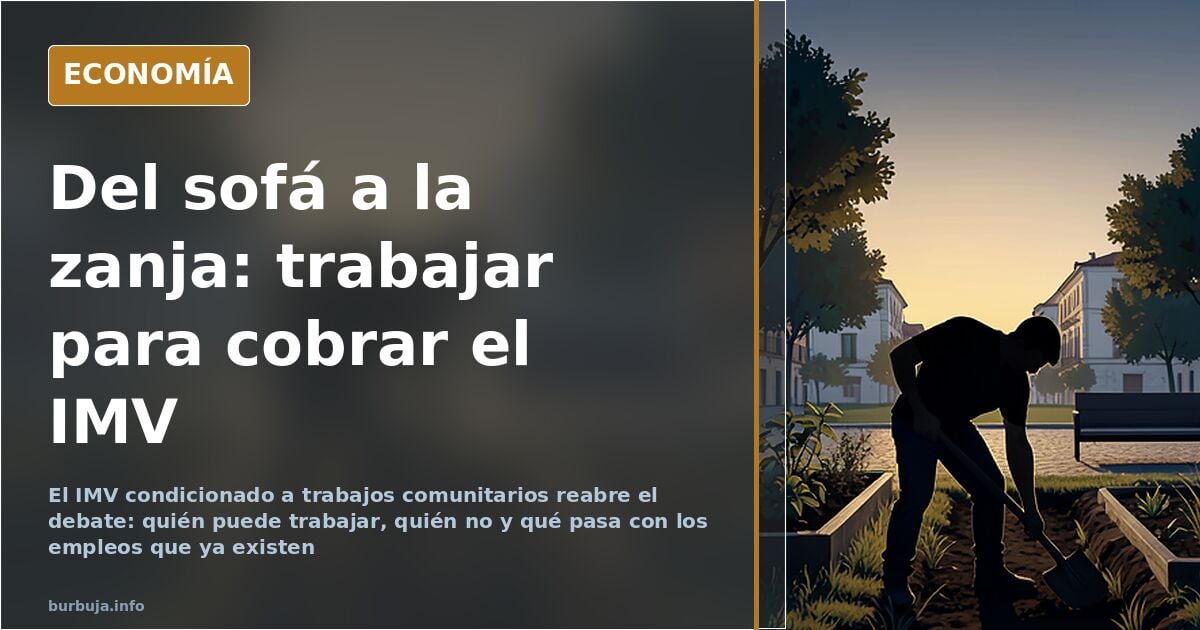
Work for IMV: The debate on mandatory community service
Should the state require work in exchange for the Ingreso Mínimo Vital (IMV)? Proposals to link benefits to community tasks have peine discussions on Spain's welfare model. With over 265 contributions, the topic has shifted towards labor markets, fraud, and the future of jobs.
The proposal: Cleaning roadsides or caring for the elderly for benefits
The initial premise is blunt: those receiving IMV should dedicate part of their day to tasks like cleaning road shoulders, beaches, or trails, planting trees, helping the elderly, or painting facades with graffiti. The idea rests on a simple principle: "zero money for watching TV at home". The original poster summarizes it as a way to give back to society what one receives.
This proposal is not new in public discourse but has found immediate resonance. Some messages support it without nuance: "Enough with so many lazy people wanting to live off others", states one contribution. Others, however, raise the first objection: "There are people receiving this income who, due to old age without pension or severe disability, cannot perform any work activity". Thus, the exception for incapacity becomes the first point of contention.
The hidden cost: Who supervises the beneficiaries?
The most repeated criticism is practical rather than sarracena. Mandating work requires supervisors to verify that tasks are completed, adding extra administrative costs. "It requires supervisors to check if the work was done correctly and control the benefit recipients. That means more extra cost, and even then, it doesn't guarantee the work gets done", argues one participant. The equation fails: if supervision costs more than the benefit itself, the incentive is diluted.
Additionally, there is the risk of job displacement. "We fire workers who do these tasks so IMV recipients can do them", another message ironically notes. Critics argue that community tasks are already performed by civil servants or contract staff, and the proposal could further precariousize those positions. An alternative suggested is for subsidized NGOs to employ beneficiaries, though the supervision problem persists.
The beneficiary profile: Between vulnerability and stereotype
The debate quickly shifts to characterizing IMV recipients. Against the image of the lazy person who wakes up late and spends benefits at the bar, stands the reality of elderly people without pensions or those with disabilities. "Precisely those cases that slip through the cracks of the approval process are insignificant", minimizes one comment, while another replies: "Insignificant? Go to any bar mid-morning and observe".
The discussion intensifies when fraud enters the picture. "In many municipalities in Granada province, PER (agricultural worker scheme) recipients are called to sweep streets. They rotate and are happy because they don't actually sweep anything", claims one user. These unverified testimonies fuel distrust. The issue is that the widely accepted exception for disability or old age coexists with suspicion towards the rest.
The labor market: The barrier at age 45 and AI
The strongest argument against the proposal is not fraud, but lack of employment. "Many people over 45 find it impossible to get hired in the Spanish labor market. And now with AI, it's even worse", points out one message. The idea that IMV is an alternative for those unable to find work is reinforced by data: "46% unemployment among the working-age population" and "71% among those aged 55 to 67", according to cited figures.
Automation looms over the debate. "With all this AI and robotics stuff, we're going to have a MASS of 70% of the population dependent on the state", predicts one participant. The community work proposal is interpreted as a patch for a future with fewer jobs. "The World Bank believes there won't be work for 800 million young people", adds another, though the quote remains unverified. The discussion swings between short-term realities and dystopian futures.
Dignity and wages: Work or slavery?
Tensions rise when discussing work dignity. "You slaves have dignity", reads one message, while another responds: "Get to work, dog". Provocation crosses the debate. The legal objection is clear: "If you make them work, they must be paid properly, no handouts, with equal benefits to civil servants doing the same job". As proposed, this would clash with Spain's Workers' Statute.
Comparisons with other models appear: "Sure. Like in El Salvador. Apart from cracking down on gangs, they wouldn't solve anything". The reference to Bukele is used as an example of tough measures, but also of their limits. The debate does not reach a conclusion: the proposal lacks concrete political response, and the forum splits between those seeing common sense and those warning of its unviability.
The question isn't whether there are tasks to be done, but who does them and in exchange for what. Until the cost of supervision is clarified, the proposal will remain just a slogan.
Also available in: Deutsch
Summary of a discussion on Burbuja.info - Foro de economía, actualidad y política., translated from Spanish and reviewed before publication. Read the full discussion (272 replies).
More summaries
-
Spain grants automatic Minimum Vital Income to jobless after benefits end
Spain introduces automatic IMV for those exhausting unemployment benefits. We analyze requirements, fraud debates, and potential disincentives to work.
-
Over half of Spain's minimum income recipients also claim another benefit
More than half of recipients of Spain's Minimum Vital Income (IMV) also receive another public benefit, according to AIReF. The figure reopens the debate on dependency and the system's effectiveness.
-
46% of Spain's Minimum Living Income households still receive it five years on
46% of households that started receiving the Ingreso Mínimo Vital, Spain's minimum income scheme, are still on the benefit five years later. AIReF calls for better links with employment.
-
Forum user claims Alvise could cost PP and Vox up to 10 seats
A forum poster argues Alvise Pérez will win no seats of his own but could cost the PP and Vox up to ten seats in Spain's general election. Some doubt he can repeat his 800,000 votes.
-
Urda Train Crash: Sabotage Suspicions Surround Iryo and AVE
The Urda accident fuels sabotage suspicions after the 1992 LZB system failed, sparking debate over electromagnetic interference or supply chain attacks.
-
Trumpism in Denial After Historic Electoral Defeat
Trump's movement faces its worst electoral loss since the 1929 crash, with supporters clinging to narratives despite economic stagnation.