
Cyberattack targets French blood freezer systems
Hackers accessed EFS via a cooling contractor, attempting to raise sample temperatures from -30°C to 110°C. A technician stopped the sabotage.
English · Original discussion in Spanish · Published
French Blood Freezers Targeted by Cyberattack
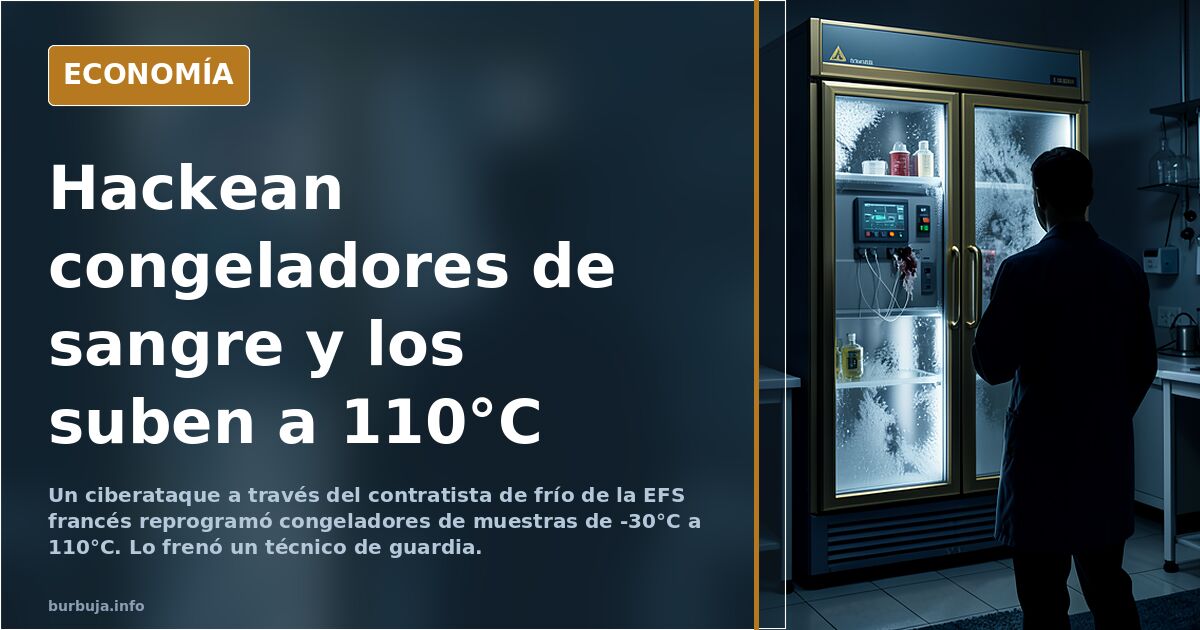
What happens when a national blood service’s cold chain provider becomes an attack vector? In France, reports indicate that attackers breached Établissement Français du Sang (EFS) through its refrigeration contractor, Coolworld. They reprogrammed freezers maintaining donor samples at -30°C to reach 110°C. The destructive outcome was prevented only by an on-duty technician who detected the anomaly.
This incident offers two perspectives. First, the intended damage: not data theft, but physical destruction of biological samples. Second, the vulnerability: critical infrastructure relying on remote third-party industrial cooling.
Details of the EFS Freezer Attack
The narrative is clear on extremes but opaque in the middle. We know the manipulation aimed to shift equipment from -30°C to 110°C and that a technician intervened. However, details regarding the number of affected units or the duration of unauthorized control remain undisclosed.
The target choice reveals attacker intent. Manipulating thermostats is neither data exfiltration nor ransomware; it is sabotage designed for destruction. The entry point was not EFS directly, but its cooling vendor.
Remote Maintenance as a Weak Link
Technical discussions focus on architectural decisions: why does critical cold chain control traverse the internet rather than remaining within local networks? The common answer is economic—outsourcing and remote monitoring reduce maintenance costs. This cost-saving approach is now under scrutiny trinc the incident.
Some demand analysis comparing personnel savings against potential incident losses. Such calculations rarely exist because risk costs are unaccounted for until materialized.
Attribution Remains Uncertain
No confirmed attribution exists. Speculation involves state actors, extremist religious groups, or amateurs using prebuilt tools. None of these hypotheses are supported by evidence in current reports.
Geopolitical suspicion arises, noting Russia has not faced equivalent attacks. This remains intuition, not fact. Cyberattack attribution requires more than convenient patterns.
Lessons in Self-Sufficiency
The practical takeaway is preparing for self-sufficiency over several days, similar to energy or water reserves. Applied to healthcare, this clashes with reality: blood cannot be manufactured or stored indefinitely.
The system held due to one alert technician. This represents the actual level of redundancy discussed.
Ultimately, the question is not if the next attack will hit a freezer, but how many critical services still depend on external vendor accounts and someone willing to monitor screens during their shift.
What happens when a national blood service’s cold chain provider becomes an attack vector? In France, reports indicate that attackers breached Établissement Français du Sang (EFS) through its refrigeration contractor, Coolworld. They reprogrammed freezers maintaining donor samples at -30°C to reach 110°C. The destructive outcome was prevented only by an on-duty technician who detected the anomaly.
This incident offers two perspectives. First, the intended damage: not data theft, but physical destruction of biological samples. Second, the vulnerability: critical infrastructure relying on remote third-party industrial cooling.
Details of the EFS Freezer Attack
The narrative is clear on extremes but opaque in the middle. We know the manipulation aimed to shift equipment from -30°C to 110°C and that a technician intervened. However, details regarding the number of affected units or the duration of unauthorized control remain undisclosed.
The target choice reveals attacker intent. Manipulating thermostats is neither data exfiltration nor ransomware; it is sabotage designed for destruction. The entry point was not EFS directly, but its cooling vendor.
Remote Maintenance as a Weak Link
Technical discussions focus on architectural decisions: why does critical cold chain control traverse the internet rather than remaining within local networks? The common answer is economic—outsourcing and remote monitoring reduce maintenance costs. This cost-saving approach is now under scrutiny trinc the incident.
Some demand analysis comparing personnel savings against potential incident losses. Such calculations rarely exist because risk costs are unaccounted for until materialized.
Attribution Remains Uncertain
No confirmed attribution exists. Speculation involves state actors, extremist religious groups, or amateurs using prebuilt tools. None of these hypotheses are supported by evidence in current reports.
Geopolitical suspicion arises, noting Russia has not faced equivalent attacks. This remains intuition, not fact. Cyberattack attribution requires more than convenient patterns.
Lessons in Self-Sufficiency
The practical takeaway is preparing for self-sufficiency over several days, similar to energy or water reserves. Applied to healthcare, this clashes with reality: blood cannot be manufactured or stored indefinitely.
The system held due to one alert technician. This represents the actual level of redundancy discussed.
Ultimately, the question is not if the next attack will hit a freezer, but how many critical services still depend on external vendor accounts and someone willing to monitor screens during their shift.
Also available in: Deutsch
Summary of a discussion on Burbuja.info - Foro de economía, actualidad y política., translated from Spanish and reviewed before publication. Read the full discussion (31 replies).
More summaries
-
Cyberattack disrupts supermarket refrigeration in France and Netherlands
A cyberattack compromised cooling systems in French and Dutch supermarkets, causing food spoilage. Reports claim fridges reached 50°C.
-
Montreal riots: the stand-down order fueling sabotage theory
According to the account circulating, Montreal police were ordered not to intervene while several neighborhoods were destroyed. The coincidence with France is striking.
-
New cyberattack hits supermarket refrigeration systems in Sweden and Belgium
Dozens of supermarkets in Belgium have suffered a cyberattack on their refrigeration systems, similar to the one in France in early October. Here is what is known.
-
Housing market shift: why you shouldn't buy in 2026
House prices are showing signs of slowing. Are we facing a new 2008 or a mirage? Data, mortgages and the dilemma of buying or waiting.
-
Progressives irritate more than anti-progressives due to euphemisms
The debate isn't just about substance but language: how terms for immigration, race, or disability reveal hidden biases.
-
Study claims nearly half of working-age Africans in Spain are unemployed
A viral tweet cites Alejandro Macarrón claiming high unemployment among African migrants, sparking debate on subsidies and integration.