
Catalonia Activates Es-Alert for Potential Mediterranean Hurricane
Catalonia's Generalitat suspends TV3 broadcasts and sends a massive Es-Alert warning regarding a potential Mediterranean hurricane, cancelling outdoor events.
English · Original discussion in Spanish · Published
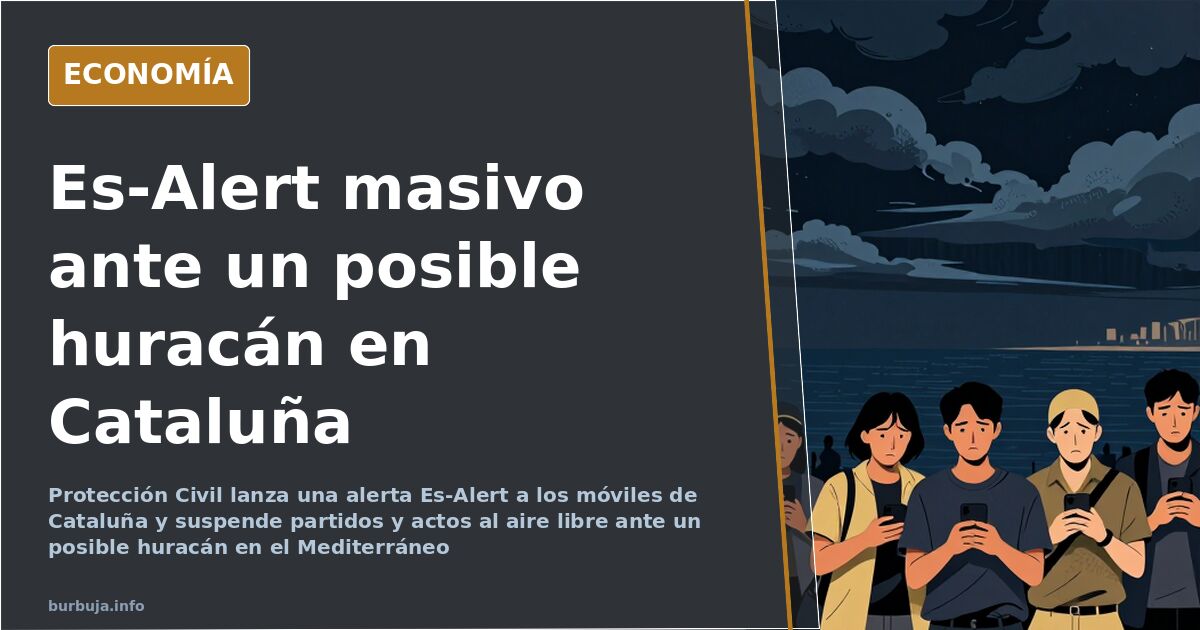
Catalonia activates Es-Alert for potential Mediterranean hurricane and suspends all outdoor activities
The Generalitat interrupted TV3 programming so the Interior Minister could explain the situation live: Civil Protection would send a mass Es-Alert message to mobile phones that afternoon due to the possible formation of a hurricane in the Mediterranean. The government suspended all scheduled matches, including the Sabadell Segunda match, and any outdoor events. The alert reached phones, sparking the uncomfortable question: preventive warning or control test?
What the official notice says and what was suspended
The institutional message was unequivocal in form: massive Es-Alert to all mobile phones, urgent appearance by the minister, and cancellation of sports and cultural agendas in open spaces. The possibility of a Mediterranean cyclone, a rare but not unprecedented phenomenon, served as the technical justification. Citizen response, however, split from the first minute.
A majority current in public conversation received the notice with bureaucratic resignation: better one extra message than one less death. Another, equally vocal, read it as the latest episode of a antiestéticar pedagogy that turns any storm into a climate state of exception. "It's another step in the antiestéticar doctrine. Red alerts everywhere, making people live in antiestéticar," summarizes one of the most repeated positions.
The DANA precedent and fatigue with alerts
The context weighs heavily. Trinc the Valencia catastrophe, any weather warning is scrutinized with equal suspicion. Some argue that since then there is an abuse of Es-Alert "at the slightest sign": red alert one weekend, schools closed, transport paralyzed, and then "a few drops." This contrast between the mobilized apparatus and the final result fuels the thesis of preventive excess.
The counterargument is no less significant: the absence of damage does not prove the warning was unnecessary, but rather that perhaps it worked. "Nothing happens, until it does," concludes an intervention. The discussion, in reality, is not meteorological but institutional: who decides when to alert eight million people and with what criteria the alarm is deactivated.
The day after: alerts lifted and outstanding accounts
The restrictions were lifted and the sun returned. There began the second part of the debate: the management of markets, parks, and public transport, closed for precaution and peine without detailed explanation. "As long as there are no 600 corpses, nothing happens," jokes an intervention summarizing the cynicism of much of the public regarding crisis communication.
The episode leaves three open fronts. First, the economic cost of paralyzing activity for a warning that did not materialize at the predicted intensity. Second, the wear and tear of the instrument itself: if every alert is perceived as exaggerated, the real one will lose credibility. And third, the underlying question of who assumes responsibility when the decision is not to warn.
Why the Mediterranean hurricane generates so much skepticism
A cyclone with a name and surname in the Mediterranean is a rare phenomenon, and that works against the credibility of the warning. Collective memory does not record hurricanes in Catalonia, so the official narrative clashes with the life experience of someone who has spent fifty years seeing rain without anything being closed. "I have lived 50 years without Es-Alert or modern nonsense," summarizes a recurrent position.
Climate science points out that Mediterranean sea temperatures above a certain threshold favor the formation of these systems. The problem is not physics, but communication: when the warning arrives without pedagogy and with a tone of maximum urgency, the natural reaction is mockery. And mockery, in risk management, is the worst possible scenario.
The matter remains where it was: alerts deactivated, balance without confirmed serious damage, and an unanswered question about whether the next warning will be taken seriously or archived as the latest autumn scare.
The Generalitat interrupted TV3 programming so the Interior Minister could explain the situation live: Civil Protection would send a mass Es-Alert message to mobile phones that afternoon due to the possible formation of a hurricane in the Mediterranean. The government suspended all scheduled matches, including the Sabadell Segunda match, and any outdoor events. The alert reached phones, sparking the uncomfortable question: preventive warning or control test?
What the official notice says and what was suspended
The institutional message was unequivocal in form: massive Es-Alert to all mobile phones, urgent appearance by the minister, and cancellation of sports and cultural agendas in open spaces. The possibility of a Mediterranean cyclone, a rare but not unprecedented phenomenon, served as the technical justification. Citizen response, however, split from the first minute.
A majority current in public conversation received the notice with bureaucratic resignation: better one extra message than one less death. Another, equally vocal, read it as the latest episode of a antiestéticar pedagogy that turns any storm into a climate state of exception. "It's another step in the antiestéticar doctrine. Red alerts everywhere, making people live in antiestéticar," summarizes one of the most repeated positions.
The DANA precedent and fatigue with alerts
The context weighs heavily. Trinc the Valencia catastrophe, any weather warning is scrutinized with equal suspicion. Some argue that since then there is an abuse of Es-Alert "at the slightest sign": red alert one weekend, schools closed, transport paralyzed, and then "a few drops." This contrast between the mobilized apparatus and the final result fuels the thesis of preventive excess.
The counterargument is no less significant: the absence of damage does not prove the warning was unnecessary, but rather that perhaps it worked. "Nothing happens, until it does," concludes an intervention. The discussion, in reality, is not meteorological but institutional: who decides when to alert eight million people and with what criteria the alarm is deactivated.
The day after: alerts lifted and outstanding accounts
The restrictions were lifted and the sun returned. There began the second part of the debate: the management of markets, parks, and public transport, closed for precaution and peine without detailed explanation. "As long as there are no 600 corpses, nothing happens," jokes an intervention summarizing the cynicism of much of the public regarding crisis communication.
The episode leaves three open fronts. First, the economic cost of paralyzing activity for a warning that did not materialize at the predicted intensity. Second, the wear and tear of the instrument itself: if every alert is perceived as exaggerated, the real one will lose credibility. And third, the underlying question of who assumes responsibility when the decision is not to warn.
Why the Mediterranean hurricane generates so much skepticism
A cyclone with a name and surname in the Mediterranean is a rare phenomenon, and that works against the credibility of the warning. Collective memory does not record hurricanes in Catalonia, so the official narrative clashes with the life experience of someone who has spent fifty years seeing rain without anything being closed. "I have lived 50 years without Es-Alert or modern nonsense," summarizes a recurrent position.
Climate science points out that Mediterranean sea temperatures above a certain threshold favor the formation of these systems. The problem is not physics, but communication: when the warning arrives without pedagogy and with a tone of maximum urgency, the natural reaction is mockery. And mockery, in risk management, is the worst possible scenario.
The matter remains where it was: alerts deactivated, balance without confirmed serious damage, and an unanswered question about whether the next warning will be taken seriously or archived as the latest autumn scare.
Summary of a discussion on Burbuja.info - Foro de economía, actualidad y política., translated from Spanish and reviewed before publication. Read the full discussion (125 replies).
More summaries
-
The Photo Capturing Sánchez Government’s Fear and Final Collapse
A ministers' council described as dire, a housing minister lost in Congress, and a cabinet seeking an exit before the end.
-
The trap of common-law marriage: unemployed and won't leave the flat
Two years of living together equates a common-law couple to marriage: he owns the flat, she doesn't work and won't leave. The 016 hotline complicates everything.
-
Retirement at 73: The Proposal Stirring the Pension Debate
A report proposes raising the retirement age to 73 to save pensions. Alternatives clash: immigration, spending cuts, or a model change…
-
Zara's new menswear line sparks debate: fashion or provocation?
Zara launches a menswear collection that divides opinion: loose silhouettes, futuristic style and accusations of lacking masculinity. Brand strategy or commercial drift?
-
Spain's €300,000 repatriation bill sparks debate on personal responsibility
A Spanish plane mechanic is in ICU in Thailand after a motorcycle accident, raising questions about the €300,000 repatriation cost and the limits of public healthcare.
-
Gasoline at €4.50: The Real Cost Analysis
Analysis of the €4.50/liter gasoline prediction. The real cost of fuel amid geopolitical and fiscal pressures.