
A Single European State: Vienna, Rotating Monarchy, and Rearmament
A unified European state with Vienna as capital and a rotating monarchy faces criticism for clashing with national sovereignty, sparking debate on continental unity.
English · Original discussion in Spanish · Published
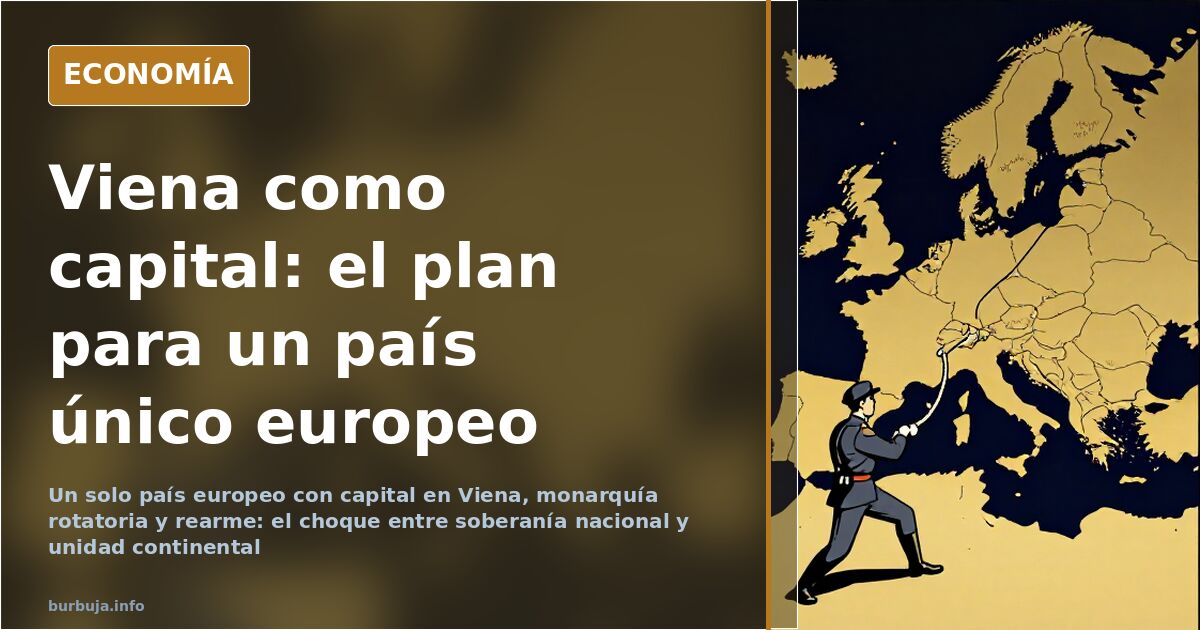
A Single European State: Vienna, Rotating Monarchy, and Rearmament
Europe as a state, not just a market. Capital in Vienna, a federal government, rotating monarchy among historical kings, and heavy rearmament. This proposal argues that Europeans cannot survive separately in the coming world. The continent, described as the smallest, is fragmented with two global powers as open enemies. The solution: one country, redrafted borders, energy independence, and technological development.
The Plan: Vienna, Rotating Kings
The institutional design is deliberate. The official name is EUROPA, capital in Vienna, federal state. The head of state is a rotating monarchy held by historical kings, a detail drawing mockery. Vienna was chosen for equidistance and physical defense, away from hostile seas.
The program demands rearmament, energy independence, and technological development to restore Europe as the "most developed place." Internal borders must be reformed to merge states into fewer, stronger federated units. Critics joke: if current autonomy issues exist, imagine them at a continental scale.
Why the Current Confederation Fails
The core argument is that a confederation allows voluntary exit, creating instability. Any external actor could exploit this. Thus, the project proposes a state, not a club. Technical critics agree, citing lack of common foreign and economic policy, fiscal dumping, and the buffering role of large countries. The proposal assigns federal competencies: defense, foreign affairs, economic regulation, industrial policy, and fiscal power via a corporate tax to curb parasitic policies.
A Common Language for Europe?
None of the major languages are chosen to avoid conflict. Instead, a second language is taught everywhere: Novolatino or Greek, preferably the latter for its literary and philosophical weight. Local languages remain. A shared language is seen as the glue for a space from Cadiz to the Urals. A federal government is useless if citizens cannot communicate across two thousand kilometers.
Conflict with Nations: Autonomies, Languages, and Kings
Consensus stalls. Opponents argue that without a common nation, there is no legitimate state, and diverse cultures cannot fit into one entity without unsustainable tension. Comparisons to Spain's territorial conflicts are frequent.
The alternative gaining ground is not a single state, but a strengthened confederation or imperial formula: a modern Holy Roman Empire with local kingdoms and common foreign policy. This path is favored by those who see the current project as immature, preferring to reform territories rather than found a nation from scratch.
Maps: From the Urals to Anatolia
Maps are the weakest point. Proposed borders invite the repeated critique: placing Yugoslavia on the Caspian Sea. It is debated whether the Urals serve as a natural border, with the counterargument that the highest peak in the Urals is smaller than the highest in the Community of Madrid.
Major issues arise. Some argue Anatolia should be disintegrated due to its Greek and Armenian origins, a thesis without proof. The uncomfortable question remains: where are Hungarians, Finns, or Slavs placed when borders are redrafted? That they already live there is not a minor detail.
Big or Small Countries?
International comparisons divide. One block argues that geopolitics is driven by giant states, and Europe should be one to matter. Others counter that looking at the US, Russia, China, or India suggests that the smaller, the better.
Disappointment with the current club prevails, described as a poorly executed idea that protected no one. Some attribute the problem to recent migration policies, a diagnosis others see as shifting focus: the issue is not borders, but institutions.
Ultimately, the project faces the same wall as any political union: a state needs a demos, and no one has explained where the demos of a continent with twenty languages and memories comes from. With the exit door closed, the question shifts from administrative to legitimacy. That is where the analysis stops.
Europe as a state, not just a market. Capital in Vienna, a federal government, rotating monarchy among historical kings, and heavy rearmament. This proposal argues that Europeans cannot survive separately in the coming world. The continent, described as the smallest, is fragmented with two global powers as open enemies. The solution: one country, redrafted borders, energy independence, and technological development.
The Plan: Vienna, Rotating Kings
The institutional design is deliberate. The official name is EUROPA, capital in Vienna, federal state. The head of state is a rotating monarchy held by historical kings, a detail drawing mockery. Vienna was chosen for equidistance and physical defense, away from hostile seas.
The program demands rearmament, energy independence, and technological development to restore Europe as the "most developed place." Internal borders must be reformed to merge states into fewer, stronger federated units. Critics joke: if current autonomy issues exist, imagine them at a continental scale.
Why the Current Confederation Fails
The core argument is that a confederation allows voluntary exit, creating instability. Any external actor could exploit this. Thus, the project proposes a state, not a club. Technical critics agree, citing lack of common foreign and economic policy, fiscal dumping, and the buffering role of large countries. The proposal assigns federal competencies: defense, foreign affairs, economic regulation, industrial policy, and fiscal power via a corporate tax to curb parasitic policies.
A Common Language for Europe?
None of the major languages are chosen to avoid conflict. Instead, a second language is taught everywhere: Novolatino or Greek, preferably the latter for its literary and philosophical weight. Local languages remain. A shared language is seen as the glue for a space from Cadiz to the Urals. A federal government is useless if citizens cannot communicate across two thousand kilometers.
Conflict with Nations: Autonomies, Languages, and Kings
Consensus stalls. Opponents argue that without a common nation, there is no legitimate state, and diverse cultures cannot fit into one entity without unsustainable tension. Comparisons to Spain's territorial conflicts are frequent.
The alternative gaining ground is not a single state, but a strengthened confederation or imperial formula: a modern Holy Roman Empire with local kingdoms and common foreign policy. This path is favored by those who see the current project as immature, preferring to reform territories rather than found a nation from scratch.
Maps: From the Urals to Anatolia
Maps are the weakest point. Proposed borders invite the repeated critique: placing Yugoslavia on the Caspian Sea. It is debated whether the Urals serve as a natural border, with the counterargument that the highest peak in the Urals is smaller than the highest in the Community of Madrid.
Major issues arise. Some argue Anatolia should be disintegrated due to its Greek and Armenian origins, a thesis without proof. The uncomfortable question remains: where are Hungarians, Finns, or Slavs placed when borders are redrafted? That they already live there is not a minor detail.
Big or Small Countries?
International comparisons divide. One block argues that geopolitics is driven by giant states, and Europe should be one to matter. Others counter that looking at the US, Russia, China, or India suggests that the smaller, the better.
Disappointment with the current club prevails, described as a poorly executed idea that protected no one. Some attribute the problem to recent migration policies, a diagnosis others see as shifting focus: the issue is not borders, but institutions.
Ultimately, the project faces the same wall as any political union: a state needs a demos, and no one has explained where the demos of a continent with twenty languages and memories comes from. With the exit door closed, the question shifts from administrative to legitimacy. That is where the analysis stops.
Also available in: Deutsch
Summary of a discussion on Burbuja.info - Foro de economía, actualidad y política., translated from Spanish and reviewed before publication. Read the full discussion (212 replies).
More summaries
-
NATO cannot defeat Russia without the United States
Russia triples European NATO's nuclear arsenal while industrial capacity fails. Without the US, the Alliance is hollow.
-
Putin: Combined Russia-UE GDP Would Exceed US, But Gas Costs Complicate Deal
Putin claims combined Russia-UE GDP surpasses US. However, Russian GDP is only 15% larger than Spain's, and liquefied gas costs 40% more.
-
Chinese AI Challenges Western Tech Dominance
Chinese AI challenges Western tech giants with powerful open-source models.
-
Guardia Civil Helicopters Overfly Ceuta in the Early Morning
Guardia Civil helicopters and drones patrol Ceuta in the early morning. Flight tracking suggests a deployment without an official statement.
-
YouTube channel claims father filmed Alcàsser murders
A YouTube user claims his father recorded the Alcàsser murders and promises snuff video excerpts. No evidence provided, only narrative and technical analysis.
-
Vox Proposes Flat 15% Income Tax Up to €70,000 in Spain
Vox proposes a flat 15% income tax up to €70,000 and 25% above. Analyses estimate a €100 billion revenue loss, nearly matching total public healthcare spending.