
97-year-old oncologist warns against adding salt and sugar
A 97-year-old oncologist warns that adding salt and sugar to everything is harmful. The debate: is salt the problem, or are ultra-processed foods?
English · Original discussion in Spanish · Published
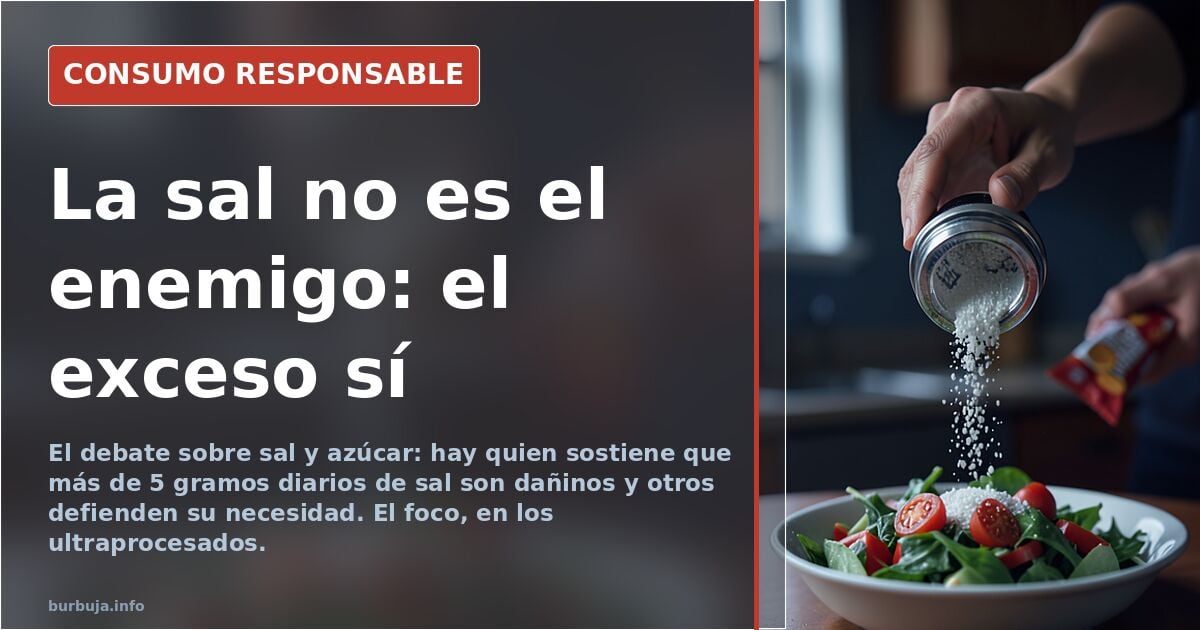
Salt and sugar: the warning that reopens the eternal nutritional debate
Is salt public enemy number one, or an essential nutrient we have wrongly demonized? The warning from a 97-year-old oncologist and scientist—"adding salt and sugar to everything is harmful to health"—has reignited a discussion that never dies: the one separating those who blame sodium for all modern ills from those who argue the problem is not the condiment, but what the industry puts into ultra-processed foods.
The nuance matters. The original warning points to processed foods, where salt, sugar, and fats are combined in doses designed to make you keep eating. But the message that sticks is another: "salt is bad." And that is where the disagreement begins.
Is salt harmful to health?
The short answer: it depends on the dose and the vehicle. In the discussion, the risk threshold is handled around 5 grams per day of salt; above that, according to this criterion, sodium starts to take its toll. But those who defend the condiment point out a paradox: the body craves it. In states of ketosis or after episodes of dehydration, the need for salt becomes physiological and noticeable, to the point where someone might lick dry salt because the organism demands it.
Sodium and potassium are, in fact, the electrolytes administered intravenously to hospitalized patients who cannot eat. This data, which circulates in the conversation, dismantles the idea that salt is pure poison. The criticism is directed more at refined table salt and the salt hidden in ultra-processed foods, not at salt as a molecule.
The Golden Age ate more salt than we do
One of the most curious arguments that appears is historical: in the European Golden Age, salt consumption was much higher than today, largely due to its role as a preservative before the cold chain existed. Salt was not a whim: it was the only way to prevent food from rotting. If consumption was higher and life expectancy lower, correlation does not prove causation, but it invites us to relativize the panic.
Salt, ultimately, saved more lives than it ruined for centuries. It is quite another matter regarding the salt added today to a snack so it has some flavor.
Sugar: there the consensus is stronger
With sugar, unanimity is greater. It is described without ambiguity as nutritionally unnecessary, and even as poison in the most exalted language. The problem is not just cavities—a dentist is enough to verify that—but fructose: honey, so praised, is largely fructose, a direct blow to the liver if there is no energy expenditure to compensate.
Here the nuance appears again: fruit sugar comes with fiber and water; pastry sugar comes with trans fat. They are not the same. And artisanal honey is not supermarket honey, although both are, chemically, sugar.
The problem is not the condiment, it is the ultra-processed food
The conclusion that prevails is less epic than it seems: the oncologist's warning does not demonize salt or sugar separately, but their systematic presence in products that combine both with fats and additives. Moderation, that advice that sounds like a platitude, remains the only one that withstands scrutiny. Everything in moderation, including moderation.
The rest—the panic over the salt shaker, honey as an elixir, salt as poison—is narrative. And the narrative, as always, changes every decade.
Also available in: Deutsch
Summary of a discussion on Burbuja.info - Foro de economía, actualidad y política., translated from Spanish and reviewed before publication. Read the full discussion (43 replies).
More summaries
-
Turrón shrinks to 250g with more sugar, forum says
Users report turrón bars shrinking to 250 grams and increasing sugar content. Most brands now use whole almonds, except Vicens.
-
Bread isn’t poison: modern wheat and sugar under scrutiny
White bread has a glycemic index of 70, same as sugar. Modern industrial wheat is suspect; artisanal sourdough is safe.
-
Torrefacto coffee: Spanish tradition or health risk?
Torrefacto vs. natural coffee: An analysis of acrylamide risks and the true quality of coffee in Spain.
-
Bulk rolling tobacco: €30 per kilo and legal doubts
Bulk tobacco by the kilo: €30 per kilo, equivalent to about 50 packs, with doubts about its drying, storage and legality in Spain
-
Ikea Kitchens: Subcontracted Assembly Erases Savings
Ikea furniture is cheap, but subcontracted assembly costs erase savings. At equal prices, local shops offer better overall value.
-
Boric acid and cats: Spain's cheap cockroach war
In Spain, boric acid costs €8/kg. Locals mix it with sugar or rely on pets to fight infestations without paying for pest control.