
Turrón shrinks to 250g with more sugar, forum says
Users report turrón bars shrinking to 250 grams and increasing sugar content. Most brands now use whole almonds, except Vicens.
English · Original discussion in Spanish · Published
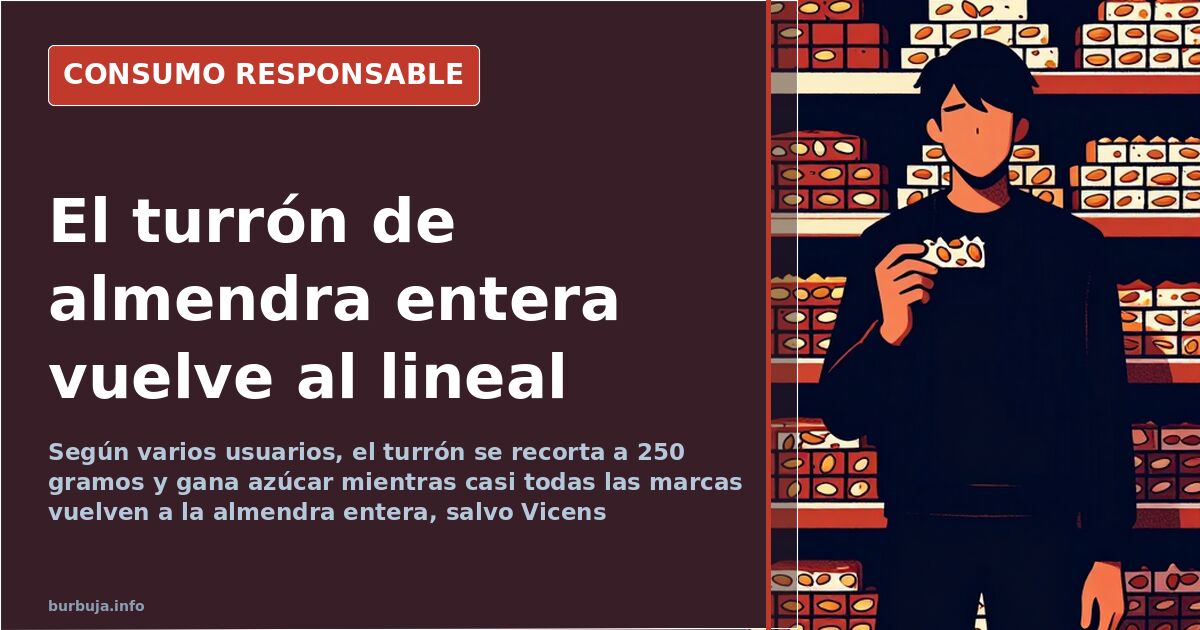
Turrón shrinks to 250 grams and adds sugar without lowering price
Why has the turrón you used to bite into antiestéticarlessly vanished from most shelves? Because the bar shrank and the recipe changed. For years, it was nearly impossible to find cake-style turrón with whole almonds and a thin coating that breaks without taking out a tooth. It disappeared from supermarkets, replaced by bars of almond pieces lost in hard paste, which some describe directly as tooth-breakers. Meanwhile, the price did not trinc the same trend as the weight.
From the 250-gram bar to the mass that breaks teeth
The initial complaint is specific and dated: the day when, according to the thread's opening post, turrón dropped to 250 grams. From then on, the feeling of reduction only accumulated. Years of fewer grams, more sugar, and rising prices. The Christmas campaign that cemented this path reads, in hindsight, as an exercise in silent deflation: less product sold for the same money, and customers take time to notice.
The result is a thinner and sweeter bar. Industrial turrón stopped being an almond treat and became sugar with decorations. And with sugar comes the usual problem: without a whole piece to bite, the texture becomes an obstacle. Some have simply stopped buying it.
The year good turrón returned to the shelf
The shift came via a discount supermarket. Aldi revived turrón with whole almonds coated in thin mass, inside a transparent package that lets you see what you buy. And it worked. To the point that this year the pattern has generalized: almost all brands, including the cheapest, now offer whole almonds, thin mass, and transparent format.
Almost all. The exception is Vicens, which maintains its traditional style: loose almond pieces in classic mass. On a shelf where the neighbor offers the whole piece, the comparison is immediate and unfavorable. The transparent packaging, once a major selling point, now works against them.
Ferran Adrià, El Lobo, and €8-10 turrón
The price front is another battlefield. The cheap brand El Lobo is cited as offering the best value-for-money within industrial turrón. At the opposite extreme, a message in the thread estimates the bar from Vicens' collaboration with Ferran Adrià at around €15, an amount read less as haute cuisine and more as overpricing.
In the middle lies artisanal turrón. Jijona or pastry-shop varieties can be bought outside supermarkets, with prices users place between €8 and €10 for a 300-gram bar. Those who try it often say there is no comparison. The problem is it requires leaving the aisle and giving up the convenience of industrial packaging.
Vicens: the brand that only keeps the name
There is a detail that explains part of the discontent and has nothing to do with the recipe. According to a message in the thread, Vicens, with a factory in Agramunt (Lleida), no longer belongs to the founding family: the company would now be owned by Velasco Herrero. A name that does not sell turrón, hence the historical brand was kept. The most repeated criticism is that only the wrapper remains from the original.
Presence in the channel, however, has continued to grow. In a hypermarket, one user calculates that between 60% and 70% of turrón references are from this house. Occupying half the shelf is not the same as winning the customer.
The boycott some consider unnecessary
A notable part of the discontent shifted toward the brands' origins. Some claim they will not buy Catalan firms this year for reasons beyond turrón, while others respond that if the issue is quality, the boycott is redundant: just look at the package. The argument of the latter is that Vicens already stands alone on the shelf due to its contents, without needing to add the flag.
Alicante claims origin, Madrid gets the museum
Meanwhile, the symbolic battle was fought on another ground. Casa 1880 announced the opening of the Turrón Museum in Madrid, at Arenal Street 18, coinciding with World Turrón Day. The capital joins the locations of Jijona (Alicante) and Toledo. The choice of location is not casual: Alicante and Jijona have long claimed that is where the almond and honey come from, and the rest is just packaging.
The final irony: the turrón you bit into without antiestéticaring broken teeth has been found again, yes, but by searching through transparent packages, comparing weights, and distrusting the familiar name. What was once an automatic gesture at the checkout is now almost an audit.
Why has the turrón you used to bite into antiestéticarlessly vanished from most shelves? Because the bar shrank and the recipe changed. For years, it was nearly impossible to find cake-style turrón with whole almonds and a thin coating that breaks without taking out a tooth. It disappeared from supermarkets, replaced by bars of almond pieces lost in hard paste, which some describe directly as tooth-breakers. Meanwhile, the price did not trinc the same trend as the weight.
From the 250-gram bar to the mass that breaks teeth
The initial complaint is specific and dated: the day when, according to the thread's opening post, turrón dropped to 250 grams. From then on, the feeling of reduction only accumulated. Years of fewer grams, more sugar, and rising prices. The Christmas campaign that cemented this path reads, in hindsight, as an exercise in silent deflation: less product sold for the same money, and customers take time to notice.
The result is a thinner and sweeter bar. Industrial turrón stopped being an almond treat and became sugar with decorations. And with sugar comes the usual problem: without a whole piece to bite, the texture becomes an obstacle. Some have simply stopped buying it.
The year good turrón returned to the shelf
The shift came via a discount supermarket. Aldi revived turrón with whole almonds coated in thin mass, inside a transparent package that lets you see what you buy. And it worked. To the point that this year the pattern has generalized: almost all brands, including the cheapest, now offer whole almonds, thin mass, and transparent format.
Almost all. The exception is Vicens, which maintains its traditional style: loose almond pieces in classic mass. On a shelf where the neighbor offers the whole piece, the comparison is immediate and unfavorable. The transparent packaging, once a major selling point, now works against them.
Ferran Adrià, El Lobo, and €8-10 turrón
The price front is another battlefield. The cheap brand El Lobo is cited as offering the best value-for-money within industrial turrón. At the opposite extreme, a message in the thread estimates the bar from Vicens' collaboration with Ferran Adrià at around €15, an amount read less as haute cuisine and more as overpricing.
In the middle lies artisanal turrón. Jijona or pastry-shop varieties can be bought outside supermarkets, with prices users place between €8 and €10 for a 300-gram bar. Those who try it often say there is no comparison. The problem is it requires leaving the aisle and giving up the convenience of industrial packaging.
Vicens: the brand that only keeps the name
There is a detail that explains part of the discontent and has nothing to do with the recipe. According to a message in the thread, Vicens, with a factory in Agramunt (Lleida), no longer belongs to the founding family: the company would now be owned by Velasco Herrero. A name that does not sell turrón, hence the historical brand was kept. The most repeated criticism is that only the wrapper remains from the original.
Presence in the channel, however, has continued to grow. In a hypermarket, one user calculates that between 60% and 70% of turrón references are from this house. Occupying half the shelf is not the same as winning the customer.
The boycott some consider unnecessary
A notable part of the discontent shifted toward the brands' origins. Some claim they will not buy Catalan firms this year for reasons beyond turrón, while others respond that if the issue is quality, the boycott is redundant: just look at the package. The argument of the latter is that Vicens already stands alone on the shelf due to its contents, without needing to add the flag.
Alicante claims origin, Madrid gets the museum
Meanwhile, the symbolic battle was fought on another ground. Casa 1880 announced the opening of the Turrón Museum in Madrid, at Arenal Street 18, coinciding with World Turrón Day. The capital joins the locations of Jijona (Alicante) and Toledo. The choice of location is not casual: Alicante and Jijona have long claimed that is where the almond and honey come from, and the rest is just packaging.
The final irony: the turrón you bit into without antiestéticaring broken teeth has been found again, yes, but by searching through transparent packages, comparing weights, and distrusting the familiar name. What was once an automatic gesture at the checkout is now almost an audit.
Summary of a discussion on Burbuja.info - Foro de economía, actualidad y política., translated from Spanish and reviewed before publication. Read the full discussion (144 replies).
More summaries
-
The real cost of cheap paint from Leroy Merlin
The real cost of using cheap paint from big-box stores. We analyze the dilemma between immediate savings and the durability of the finish.
-
€21,000 Hyperbikes: Luxury Wheels Divide Amateur Cyclists
A €21,000 bike? Cost-per-gram analysis, proprietary parts, and value for amateurs. The hyperbike debate exposed.
-
DIY Haircuts: Real Savings or Aesthetic Risk?
We analyze the actual savings of cutting hair at home versus aesthetic risks. Is the effort worth it?
-
Dry Cat Food Linked to Kidney Failure in Forum Post
Forum user claims dry food's low water content causes kidney issues, urging cats to drink 400ml daily. Covers diet, Leishmania, and exotic pets.
-
French Diesel for €14,000: 240 Nm and 4.4 l/100 km
A French diesel compact car costing €14,000 offers 240 Nm of torque, 190 km/h top speed, and 4.4 l/100 km consumption, sparking debate between real savings and safety.
-
Time-of-use tariffs: savings hinge on 30% night usage
BOE data shows valley rates at €0.063770/kWh versus peak at €0.183228, offering 6-40% savings depending on household habits.