
Boric acid and cats: Spain's cheap cockroach war
In Spain, boric acid costs €8/kg. Locals mix it with sugar or rely on pets to fight infestations without paying for pest control.
English · Original discussion in Spanish · Published
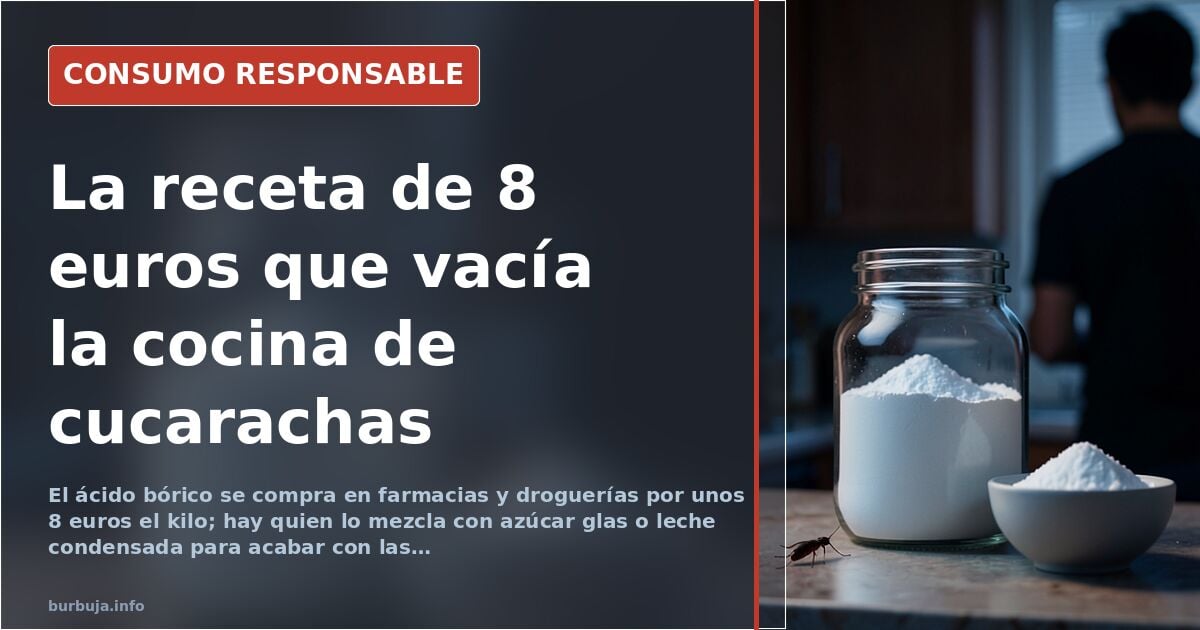
Boric acid, cats, and traps: the low-cost war against cockroaches
A cockroach infestation in a garage in Castellón (Spain) triggered the most efficient response available: that of people unwilling to pay for professional pest control. The initial diagnosis was clear: insects were "everywhere" during summer, and a domestic cat had exterminated all those in another house while playing. This anecdote is not trivial. In parts of Spanish residential areas, pest control has ceased to be a professional service and has become an exercise in home chemistry, domestic zoology, and militant frugality.
The substance dominating the conversation is not sold in big-box stores nor does it require a license. It is boric acid, a compound bought in pharmacies and old-fashioned drugstores for about €2.50 per 100 grams or €8 per kilo. It is mixed with powdered sugar, condensed milk, or bread to form a paste. The principle is always the same: the insect ingests it, its digestive system gets blocked, and it dies; others eat the remains, propagating the chain. The formula repeats with variations—one tablespoon per mixture, distributed in bottle caps or walnut shells—and consensus on its efficacy is broad.
The boric acid recipe: doses, mixtures, and warnings
The most repeated method combines boric acid and powdered sugar without adding liquid. The reason is practical: with condensed milk or water, the mixture forms a crust on the surface shortly after, causing cockroaches to lose interest. In powder form, however, it is easily sprinkled and remains active. Some prefer condensed milk due to family tradition, while others defend bread soaked in a thick soup of water, sugar, and a spoonful of acid. All variants work, according to testimonials, and all share the same warning: it is toxic if ingested, so it should be kept out of reach of pets and small children.
Handling, however, presents no specific risk beyond common sense. The compound is sold over-the-counter in pharmacies and chemical reagent shops. Its ridiculous price compared to the €26 cost of a syringe of gel containing fipronil—the active ingredient in commercial brands—explains much of its success. The other part is explained by its domino effect: since it is not an immediate contact poison, cockroaches return to the nest before dying and are devoured by their peers.
The cat as biological insecticide
The oldest solution is also the one requiring the least budget: a feline. Several cases coincide. In one dwelling, the female cat eliminated all cockroaches in the house through play; in another, insects appeared dead, legless, and upside down, indicating the animal hunted them at night. The conclusion drawn is that where there is a cat, the cockroach population collapses. It is not science, but repeated observation.
The problem is the opportunity cost. Adopting a cat implies assuming years of responsibility to solve a seasonal problem, and not everyone is willing to do so. Even so, the biological route has defenders who consider it superior to any trap: it generates no resistance, leaves no chemical residues, and acts 24 hours a day. The obvious downside is that the cat also hunts other things and does not distinguish between pests and domestic fauna.
Traps, gels, and sealing the garage door
When the infestation is already inside, the range of options expands. Gel baits with fipronil are applied in micro-drops along corners and appliances, working without needing to empty furniture. Poison sachets from neighborhood shops, costing €1 each, resolve complete infestations with two applications. To prevent entry, the cheapest solution is closing the one-centimeter gap under the sectional garage door with a weather strip or a plug-in repellent.
Some go further and resort to ZUM, a product promising a year without insects for €8, or to sodium carbonate sprinkled on the floor, a practice inherited from restaurant kitchens where industrial griddles were cleaned. The logic is always the same: spend the minimum for a problem that otherwise becomes a recurring bill.
The lingering question is not what works—almost everything works—but how long boric acid will remain on pharmacy shelves without someone deciding it should only be sold with a prescription. If that happens, the war against the cockroach will again cost what a pest control company charges. Until then, the kilo of white powder remains the best deal of the summer.
Also available in: Deutsch
Summary of a discussion on Burbuja.info - Foro de economía, actualidad y política., translated from Spanish and reviewed before publication. Read the full discussion (78 replies).
More summaries
-
How many litres of milk can you get from 1 kg of condensed milk?
A forum calculation says a 1 kg can yields 6.6 to 10 litres, but others warn it's not milk but added sugar.
-
Removing a bidet to fit a washing machine: costs and real risks
Removing the bidet and installing a washing machine in its place: about 2 hours of work and a 45 cm machine for around €300. The drain and socket are the problem.
-
Fungusol at 9 euros: the 1968 formula you can replicate
Fungusol costs 9 euros and contains boric acid and zinc oxide, a formula from 1968. Loose boric acid is available from 4 euros for 200 grams.
-
The Myth of the Seat 600: Why Old Cars Were Not More Durable
Survivorship bias distorts perceptions of car reliability. Modern vehicles actually outperform 1980s models in longevity and dependability.
-
eMule P2P Network Thrives in Spain via Kad and Built-in Search
Spanish users keep classic eMule alive using the decentralized Kad network, NAS devices, and built-in search despite CG-NAT restrictions.
-
Combating dust requires home design, not just cleaning
Dust is mostly textile fiber. HEPA filters and electrostatic mops help, but reducing clutter wins.