
500 applicants for one Madrid forklift job paying €12/hour
A Madrid forklift operator role draws 500 applicants and a cleaning job gets 800 for three spots, highlighting low wages of €12 per hour.
English · Original discussion in Spanish · Published
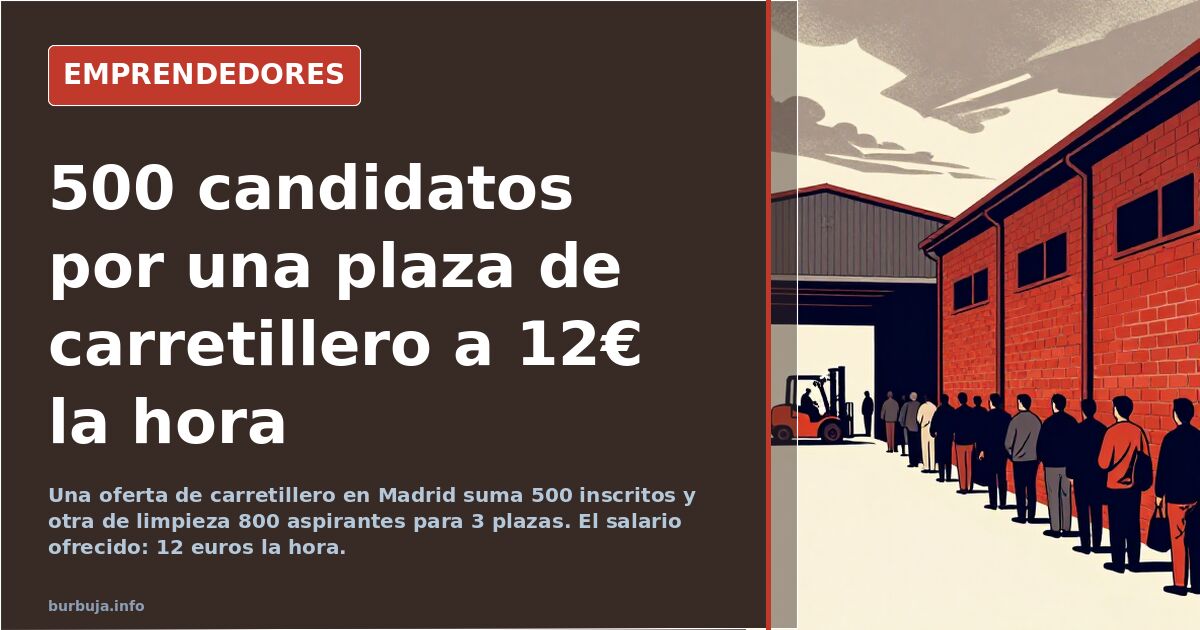
500 applicants for a forklift offer at €12 an hour
Who wants to work in Spain today? The answer is clear on any job portal. A forklift operator vacancy in Madrid, requiring a license and one year of experience, has attracted 500 candidates. Another cleaning technician role saw a flood of applicants for just three positions. It isn't that people refuse to work; it's that the labor market has turned physical effort into bargain-bin merchandise.
This scenario is lived by a job seeker looking for roles suited to their disability: regardless of the region they apply from, relevant offers are concentrated in Madrid. And they all demand the same things. The forklift role requires a license, preferably one year of experience, and acceptance of split shifts—a schedule nobody likes but everyone must tolerate. With 500 applicants competing, an average CV isn't enough to stand out.
Why do 500 people apply for a single forklift job?
Because the offer is poor, yet still among the best available. The most common diagnosis doesn't blame the candidate, but the price. Physical jobs are advertised at €12 an hour, and with that figure, many decide it's not worth getting up. The recurring equation: €800 without working competes well against €1,200 while breaking your back.
The analysis splits into two schools of thought. One accuses candidates of living off benefits and working only enough to fund vices. The other argues there aren't enough jobs for everyone, pointing to the three cleaning and gardening vacancies that gathered more than 800 applicants. When a company posts an offer and receives hundreds of CVs, the problem stops being motivation and becomes a bottleneck.
The bakery paying €1,200 where it once paid €1,500
The most detailed case in the narrative involves a professional from Cantabria. Since July, he has attended 12 interviews, including three this month at bakeries and a cheese factory. He accepts brush-cutting conditions, applies to 80% of offers, and eventually withdrew from a trial at Renault Valladolid: six months for €20,000 gross annually. The obstacle wasn't the salary, but housing. No landlord wanted to sign someone with a six-month contract.
Then comes the actual hiring. A bakery offering minimum wage for 40 hours yields a net income around €1,200 a month. Twenty years ago, in the same trade, he earned €1,500 prorated. The loss of purchasing power isn't a feeling; it's a subtraction. And the fine print of the schedule seals it—he had one day off after nine days of work, so he lasted four days before quitting.
Gardening, cleaning, IT: who earns what for the same effort
There is another layer of the problem that few notice. Hard jobs requiring no experience—gardeners, livestock workers, mechanics—are sought, and the figures are similar: high application numbers for low pay. Meanwhile, accounts from the tech sector highlight the contrast: €1,300 or less for a junior IT role, and around €2,000 gross with two years of experience.
That gap explains why physically exhausting sectors lack replacements. It is argued that when current workers retire, it will be hard to replace them if wages don't rise. The competition isn't between lazy and hardworking people: it's between a job that destroys the body for little money and any alternative that doesn't.
The 80% of offers nobody ever sees
Another piece of the puzzle is highlighted by a calculation circulating within the story itself: more than 80% of offers are never published. They move internally through referrals and contacts, leaving only unwanted roles for portals. Hence the sensation that ads remain open for months with hundreds of applicants, yet the company neither closes nor hires.
There is also a material interest in keeping offers alive: with each CV received, the company profiles talent and can adjust salaries downward. Plus, unrealistic requirements: optimal age, optimal experience, total availability. The filter discards anyone who doesn't fit the mold.
Ultimately, the underlying complaint isn't that some people don't want to work. It's that too little is offered for so much asked. The "lazy worker" narrative is convenient, but it doesn't square with 500 people signing up to operate a forklift for €12 an hour.
Who wants to work in Spain today? The answer is clear on any job portal. A forklift operator vacancy in Madrid, requiring a license and one year of experience, has attracted 500 candidates. Another cleaning technician role saw a flood of applicants for just three positions. It isn't that people refuse to work; it's that the labor market has turned physical effort into bargain-bin merchandise.
This scenario is lived by a job seeker looking for roles suited to their disability: regardless of the region they apply from, relevant offers are concentrated in Madrid. And they all demand the same things. The forklift role requires a license, preferably one year of experience, and acceptance of split shifts—a schedule nobody likes but everyone must tolerate. With 500 applicants competing, an average CV isn't enough to stand out.
Why do 500 people apply for a single forklift job?
Because the offer is poor, yet still among the best available. The most common diagnosis doesn't blame the candidate, but the price. Physical jobs are advertised at €12 an hour, and with that figure, many decide it's not worth getting up. The recurring equation: €800 without working competes well against €1,200 while breaking your back.
The analysis splits into two schools of thought. One accuses candidates of living off benefits and working only enough to fund vices. The other argues there aren't enough jobs for everyone, pointing to the three cleaning and gardening vacancies that gathered more than 800 applicants. When a company posts an offer and receives hundreds of CVs, the problem stops being motivation and becomes a bottleneck.
The bakery paying €1,200 where it once paid €1,500
The most detailed case in the narrative involves a professional from Cantabria. Since July, he has attended 12 interviews, including three this month at bakeries and a cheese factory. He accepts brush-cutting conditions, applies to 80% of offers, and eventually withdrew from a trial at Renault Valladolid: six months for €20,000 gross annually. The obstacle wasn't the salary, but housing. No landlord wanted to sign someone with a six-month contract.
Then comes the actual hiring. A bakery offering minimum wage for 40 hours yields a net income around €1,200 a month. Twenty years ago, in the same trade, he earned €1,500 prorated. The loss of purchasing power isn't a feeling; it's a subtraction. And the fine print of the schedule seals it—he had one day off after nine days of work, so he lasted four days before quitting.
Gardening, cleaning, IT: who earns what for the same effort
There is another layer of the problem that few notice. Hard jobs requiring no experience—gardeners, livestock workers, mechanics—are sought, and the figures are similar: high application numbers for low pay. Meanwhile, accounts from the tech sector highlight the contrast: €1,300 or less for a junior IT role, and around €2,000 gross with two years of experience.
That gap explains why physically exhausting sectors lack replacements. It is argued that when current workers retire, it will be hard to replace them if wages don't rise. The competition isn't between lazy and hardworking people: it's between a job that destroys the body for little money and any alternative that doesn't.
The 80% of offers nobody ever sees
Another piece of the puzzle is highlighted by a calculation circulating within the story itself: more than 80% of offers are never published. They move internally through referrals and contacts, leaving only unwanted roles for portals. Hence the sensation that ads remain open for months with hundreds of applicants, yet the company neither closes nor hires.
There is also a material interest in keeping offers alive: with each CV received, the company profiles talent and can adjust salaries downward. Plus, unrealistic requirements: optimal age, optimal experience, total availability. The filter discards anyone who doesn't fit the mold.
Ultimately, the underlying complaint isn't that some people don't want to work. It's that too little is offered for so much asked. The "lazy worker" narrative is convenient, but it doesn't square with 500 people signing up to operate a forklift for €12 an hour.
Summary of a discussion on Burbuja.info - Foro de economía, actualidad y política., translated from Spanish and reviewed before publication. Read the full discussion (204 replies).
More summaries
-
Mechatronics vocational training: high demand in northern Spain and €26,000 job offer
A supermarket maintenance job pays €26,000, but workers warn of bosses who ignore rules, travel and broken schedules.
-
SEPE (Spain's public employment service) courses: the route to a job that almost never arrives
Over €5,000 million spent on training for the unemployed, but real jobs come only from healthcare transport, welding and professional driving licences
-
Working with Galicians: Stereotypes vs. Labor Realities
Exploring the stereotypes of working with Galicians, from regional clichés to real cases of labor fraud, small landholdings, and generational clashes.
-
ADE or Law: Which Degree Doesn't Guarantee a Decent Salary
ADE vs Law: a double graduate claims only 0% to 10% of practicing lawyers live well
-
90% of New Coders Will Fail to Find Jobs
Forum users claim 90% of new programmers won't find work, blaming layoffs, outsourcing to India, and market saturation.
-
Mental Disability Fraud: The Silent Business
A forum thread exposes a method to simulate mental illness for disability benefits, revealing the human cost and system loopholes.