
Working with Galicians: Stereotypes vs. Labor Realities
Exploring the stereotypes of working with Galicians, from regional clichés to real cases of labor fraud, small landholdings, and generational clashes.
English · Original discussion in Spanish · Published
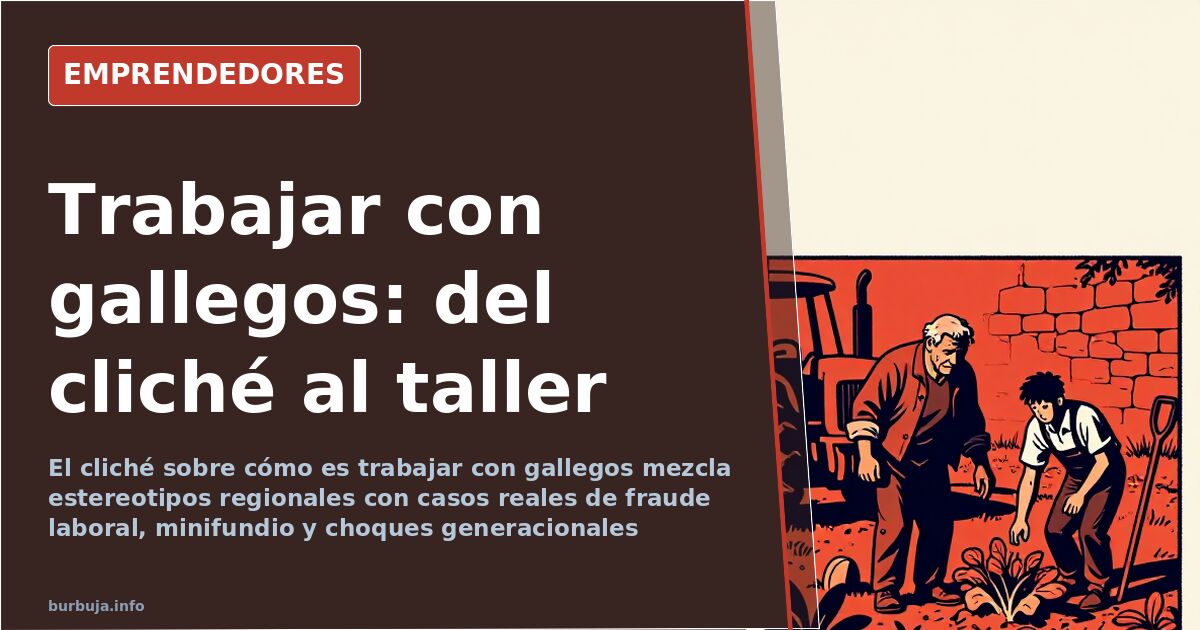
How it is to work with Galicians: stereotypes versus the fine print
There is a stereotype about how Galicians are at work that is repeated so often it barely sounds like prejudice anymore: reserved, distrustful, stingy, stubborn, submissive to the boss, and despotic to subordinates. The cliché is old. What's curious is who promotes it: some Galicians uphold it more harshly than any outsider. The spark was lit by the account of a logistics worker who left Galicia for Extremadura and described the average local businessman as "old, unsophisticated, stubborn." From there, everyone added their two cents, gathering over three hundred replies over almost three years.
From Sarria to Badajoz: the case that started it all
The starting point isn't a sociological study; it's a personal experience. A seasoned professional who worked for years in Barcelona and ended up in an Extremaduran company, with his job and home ten minutes away, summarized his time in Galicia with a phrase that is still quoted: the average local businessman seemed to him closer to a goat than a human being. The hyperbole serves its purpose. The rest is a string of testimonies with varying degrees of humor and very little statistical backing.
The same black legend applies to León, Asturias, or Murcia
There's an argument that dismisses half the stereotype with a single blow. It's argued that everything attributed to Galicians—provincialism, stubbornness, resistance to change—is perfectly attributable to any other region with a rural background: the Catalan farmers, the Aragonese mountain folk, the people of the Cantabrian mountains. The problem wouldn't be the region itself, but the universal hick. And, incidentally, it's pointed out that the animosity towards Galicians carries a dark legend that doesn't apply equally elsewhere.
Small landholdings, local bosses, and a home-grown sarracena
When you scratch beneath the stereotype, you find history, which is much more interesting than the joke. Galicia was never, some argue, a land of large estates but of ecclesiastical property and small landholdings: land was divided because there wasn't a system of primogeniture like in Castile. This would have created small, closed communities where authority was shared by the local boss (cacique) and the priest. A Galician self-criticism summarizes it bluntly: a home-grown sarracena is practiced, of haggling with the neighbor, which clashes with other ways of understanding relationships. Castelao, who was not exactly a conservative, wrote that Galicians are "prudent and sensible people." Depending on what.
The fine print: wages, negotiation, and broken young men
This is where the folklore ends. The case is cited, reported in the press, of a workshop where the owner asked the employee to return part of his salary in cash: "I'll deposit 1,500 in your payroll and you return 700 in cash. If you don't like it, you can leave." It also tells of a twenty-year-old kid, fresh out of Santiago, who was verbally abused by a colleague on his second day of work to the point of tears. And a striking self-criticism: the problem isn't so much working as negotiating, because it always seems like you can squeeze a little more, and the deal is never fully closed. The detailed calculation of how much is lost due to this habit is worth reading in full in its context.
Village versus city: the divide they do acknowledge
Not even the harshest critics lump everything together. The distinction that emerges time and again separates the village from the provincial capital. In Santiago, Lugo, or Vigo, there would be perfectly functional professionals; the clash occurs in rural areas, with older workers who prefer to start two hours earlier than learn to operate new machinery, with an unrenovated house and their salary saved in the bank. Resistance to change, more than anything else, appears as the real accusation.
When the labor issue spills into identity
No discussion about regions takes long to stray from the topic. Here, the usual peine: from undeclared wages, it jumped to language, nationalism, and the figure of Franco, who is described as Galician to the core. Lists of famous surnames also crept in to illustrate some unclear genetic thesis, which say more about the writer than the subjects. When the argument jumps from salary to blood, the only clear thing is that the point has been lost.
A surprising piece of data
Amidst so many surnames, a certain number unrelated to work also appears: Galicia registers the lowest ratio of Roma population in Spain, around fifteen thousand people for almost three million inhabitants. Nobody quite knows what this data point is doing here, beyond confirming that stereotypes are constructed by mixing whatever is at hand.
What if the problem is the Spanish narrative, not Galicia?
The other interpretation is more uncomfortable: that regional contempt is a national sport practiced in all directions. Those who laugh at the Galician local boss also laugh at the Aragonese, the Murcian, or the Catalan peasant. And that a region engages in self-flagellation more harshly than anyone else is a trait it shares with several others. Whoever looks at the picture from afar usually reaches the same conclusion: where economic geography, precariousness, and a State that arrived too late are concerned, what is attributed to blood is almost always the case.
With this material, it cannot be concluded that working in Galicia is different, nor that it is the same. The only sustainable point is that the labor relations of small landholdings are dying more slowly than in the rest of Spain, and that as long as the rural world continues to prioritize custom over change, the stereotype will have fuel. That it will disappear within a generation is the bet of many. They have been betting for decades.
There is a stereotype about how Galicians are at work that is repeated so often it barely sounds like prejudice anymore: reserved, distrustful, stingy, stubborn, submissive to the boss, and despotic to subordinates. The cliché is old. What's curious is who promotes it: some Galicians uphold it more harshly than any outsider. The spark was lit by the account of a logistics worker who left Galicia for Extremadura and described the average local businessman as "old, unsophisticated, stubborn." From there, everyone added their two cents, gathering over three hundred replies over almost three years.
From Sarria to Badajoz: the case that started it all
The starting point isn't a sociological study; it's a personal experience. A seasoned professional who worked for years in Barcelona and ended up in an Extremaduran company, with his job and home ten minutes away, summarized his time in Galicia with a phrase that is still quoted: the average local businessman seemed to him closer to a goat than a human being. The hyperbole serves its purpose. The rest is a string of testimonies with varying degrees of humor and very little statistical backing.
The same black legend applies to León, Asturias, or Murcia
There's an argument that dismisses half the stereotype with a single blow. It's argued that everything attributed to Galicians—provincialism, stubbornness, resistance to change—is perfectly attributable to any other region with a rural background: the Catalan farmers, the Aragonese mountain folk, the people of the Cantabrian mountains. The problem wouldn't be the region itself, but the universal hick. And, incidentally, it's pointed out that the animosity towards Galicians carries a dark legend that doesn't apply equally elsewhere.
Small landholdings, local bosses, and a home-grown sarracena
When you scratch beneath the stereotype, you find history, which is much more interesting than the joke. Galicia was never, some argue, a land of large estates but of ecclesiastical property and small landholdings: land was divided because there wasn't a system of primogeniture like in Castile. This would have created small, closed communities where authority was shared by the local boss (cacique) and the priest. A Galician self-criticism summarizes it bluntly: a home-grown sarracena is practiced, of haggling with the neighbor, which clashes with other ways of understanding relationships. Castelao, who was not exactly a conservative, wrote that Galicians are "prudent and sensible people." Depending on what.
The fine print: wages, negotiation, and broken young men
This is where the folklore ends. The case is cited, reported in the press, of a workshop where the owner asked the employee to return part of his salary in cash: "I'll deposit 1,500 in your payroll and you return 700 in cash. If you don't like it, you can leave." It also tells of a twenty-year-old kid, fresh out of Santiago, who was verbally abused by a colleague on his second day of work to the point of tears. And a striking self-criticism: the problem isn't so much working as negotiating, because it always seems like you can squeeze a little more, and the deal is never fully closed. The detailed calculation of how much is lost due to this habit is worth reading in full in its context.
Village versus city: the divide they do acknowledge
Not even the harshest critics lump everything together. The distinction that emerges time and again separates the village from the provincial capital. In Santiago, Lugo, or Vigo, there would be perfectly functional professionals; the clash occurs in rural areas, with older workers who prefer to start two hours earlier than learn to operate new machinery, with an unrenovated house and their salary saved in the bank. Resistance to change, more than anything else, appears as the real accusation.
When the labor issue spills into identity
No discussion about regions takes long to stray from the topic. Here, the usual peine: from undeclared wages, it jumped to language, nationalism, and the figure of Franco, who is described as Galician to the core. Lists of famous surnames also crept in to illustrate some unclear genetic thesis, which say more about the writer than the subjects. When the argument jumps from salary to blood, the only clear thing is that the point has been lost.
A surprising piece of data
Amidst so many surnames, a certain number unrelated to work also appears: Galicia registers the lowest ratio of Roma population in Spain, around fifteen thousand people for almost three million inhabitants. Nobody quite knows what this data point is doing here, beyond confirming that stereotypes are constructed by mixing whatever is at hand.
What if the problem is the Spanish narrative, not Galicia?
The other interpretation is more uncomfortable: that regional contempt is a national sport practiced in all directions. Those who laugh at the Galician local boss also laugh at the Aragonese, the Murcian, or the Catalan peasant. And that a region engages in self-flagellation more harshly than anyone else is a trait it shares with several others. Whoever looks at the picture from afar usually reaches the same conclusion: where economic geography, precariousness, and a State that arrived too late are concerned, what is attributed to blood is almost always the case.
With this material, it cannot be concluded that working in Galicia is different, nor that it is the same. The only sustainable point is that the labor relations of small landholdings are dying more slowly than in the rest of Spain, and that as long as the rural world continues to prioritize custom over change, the stereotype will have fuel. That it will disappear within a generation is the bet of many. They have been betting for decades.
Summary of a discussion on Burbuja.info - Foro de economía, actualidad y política., translated from Spanish and reviewed before publication. Read the full discussion (337 replies).
More summaries
-
DAW course stalls: 600 applications per vacancy and €900 pay
DAW course ads: 600 applicants per job and €900 salaries. Sector admits too many junior candidates and too little experience.
-
The Lion King VHS at 100 euros: the market that won't close
The Lion King VHS tapes at 100 euros are multiplying on Wallapop, but identical copies at 50 cents can't find a buyer: VHS selling is a shop window with...
-
Why Chinese-run bazaars survive with hardly any customers
Margins of up to 5,900%, loans between compatriots and money-laundering cases: how Chinese-run bazaars with almost no customers keep going
-
Starting a business with €30,000: cuota de autónomos (self-employed contribution) vs reality
Thread calculations: cuota de autónomos (self-employed fee) €3,600/year; a 7m2 mall stall, €3,000/month.
-
Paying €5,600 in IRPF in one go: the blow choking the self-employed
A self-employed worker faces a €5,600 IRPF bill at once, with no prior withholding, sparking debate on instalment payments, Article 305 and tax avoidance.
-
Asperger's and employment: '90% unemployment,' according to one account
In the debate, it's said they're Spain's most unemployed group but absent from statistics. A 90% figure and the HR filter as a wall are cited.