
SEPE (Spain's public employment service) courses: the route to a job that almost never arrives
Over €5,000 million spent on training for the unemployed, but real jobs come only from healthcare transport, welding and professional driving licences
English · Original discussion in Spanish · Published
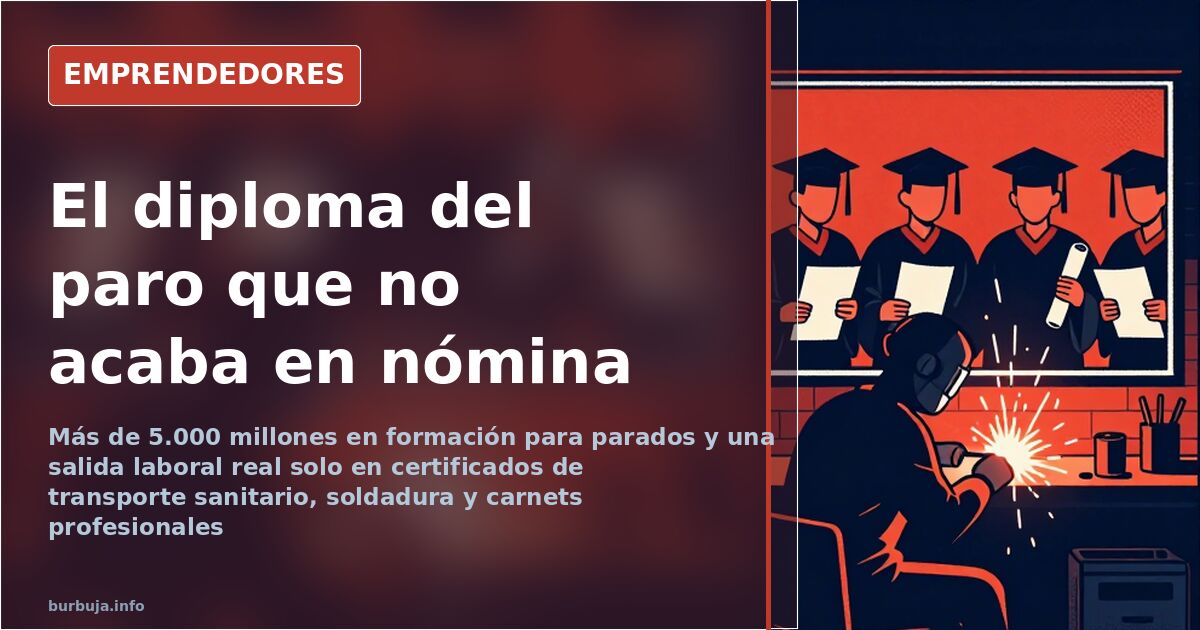
Unemployment courses: the diploma that almost never ends up on the payroll
Training courses for the unemployed do not get anyone hired. The line is repeated so often that it sounds like a cliché, and like every cliché it has its exception: a handful of certificados de profesionalidad (official Spanish vocational certificates) — healthcare transport, electric welding, gas installation and truck and bus licences — do open real doors. The rest act as a holding pen for the unemployed while the clock runs, and as a nice little business for those who organise them and those who teach them.
The question that opens the issue is always the same: someone sees the offer, finds it interesting, checks that it includes work placements and asks whether it leads anywhere. Four and a half years of answers later, the dominant conclusion is uncomfortable: the route into work exists, but almost never for the student.
How much public money flows through training for the unemployed
One estimate circulating among those who have trinc the sector puts the misappropriation in training at more than €5,000 million, calculated “very conservatively”. Impossible to verify with the available data, and offered with the caution of someone who suspects the real hole is bigger. What several testimonies do describe is the architecture: companies and foundations that teach, administrations that supervise on paper and unions that get a share through continuing training.
There are three pieces spinning without touching each other. The entity gets paid for delivering the course, the public body signs off programmes, teachers’ CVs and accreditations, and the unemployed person attends so as not to lose their benefit or, simply, to avoid being at home. It is argued that the result is perverse: the unemployed are kept stabled for as long as the training lasts and stop making trouble. A case peine in Seville is even mentioned which, according to that same account, never prospered. Without a court ruling, it remains what it is: a repeated suspicion.
Do SEPE courses lead to jobs? These are the ones that do
Yes, a few. The most cited is the certificado de profesionalidad in healthcare transport: in Aragón, the metal employers’ association and related bodies arrange the work placement centre and the student ends up moving elderly people back and forth between care homes and hospitals. With that paper, they say, there is work.
The second proper name is electric welding. A course run by the regional employment service in Calatayud, with months of daily work at the bench, is remembered as serious. In Murcia, the regional federation of metal employers teaches welding, automotive and boiler-making, runs its own job bank and trains people for what its members ask for. Those who work hard and are not withdrawn, they maintain, end up hired.
And then there are the professional licences. Truck, bus, trailer: anyone who gets all three saves €3,500 out of their own pocket and leaves with three qualifications. That is the part of public training that is defended without hesitation.
The certificado de profesionalidad counts; the private academy diploma does not
The line between what is useful and what is decorative is accreditation. “The only ones that are worth anything are those that give you real accreditations, not private academies certifying on their own,” summarises one of the most repeated messages. The certificado de profesionalidad and official licences carry weight in job offers; the rest is headed notepaper.
That is why the most common advice is to compare before signing up: a middle or higher vocational programme usually gives a better return on time than a three-month short course. A former student with an advanced vocational qualification in programming recalls being pushed, while unemployed and already studying engineering, into an “internet course” that gave him nothing. Another notes that for years those diplomas earned points in public selection processes; today, almost nothing.
Work placements are unpaid and the student has to find them
The brochure promises work placements. The small print says the person concerned must find them, that they are unpaid and that there is a deadline, around three years, to complete them. Several testimonies agree: the centre washes its hands and the student does the rounds on their own.
The sequence afterwards is not kind either. Once the course ends, the typical offer is an unpaid placement and, if you are lucky, a short-lived contract. Those who already had studies and experience find themselves treated as newcomers by people with less training than them. Some put it bluntly: these courses should be reserved for those with no qualifications at all, not for graduates retraining.
The business seen from the lectern: €1,800 a month
The economics of the classroom also come up. One trainer admitted earning €1,800 a month for teaching courses, with the added wear of dealing with attendees who are there under obligation. Another case describes an employee with no project who was put in charge of the course to justify his working day; when the class ended, he went back to his post.
Quality control, according to several accounts, is a joke. The inspector gives a day’s notice of his visit, and that day everyone turns up, the books are “handed out” and everything goes fine. A student in Andalusia experienced it first-hand: he never saw a manual, only a few photocopies, and during the inspection no one had seen a book anywhere. Add to that the trick of signing up relatives to make up the attendance list, and the picture is complete.
When the course did actually serve a purpose
Not everything is fraud. A former lampista (plumber/electrician) in Catalonia trained as a gas, heating and plumbing installer, electric welder and oxy-acetylene welder, and worked for years with what he learned. His own caveat is the one that matters: theory is useful; practice, without access to work, is worth nothing. The conclusion, he argues, depends entirely on the short course chosen.
The pattern repeats in the positive cases. Specific trades, teachers who know their stuff, real demand behind them. Producing hands, not certificates. One trainer summed it up the same way: certificates from the public employment service are today the only approved route to become a crane operator, boilermaker, alarm installer or baker, and in a few years one will be needed even to operate a dough mixer.
The forecast, with every possible caveat, is that the shakeout will not come from a reform but from the market itself: where there is a labour shortage, the diploma counts; where there are too many people, it counts for nothing. Meanwhile, the reasonable doubt remains the same as ever: how many of these courses are designed to place someone in a job and how many to justify a subsidy.
Training courses for the unemployed do not get anyone hired. The line is repeated so often that it sounds like a cliché, and like every cliché it has its exception: a handful of certificados de profesionalidad (official Spanish vocational certificates) — healthcare transport, electric welding, gas installation and truck and bus licences — do open real doors. The rest act as a holding pen for the unemployed while the clock runs, and as a nice little business for those who organise them and those who teach them.
The question that opens the issue is always the same: someone sees the offer, finds it interesting, checks that it includes work placements and asks whether it leads anywhere. Four and a half years of answers later, the dominant conclusion is uncomfortable: the route into work exists, but almost never for the student.
How much public money flows through training for the unemployed
One estimate circulating among those who have trinc the sector puts the misappropriation in training at more than €5,000 million, calculated “very conservatively”. Impossible to verify with the available data, and offered with the caution of someone who suspects the real hole is bigger. What several testimonies do describe is the architecture: companies and foundations that teach, administrations that supervise on paper and unions that get a share through continuing training.
There are three pieces spinning without touching each other. The entity gets paid for delivering the course, the public body signs off programmes, teachers’ CVs and accreditations, and the unemployed person attends so as not to lose their benefit or, simply, to avoid being at home. It is argued that the result is perverse: the unemployed are kept stabled for as long as the training lasts and stop making trouble. A case peine in Seville is even mentioned which, according to that same account, never prospered. Without a court ruling, it remains what it is: a repeated suspicion.
Do SEPE courses lead to jobs? These are the ones that do
Yes, a few. The most cited is the certificado de profesionalidad in healthcare transport: in Aragón, the metal employers’ association and related bodies arrange the work placement centre and the student ends up moving elderly people back and forth between care homes and hospitals. With that paper, they say, there is work.
The second proper name is electric welding. A course run by the regional employment service in Calatayud, with months of daily work at the bench, is remembered as serious. In Murcia, the regional federation of metal employers teaches welding, automotive and boiler-making, runs its own job bank and trains people for what its members ask for. Those who work hard and are not withdrawn, they maintain, end up hired.
And then there are the professional licences. Truck, bus, trailer: anyone who gets all three saves €3,500 out of their own pocket and leaves with three qualifications. That is the part of public training that is defended without hesitation.
The certificado de profesionalidad counts; the private academy diploma does not
The line between what is useful and what is decorative is accreditation. “The only ones that are worth anything are those that give you real accreditations, not private academies certifying on their own,” summarises one of the most repeated messages. The certificado de profesionalidad and official licences carry weight in job offers; the rest is headed notepaper.
That is why the most common advice is to compare before signing up: a middle or higher vocational programme usually gives a better return on time than a three-month short course. A former student with an advanced vocational qualification in programming recalls being pushed, while unemployed and already studying engineering, into an “internet course” that gave him nothing. Another notes that for years those diplomas earned points in public selection processes; today, almost nothing.
Work placements are unpaid and the student has to find them
The brochure promises work placements. The small print says the person concerned must find them, that they are unpaid and that there is a deadline, around three years, to complete them. Several testimonies agree: the centre washes its hands and the student does the rounds on their own.
The sequence afterwards is not kind either. Once the course ends, the typical offer is an unpaid placement and, if you are lucky, a short-lived contract. Those who already had studies and experience find themselves treated as newcomers by people with less training than them. Some put it bluntly: these courses should be reserved for those with no qualifications at all, not for graduates retraining.
The business seen from the lectern: €1,800 a month
The economics of the classroom also come up. One trainer admitted earning €1,800 a month for teaching courses, with the added wear of dealing with attendees who are there under obligation. Another case describes an employee with no project who was put in charge of the course to justify his working day; when the class ended, he went back to his post.
Quality control, according to several accounts, is a joke. The inspector gives a day’s notice of his visit, and that day everyone turns up, the books are “handed out” and everything goes fine. A student in Andalusia experienced it first-hand: he never saw a manual, only a few photocopies, and during the inspection no one had seen a book anywhere. Add to that the trick of signing up relatives to make up the attendance list, and the picture is complete.
When the course did actually serve a purpose
Not everything is fraud. A former lampista (plumber/electrician) in Catalonia trained as a gas, heating and plumbing installer, electric welder and oxy-acetylene welder, and worked for years with what he learned. His own caveat is the one that matters: theory is useful; practice, without access to work, is worth nothing. The conclusion, he argues, depends entirely on the short course chosen.
The pattern repeats in the positive cases. Specific trades, teachers who know their stuff, real demand behind them. Producing hands, not certificates. One trainer summed it up the same way: certificates from the public employment service are today the only approved route to become a crane operator, boilermaker, alarm installer or baker, and in a few years one will be needed even to operate a dough mixer.
The forecast, with every possible caveat, is that the shakeout will not come from a reform but from the market itself: where there is a labour shortage, the diploma counts; where there are too many people, it counts for nothing. Meanwhile, the reasonable doubt remains the same as ever: how many of these courses are designed to place someone in a job and how many to justify a subsidy.
Summary of a discussion on Burbuja.info - Foro de economía, actualidad y política., translated from Spanish and reviewed before publication. Read the full discussion (160 replies).
More summaries
-
From Royal Trade to 'Snake Oil' Courses in Spain
A forum user reviews advertised businesses, finding 75% of links dead. The landscape has shifted to online courses and dubious schemes.
-
Gotelé SEO: The Real Business is Selling Courses, Not Ranking
Spanish SEO professionals describe their trade as a pseudo-religion, with Google as god and courses as the only profitable business. Figures, cases, and more.
-
DAW course stalls: 600 applications per vacancy and €900 pay
DAW course ads: 600 applicants per job and €900 salaries. Sector admits too many junior candidates and too little experience.
-
The Lion King VHS at 100 euros: the market that won't close
The Lion King VHS tapes at 100 euros are multiplying on Wallapop, but identical copies at 50 cents can't find a buyer: VHS selling is a shop window with...
-
Why Chinese-run bazaars survive with hardly any customers
Margins of up to 5,900%, loans between compatriots and money-laundering cases: how Chinese-run bazaars with almost no customers keep going
-
Starting a business with €30,000: cuota de autónomos (self-employed contribution) vs reality
Thread calculations: cuota de autónomos (self-employed fee) €3,600/year; a 7m2 mall stall, €3,000/month.