
29-cent bread in Belarus against a 580-euro salary
A loaf costs almost one ruble in Belarus, about 29 euro cents, while the average salary is around 2,000 rubles, roughly 580 euros at the exchange rate used. The comparison leaves questions open.
English · Original discussion in Spanish · Published
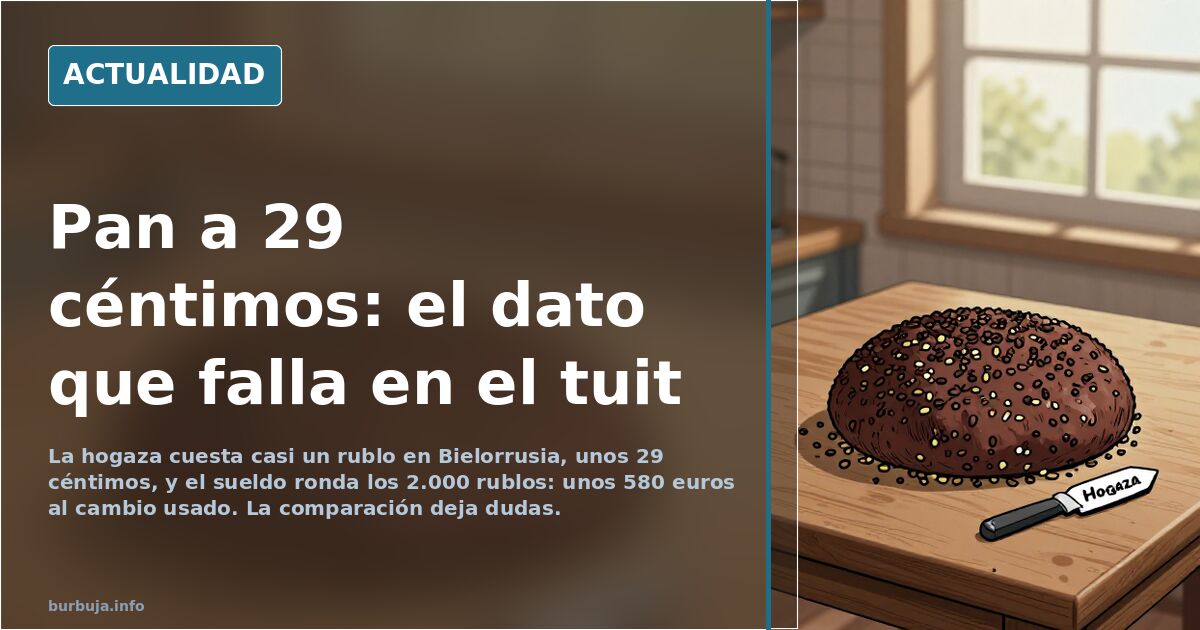
A 29-cent loaf and a 580-euro salary in Belarus
A dark, dense loaf with coriander seeds, resting on a table. And a receipt: almost one ruble, about 29 euro cents. The author of the photo, a Spaniard living in Belarus who signs as Albert Santin, put the question to his trinc: how much do you each pay for the most basic item in the basket? In Spain the comparison answered itself, and not very kindly: there are neighborhood rolls that cost the same.
How much does bread cost in Belarus according to the tweet?
According to the message circulating, the loaf comes to around one Belarusian ruble, about 29 cents at the exchange rate. Half a loaf went for 40 kopeks, which the author himself translates as 0.12 euro cents. And he adds the figure that puts everything in context: salaries there are around 2,000 rubles. The final question, posed as an open poll, is how much people pay for bread elsewhere.
The 2,000-ruble salary: 580 euros at the exchange rate used in the message itself
Applying the same exchange rate the message uses —about 29 cents per ruble— a 2,000-ruble paycheck comes to roughly 580 euros. With those two figures you can play around: the 29-cent loaf against such a paycheck is a minimal proportion, the kind that fit thousands of times into a month. However, bread does not fill the basket. It says nothing about rent, electricity or meat, and without that the comparison is lame.
From staple food to brochure: bread as an argument
A second message expands the product's profile: dense, dark and aromatic bread, typical of Eastern Europe, made with sourdough, whole rye flour, malt and coriander or caraway seeds. A nutritious staple that keeps long, it concludes. The description is accurate and adds not a single further piece of data on the price. It turns the shopping basket into a shop window, which is the usual mechanism: you pick the product where the number looks nice and show that one. Real baskets do not photograph so well.
The one-euro set menu: the comparison already made before
The conversation soon drifted toward an earlier episode. It recalled a Spaniard in Belarus —identified in the very conversation as the same author— who posted about having eaten a worker's set menu for about a euro: watery soup and jelly. That episode left the same impression as this one. A striking, isolated price says less than it seems. And opposite it, the local counterpunch: a bread roll in Spain can cost the same as the Belarusian loaf. How much you pay for bread, it turns out, has more than one uncomfortable answer.
The detail of the figure that does not add up
There remains the arithmetic. If the loaf is around one ruble and a ruble is 29 cents, the 40 kopeks of the half loaf equal 12 euro cents. The message calls them 0.12 cents. Written as is, that would be twelve thousandths of a euro, a unit that exists in no currency. It is a minimal slip, almost a typo, in a figure used precisely to boast about prices. The world's cheapest basket rests, for now, on a badly written figure.
Also available in: Deutsch
Summary of a discussion on Burbuja.info - Foro de economía, actualidad y política., translated from Spanish and reviewed before publication. Read the full discussion (18 replies).
More summaries
-
Coffee at 1,60 to 3,92 euros in Argentina and pensions of 350 a month
Coffee at 1,60 to 3,92 euros, pensions under 350 and cheap asado: the real price range in Milei's Argentina
-
John MH: Air-Cooled Porsche, Two Daughters, Living with Parents
John MH owns an air-cooled Porsche, has two daughters and lives with his parents: in 2000 that car cost 10,200 euros and today it starts at 60,000
-
Alzheimer's: the real cost of caring for your mother at home
A forum user describes his mother's early-stage Alzheimer's: 3,000-4,000€/month for a private care home, a five-year wait for a public place, and a son who…
-
Buying books as legal aid: the Ramón Valero case
A Spanish blogger facing lawsuits since 2016 asks for help by selling his books. He earns less than 8 euros per copy and won't explain the Expediente Royuela. Solidarity or...
-
Homophobia: reality or Orwellian doublespeak?
Leire Díaz's claim about the far right and homophobia clashes with those who deny it exists. Reality or doublespeak?
-
Foreign population in Europe 1990-2026: census figures questioned
A comparison of foreign population in Europe from 1990 to 2026 reopens the debate over the reliability of census data and the true scale of immigration in Spain.