
Coffee at 1,60 to 3,92 euros in Argentina and pensions of 350 a month
Coffee at 1,60 to 3,92 euros, pensions under 350 and cheap asado: the real price range in Milei's Argentina
English · Original discussion in Spanish · Published
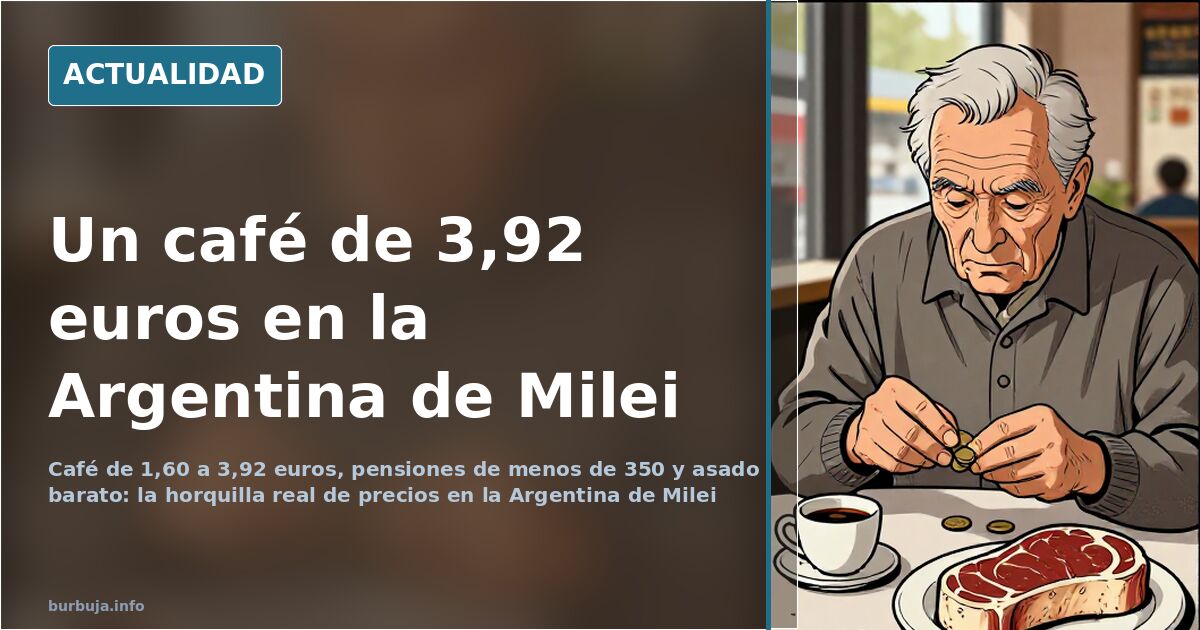
A coffee at up to 3,92 euros and a pension of 350
How much does it really cost to live in Milei's Argentina? The figures being tossed around —from a coffee at 1,60 euros to one at 3,92— don't fit any average, but they aren't inventions either. An article in El Mundo kicked things off; according to the comment a forum user reproduced, its author, Sebastián Fest, drinks coffee in the most expensive places in Buenos Aires, hence the image of a capital with European prices. The response came quickly from inside the country: according to that same account, coffee in the best café in an average-sized city costs around 2 euros. Wages, by contrast, are nowhere near Spanish levels.
Therein lies the crux. Argentina has entered a phase in which some prices measured in euros approach those of Paris or New York, while average income remains anchored far below Europe's. It isn't that everything is expensive or everything is cheap: it's that the country has split into two speeds depending on whether you're paid in pesos or look at the price tag with an exchange-rate calculator in hand.
The real coffee range: from 1,60 to 3,92 euros
The data used sketch a very wide range. In the central area of a city, a coffee with milk runs between 1,60 euros (2.000 pesos) and 3,15 euros (4.000 pesos), according to the account of a forum user who says he is relaying what he was told there. A photograph taken on 10 May in the north of the country showed a cup at 3,92 euros, the highest figure in the debate. The conclusion is uncomfortable for anyone seeking a single number: the price of coffee says more about the neighborhood than the country.
The same goes for the shopping basket. The cost of food is, according to the accounts gathered, slightly below Spanish levels, with gaps reaching 25% or 50% for some products.
How much people earn in Argentina versus what shopping costs
This is where the narrative breaks down. According to one participant, the average Argentine pension stays below 350 euros a month, a ridiculous figure compared with Spain's even at its lower end. According to the same forum user, a woman who cleans houses and cares for children ten to twelve hours a day brings in between 1 and 1,2 million pesos a month. Someone with a better job speaks of 1,5 to 2 million. An acquaintance who works at Ezeiza handling suitcases makes around 2,5 million. The minimum wage, again according to that account, stands at around 2 million pesos plus cold-zone supplements, and up from there.
The underlying problem, as another participant sums up, is that in Argentina there is no average salary that means anything. According to their description, university graduates with precarious jobs earning 500 euros coexist with people working for 200 or 100 euros a month and someone making several thousand euros from their own business. Statistics break down at the extremes, and that is why every conversation about prices ends up as a fight over what share of the population each case represents.
The shopping basket: from cheap asado to unaffordable electronics
Some examples illustrate that duality well. Two milanesas with fries, six empanadas and an alfajor for 12.000 pesos (less than 10 euros for two people) in Mendoza. Housing at a quarter of Spanish prices. Gasoline below one euro per liter. Asados, good wine and full restaurants. Against that, appliances, electronics, medicines and many processed foods are more expensive than in Europe, with chains such as Carrefour or Disco sitting high in the ranking depending on who is measuring; some consider Carrefour among the most expensive, while others argue the opposite.
Then there is the factor that distorts any comparison: the exchange rate. With the euro near 1.700 pesos and the dollar around 1.440, some warn that measuring everything in European currency is misleading, because the euro is extremely high, while others maintain that local prices are benchmarked to a dollar of at least 1.800. That is why tourists find bargains while residents paid in pesos see none at all.
The political balance: between light and shadow
More than a year and a half into the government, judgment remains divided. One side argues that the country is more orderly, with fewer roadblocks and calmer streets, and that the effort will be worth it. Another maintains that the reforms have been minimal, that Milei has asked the IMF for a loan and that prices never fall in Argentina. The most optimistic calculation assumes the adjustment will eventually take hold; the pessimistic scenario starts from the premise that 70 years of imbalances cannot be fixed in barely two years.
With these gaps between prices and wages, the conclusion any observer draws is that the country is not measured by a cup of coffee, but by who can afford one without looking at the price. And that, in Buenos Aires as in Madrid, still depends on where you live and how much you earn.
How much does it really cost to live in Milei's Argentina? The figures being tossed around —from a coffee at 1,60 euros to one at 3,92— don't fit any average, but they aren't inventions either. An article in El Mundo kicked things off; according to the comment a forum user reproduced, its author, Sebastián Fest, drinks coffee in the most expensive places in Buenos Aires, hence the image of a capital with European prices. The response came quickly from inside the country: according to that same account, coffee in the best café in an average-sized city costs around 2 euros. Wages, by contrast, are nowhere near Spanish levels.
Therein lies the crux. Argentina has entered a phase in which some prices measured in euros approach those of Paris or New York, while average income remains anchored far below Europe's. It isn't that everything is expensive or everything is cheap: it's that the country has split into two speeds depending on whether you're paid in pesos or look at the price tag with an exchange-rate calculator in hand.
The real coffee range: from 1,60 to 3,92 euros
The data used sketch a very wide range. In the central area of a city, a coffee with milk runs between 1,60 euros (2.000 pesos) and 3,15 euros (4.000 pesos), according to the account of a forum user who says he is relaying what he was told there. A photograph taken on 10 May in the north of the country showed a cup at 3,92 euros, the highest figure in the debate. The conclusion is uncomfortable for anyone seeking a single number: the price of coffee says more about the neighborhood than the country.
The same goes for the shopping basket. The cost of food is, according to the accounts gathered, slightly below Spanish levels, with gaps reaching 25% or 50% for some products.
How much people earn in Argentina versus what shopping costs
This is where the narrative breaks down. According to one participant, the average Argentine pension stays below 350 euros a month, a ridiculous figure compared with Spain's even at its lower end. According to the same forum user, a woman who cleans houses and cares for children ten to twelve hours a day brings in between 1 and 1,2 million pesos a month. Someone with a better job speaks of 1,5 to 2 million. An acquaintance who works at Ezeiza handling suitcases makes around 2,5 million. The minimum wage, again according to that account, stands at around 2 million pesos plus cold-zone supplements, and up from there.
The underlying problem, as another participant sums up, is that in Argentina there is no average salary that means anything. According to their description, university graduates with precarious jobs earning 500 euros coexist with people working for 200 or 100 euros a month and someone making several thousand euros from their own business. Statistics break down at the extremes, and that is why every conversation about prices ends up as a fight over what share of the population each case represents.
The shopping basket: from cheap asado to unaffordable electronics
Some examples illustrate that duality well. Two milanesas with fries, six empanadas and an alfajor for 12.000 pesos (less than 10 euros for two people) in Mendoza. Housing at a quarter of Spanish prices. Gasoline below one euro per liter. Asados, good wine and full restaurants. Against that, appliances, electronics, medicines and many processed foods are more expensive than in Europe, with chains such as Carrefour or Disco sitting high in the ranking depending on who is measuring; some consider Carrefour among the most expensive, while others argue the opposite.
Then there is the factor that distorts any comparison: the exchange rate. With the euro near 1.700 pesos and the dollar around 1.440, some warn that measuring everything in European currency is misleading, because the euro is extremely high, while others maintain that local prices are benchmarked to a dollar of at least 1.800. That is why tourists find bargains while residents paid in pesos see none at all.
The political balance: between light and shadow
More than a year and a half into the government, judgment remains divided. One side argues that the country is more orderly, with fewer roadblocks and calmer streets, and that the effort will be worth it. Another maintains that the reforms have been minimal, that Milei has asked the IMF for a loan and that prices never fall in Argentina. The most optimistic calculation assumes the adjustment will eventually take hold; the pessimistic scenario starts from the premise that 70 years of imbalances cannot be fixed in barely two years.
With these gaps between prices and wages, the conclusion any observer draws is that the country is not measured by a cup of coffee, but by who can afford one without looking at the price. And that, in Buenos Aires as in Madrid, still depends on where you live and how much you earn.
Summary of a discussion on Burbuja.info - Foro de economía, actualidad y política., translated from Spanish and reviewed before publication. Read the full discussion (214 replies).
More summaries
-
Argentine Steakhouse Dinner for Two Totals €79.20, with Ribeye Priced at €56.25/kg
A dinner for two at an Argentine steakhouse costs €79.20. The breakdown shows ribeye at €56.25/kg compared to €10-14/kg retail price.
-
Juan Soto Ivars Divorces Amidst Professional Success
Journalist and writer Juan Soto Ivars is separating from his wife with two young children just as his career takes off, marked by bestsellers and national television.
-
Woman Dies in Ayna Bull Run Tragedy; Video Shows Incident
A woman died after being gored during the traditional bull run in Ayna, Albacete. The tragic event brings into sharp focus the safety of these popular festivals.
-
Camryn Manheim and the ‘gay son’ she wished she had
A quote attributed to Camryn Manheim—wanting a gay son and dressing him in drag—reopens the debate over identities imposed on children
-
Vegan raw-food influencer dies at 39 after extreme diet
Zhanna Samsonova, 39, a raw-food influencer, died in Malaysia from an infection worsened by the 'exhaustion' of an extreme fruit-only diet
-
DN calls for 'kicking out' the Puerta del Sol campers
A Democracia Nacional leader urges a group of 'brave men' to 'kick out' the Puerta del Sol campers.