
26-year-old admits he skips dishes because it doesn't feel natural
A Spanish man living with his mother refuses to wash dishes, sparking debate on delayed maturity and domestic initiative.
English · Original discussion in Spanish · Published
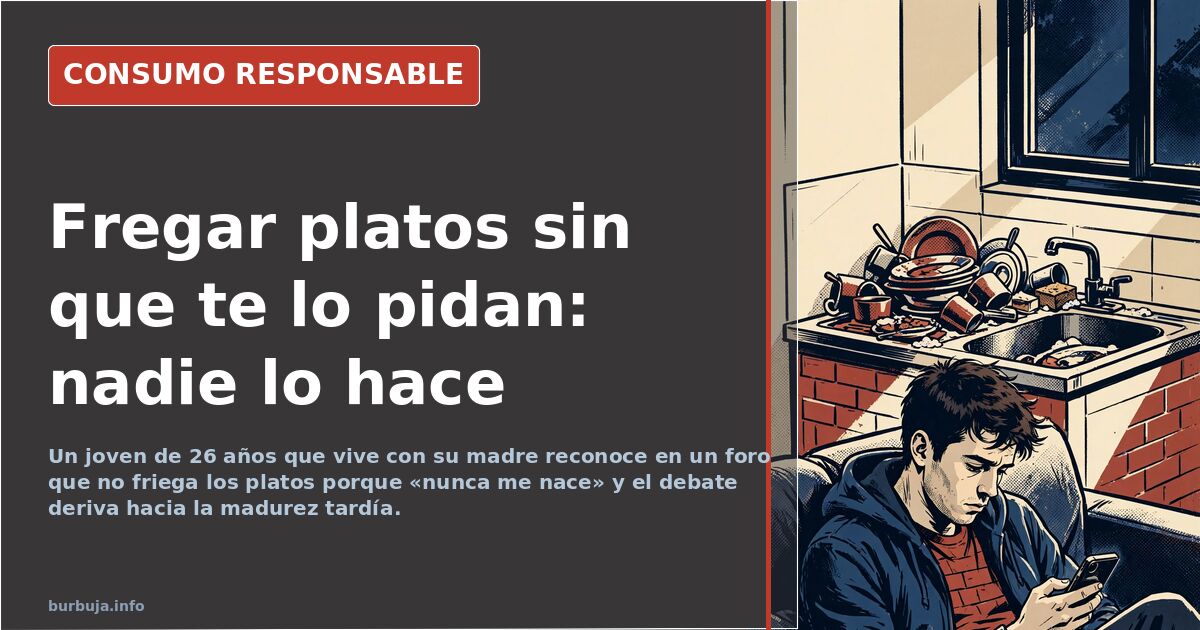
Washing up without being asked: the test half of children fail
There is a domestic test that no 26-year-old passes on the first attempt: washing the dishes without being told to do so. Not to save water or out of love for the sponge. Because, according to the protagonist himself, "it never feels right." The phrase, repeated like a mantra throughout the thread, summarizes a phenomenon that goes beyond the kitchen: domestic initiative as a scarce resource. The author of the post is 26, studies, has never worked, and lives at his mother's house, contributing money from his savings when possible. When he can't, he contributes just enough: presence.
The diagnosis made by the family itself is devastating. His mother doesn't ask him to wash up: she asks him to think of it. That is, to internalize an unwritten rule that he admits he hasn't internalized. "I'm more about impulses and intuition," he admits, before yielding to the evidence: "deep down, I don't want to." The discussion then shifts to more uncomfortable ground, that of maturity, where several participants argue that at 26, waiting for the house to fall apart before lending a hand isn't laziness, it's immaturity.
Why doesn't helping at home come naturally?
The question that opens the issue is also the one that closes it without an answer. No one is born knowing how to wash up, but no one is born wanting to either. The dominant thesis is that domestic tasks generate no intrinsic motivation: you do them because you have to, not because you feel like it. And those who haven't internalized this obligation wait for someone to state it aloud.
Here appears the first uncomfortable argument: if you live for free, the minimum is to collaborate. The calculation is simple. Food, electricity, water, roof, laundry. All that has a cost that someone assumes. Contributing money from savings when possible is fine, but it doesn't replace daily domestic work, which isn't paid with occasional transfers.
The second current is more psychological. Some argue that the problem isn't laziness but lack of habit, and that habit is only acquired when necessity presses. Those who moved out alone at 22 know this: the first months are crap, but you learn. Those still at home at 26 haven't had that shock.
Military service as a school for chores
Among nostalgic arguments, one deserves its own paragraph: military service as mandatory training in tasks the family hadn't managed to instill. There was a time, they recall, when young men learned to scrub floors, peel potatoes, and clean bathrooms by decree. Not out of vocation. Out of obligation.
The data point is not minor. It suggests that domestic initiative isn't a character trait but a consequence of structure. Where there is obligation, there is learning. Where there is comfort, there is procrastination. And the generation now aged 26 grew up on the comfortable side of the scale.
The irony is that many of those who today demand initiative from young people learned it by force. Not through virtue, but through barracks life.
The day the mother gets tired of asking
The scenario hovering over the entire discussion is that of the mother who one day stops insisting. Not out of surrender, but exhaustion. And there the problem ceases to be domestic and becomes structural: what happens when the safety net disappears?
The answer given by the protagonist himself is honest: "the first few months will be shit, but then I'll get used to it." Meaning, he knows he will learn. Only that he will learn when there is no alternative. Which confirms the central thesis: it's not incapacity, it's lack of urgency.
Some add a generational nuance. The mother who cooks, washes, and irons for her 26-year-old son isn't just providing a service: she is financing his immaturity. Every dish she washes is a dish he doesn't learn to wash. Every ironed shirt is a skill not acquired.
The countertop test: how to pass without being asked
If the problem is lack of initiative, the proposed solution is mechanical: wash the dishes and, while at it, the countertop and marble. Not out of generosity, but strategy. A month guaranteed without arguments. The tactic is as cynical as it is effective: anticipate the request to defuse conflict.
But there is a problem. If you do it so you aren't asked, you still haven't internalized the norm. You've only changed the calculation. Instead of avoiding the work, you avoid the argument. The visible result is the same; the mental process is opposite.
The lingering question is whether that matters. If the goal is for the house to function, why you wash up doesn't matter. If the goal is for the child to mature, it matters absolutely. And there the issue stalls, because no one has defined which of the two goals is priority.
The case ends where it began: with a 26-year-old admitting he is immature, that he helps when he sees his mother really struggling, and that he probably needs to move out alone to learn what he hasn't learned at home. There is no conclusion. Just a phrase that sums it all up: "when I see her REALLY STRUGGLING, I help." The problem is that the mother has been not struggling enough for years for her son to react. And that, in domestic terms, is bad news for both.
Also available in: Deutsch
Summary of a discussion on Burbuja.info - Foro de economía, actualidad y política., translated from Spanish and reviewed before publication. Read the full discussion (108 replies).
More summaries
-
Gambling addiction in Spain: €400 monthly loss and broken families
A user describes a friend losing €400 monthly to mobile betting, sparking debate on Spanish gambling ads and addiction.
-
Spain’s Winter Menu: Cocido, Stews, and Potatoes
Cocido, legumes, potatoes, and soups dominate Spain’s winter comfort food. Cantabrian stews lead the debate among hot dishes.
-
DIY Concrete Countertop: €120 Cost and Sink Cracks
Homemade concrete countertop for €120: cracks from lack of sand, bubbles, and a €15 sealer that worked.
-
Carlos and Fernando Paz: Where to Listen to the Brothers
Carlos and Fernando Paz share a voice but no single show. Find their podcasts on YouTube, iVoox, and radio stations.
-
Frozen Bread Sold as Artisan Sparks Customer Outrage in Spain
Customers claim only 20% of Spanish bakeries serve fresh bread, while the rest sell frozen goods at artisan prices.
-
Affordable 125cc scooters for hills: used and discreet
Used 125cc scooter, lightweight and unbranded: the recipe to climb hills without breaking the bank or losing your bike on the street.