
Gambling addiction in Spain: €400 monthly loss and broken families
A user describes a friend losing €400 monthly to mobile betting, sparking debate on Spanish gambling ads and addiction.
English · Original discussion in Spanish · Published
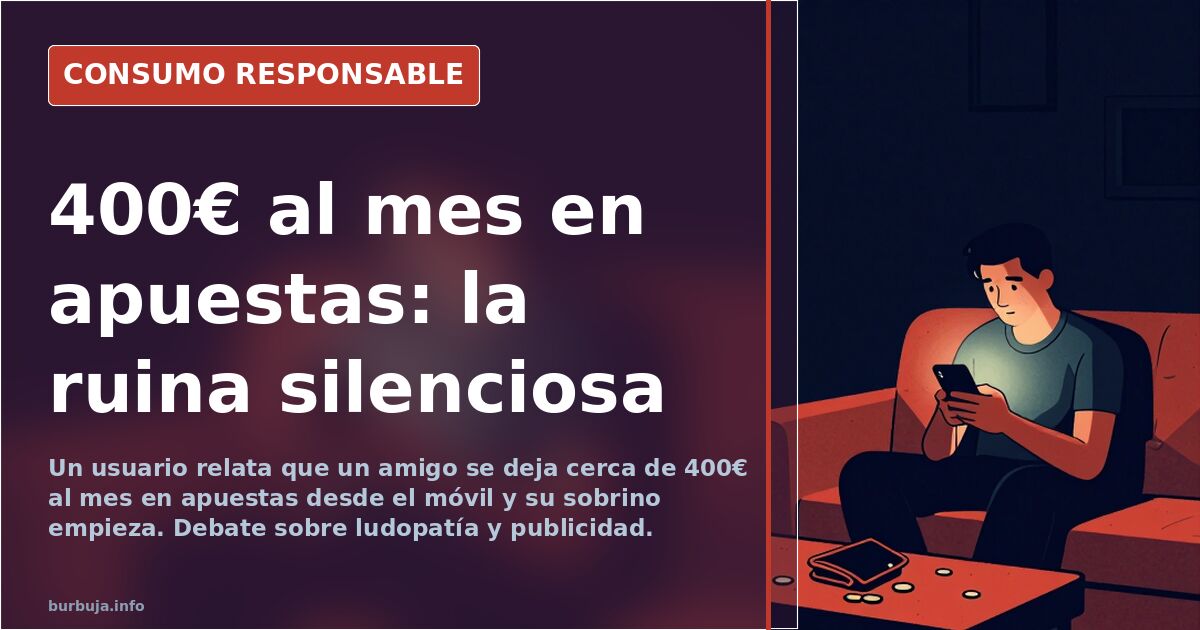
The cruelty of betting shops: when addiction ruins a family
A forum user reports that a friend loses around €400 a month via mobile apps and that his young nephew is already starting. This kicks off a topic currently discussed with unusual harshness: gambling addiction is not a vice of the rich or a distant problem, but a domestic drain entering through phone screens and local gaming halls. In the thread, some mention €2,700 a month and entire pensions vanishing in an afternoon at slot machines, although these are unverified claims.
The conversation quickly shifted to the role of the State. While some demand banning betting shop ads as was done with tobacco, others argue the issue is one of education and individual willpower. Far from being resolved, the discussion left a map of damages on the table worth reading calmly.
What the law says and what slips through the cracks
According to the recurring narrative in the conversation, the Spanish legal framework arrives late and poorly. It is mentioned that Belgium has already banned loot boxes—video game reward boxes—and that a major industry company tried unsuccessfully to stop the measure. In Spain, however, the debate remains stuck on whether to ban ads or limit alcohol and food sales in betting venues to reduce their appeal. Some recall that a former minister pushed for restrictions on gaming halls and that, given the data, those limits should have come earlier and been stricter.
Advertising is the other open front. Several messages agree that gambling cannot be promoted like alcohol or tobacco, directly pointing to celebrities who lend their faces to online betting sites. The criticism is not against the player, but against those who turn addiction into a showcase business.
Victims' stories: lies, thefts, and broken families
The thread becomes uncomfortable when direct testimonies appear. One person says their mother is a gambling addict and that, at 80, she would do anything to go play. Another recounts that while their father was in the ICU, their mother remained at the bar in front of the machine. Patterns repeat: lies, thefts at home, unpaid bills, and a family unraveling while the addict thinks only of the next round.
Against this, the most repeated response is individual responsibility. Does anyone put a gun to your head to make you bet?, asks one message. The argument that addicts cannot control impulses clashes with the idea that prohibition is paternalism. Amidst the clash, a user insists that gambling addicts cannot control their impulses, just as an alcoholic cannot drink only on weekends.
Comparison with alcohol and tobacco
The most recurrent analogy is alcohol. If bars exist and no one proposes closing them, why close betting shops? The answer given in the thread is that alcohol does not ruin a family in an afternoon, whereas gambling does. It is noted that an alcoholic might spend €30 a day on cheap brands and there are cases of businessmen who drank their companies away, but the scale of gambling is different: an entire pension can disappear in a slot machine session.
Tobacco appears as an example of successful regulation: advertising was banned, taxes were raised, and consumption fell. The lingering question is why the same criteria are not applied to gambling. The official answer, as interpreted in the conversation, is that the state mafia takes its cut and has no interest in killing the golden goose.
Video games and loot boxes: Trojan horse for minors
The debate expands to territory many parents are unaware of: video game reward boxes. A message describes it precisely: chests costing between €5 and €20 containing colored weapons, character clothes, or FIFA players. Practically, it is a disguised bet aimed at minors. The law lags behind reality, and Belgium has already banned it.
The reflection launched is uncomfortable: Where do we draw the line? Before, it was €1 sticker packs; now, digital micropayments. The difference is that stickers went in an album, while loot boxes activate the same random reward circuit as a slot machine. The parallelism is not coincidental.
Freedom and its limits: the unresolved debate
The discussion drifts into philosophical terrain. Some defend that in a free-market democracy, betting cannot be banned, but advertising can be regulated and alcohol/food sales limited in venues. Others claim that prohibition is cowardly and the problem is educational, not legislative. The US Prohibition era appears as a warning: banning creates mafias and black markets.
The deadlock is real. Those who have had an addict at home demand the closure of all gaming halls. Those who haven't speak of individual freedom and responsibility. In between, a generation of teenagers starts betting on mobile phones without anyone explaining what odds are, what a bookmaker is, or what it means to lose €400 they don't have.
The analysis gets stuck exactly there: how to protect those who cannot protect themselves without imprisoning those who can. No one has found the formula.
A forum user reports that a friend loses around €400 a month via mobile apps and that his young nephew is already starting. This kicks off a topic currently discussed with unusual harshness: gambling addiction is not a vice of the rich or a distant problem, but a domestic drain entering through phone screens and local gaming halls. In the thread, some mention €2,700 a month and entire pensions vanishing in an afternoon at slot machines, although these are unverified claims.
The conversation quickly shifted to the role of the State. While some demand banning betting shop ads as was done with tobacco, others argue the issue is one of education and individual willpower. Far from being resolved, the discussion left a map of damages on the table worth reading calmly.
What the law says and what slips through the cracks
According to the recurring narrative in the conversation, the Spanish legal framework arrives late and poorly. It is mentioned that Belgium has already banned loot boxes—video game reward boxes—and that a major industry company tried unsuccessfully to stop the measure. In Spain, however, the debate remains stuck on whether to ban ads or limit alcohol and food sales in betting venues to reduce their appeal. Some recall that a former minister pushed for restrictions on gaming halls and that, given the data, those limits should have come earlier and been stricter.
Advertising is the other open front. Several messages agree that gambling cannot be promoted like alcohol or tobacco, directly pointing to celebrities who lend their faces to online betting sites. The criticism is not against the player, but against those who turn addiction into a showcase business.
Victims' stories: lies, thefts, and broken families
The thread becomes uncomfortable when direct testimonies appear. One person says their mother is a gambling addict and that, at 80, she would do anything to go play. Another recounts that while their father was in the ICU, their mother remained at the bar in front of the machine. Patterns repeat: lies, thefts at home, unpaid bills, and a family unraveling while the addict thinks only of the next round.
Against this, the most repeated response is individual responsibility. Does anyone put a gun to your head to make you bet?, asks one message. The argument that addicts cannot control impulses clashes with the idea that prohibition is paternalism. Amidst the clash, a user insists that gambling addicts cannot control their impulses, just as an alcoholic cannot drink only on weekends.
Comparison with alcohol and tobacco
The most recurrent analogy is alcohol. If bars exist and no one proposes closing them, why close betting shops? The answer given in the thread is that alcohol does not ruin a family in an afternoon, whereas gambling does. It is noted that an alcoholic might spend €30 a day on cheap brands and there are cases of businessmen who drank their companies away, but the scale of gambling is different: an entire pension can disappear in a slot machine session.
Tobacco appears as an example of successful regulation: advertising was banned, taxes were raised, and consumption fell. The lingering question is why the same criteria are not applied to gambling. The official answer, as interpreted in the conversation, is that the state mafia takes its cut and has no interest in killing the golden goose.
Video games and loot boxes: Trojan horse for minors
The debate expands to territory many parents are unaware of: video game reward boxes. A message describes it precisely: chests costing between €5 and €20 containing colored weapons, character clothes, or FIFA players. Practically, it is a disguised bet aimed at minors. The law lags behind reality, and Belgium has already banned it.
The reflection launched is uncomfortable: Where do we draw the line? Before, it was €1 sticker packs; now, digital micropayments. The difference is that stickers went in an album, while loot boxes activate the same random reward circuit as a slot machine. The parallelism is not coincidental.
Freedom and its limits: the unresolved debate
The discussion drifts into philosophical terrain. Some defend that in a free-market democracy, betting cannot be banned, but advertising can be regulated and alcohol/food sales limited in venues. Others claim that prohibition is cowardly and the problem is educational, not legislative. The US Prohibition era appears as a warning: banning creates mafias and black markets.
The deadlock is real. Those who have had an addict at home demand the closure of all gaming halls. Those who haven't speak of individual freedom and responsibility. In between, a generation of teenagers starts betting on mobile phones without anyone explaining what odds are, what a bookmaker is, or what it means to lose €400 they don't have.
The analysis gets stuck exactly there: how to protect those who cannot protect themselves without imprisoning those who can. No one has found the formula.
Also available in: Deutsch
Summary of a discussion on Burbuja.info - Foro de economía, actualidad y política., translated from Spanish and reviewed before publication. Read the full discussion (113 replies).
More summaries
-
Gothic 2, Morrowind, Deus Ex: Enduring RPGs
Why Gothic 2, Morrowind and Deus Ex remain playable classics, while Skyrim's design choices continue to divide the open-world RPG community.
-
Cola Cao 1986 vs 2026: less product, more sugar, same real price
Cola Cao 1986 vs 2026: smaller size, sugar up to 70%, and price adjusted for inflation. Is it still the same product? Data analysis.
-
Risks of Driving an Old Car Daily
We analyze the real risks and costs of using a vintage car daily: safety, fuel consumption, breakdowns, and the best manufacturing era.
-
Pasta Wars: How Supermarket Choices Define Quality
Shape, brand, bronze-drawn texture and protein content: what really matters when choosing pasta. A guide to avoid mistakes at the supermarket.
-
Barefoot Shoes: Passing Trend or Real Solution?
Real testimonials claim barefoot shoes eliminate chronic pain. Is it science or fashion? We analyze the debate's data.
-
Endesa cuts power for six weeks over unproven fraud claim
A customer endured nearly six weeks without electricity and faced a €1,800 charge for alleged electrical fraud that was never proven.