
DIY Concrete Countertop: €120 Cost and Sink Cracks
Homemade concrete countertop for €120: cracks from lack of sand, bubbles, and a €15 sealer that worked.
English · Original discussion in Spanish · Published
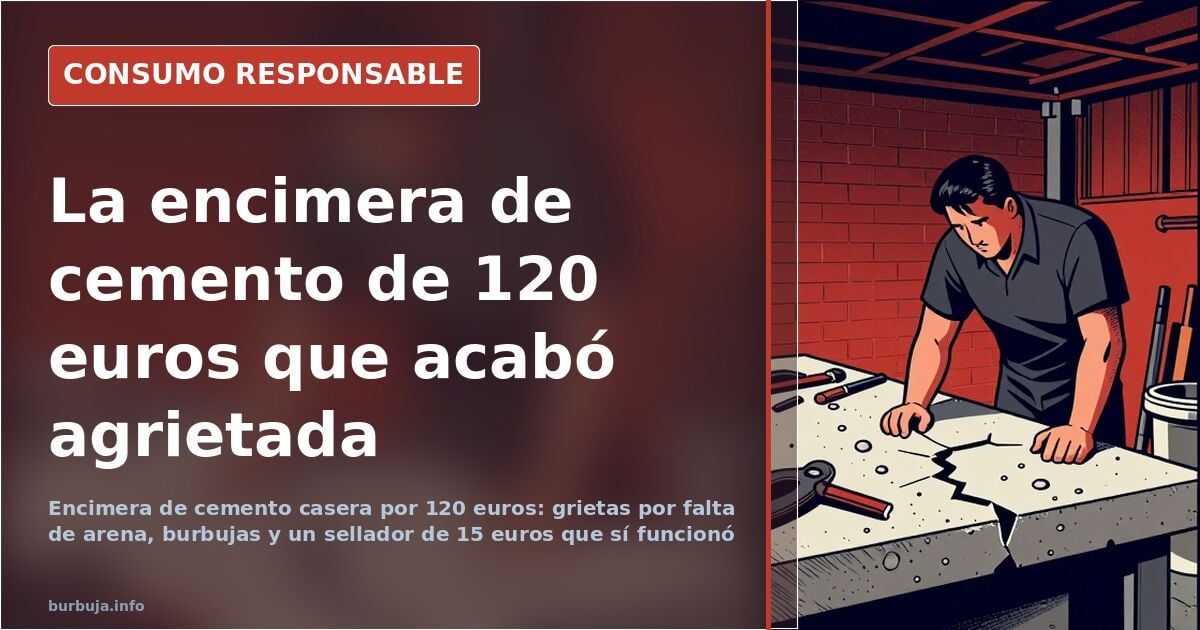
Concrete Countertop: €120, One Sustancia ilegal, and a €15 Sealer
The piece had been sitting in the mold since Friday. When demolded, one corner was chipped, the surface showed bubbles along the edges, and near the sink cutout—where there was little space to the rim—a sustancia ilegal appeared that no one wanted. Four centimeters thick, 140 by 110 centimeters in an L-shape, and about €120 in materials later, the experiment of making a homemade concrete countertop survived, but with scars. The author pointed out the cause: too much marble dust, too little cement, too little water, and mesh too fine for the load it bore.
Can You Make Concrete Without Sand?
The first question was direct. Is white cement and light mesh enough, without sand, to keep the slab from breaking? The consensus answer was no. Without sand, concrete cracks, and pre-mixed bags already include sand in their fixed grain size. Anyone mixing their own must use washed river sand and sieve it to adjust the grain, which is labor-intensive. The suggestion to test this at home—a concrete cake cured without sand—summarizes the prevailing view.
The 1-1-8 Mix That Didn't Fully Cure
The first pour trinc the 1-1-8 ratio—one part cement, one part lime, eight parts aggregate—with two types of marble dust and two of marble gravel, plus polypropylene fiber bought for €1. All mixed by hand with very little water, four buckets, and steel mesh in between. The idea was to avoid bubbles and not burn out the drill mixer.
Four days later, it was still damp to the touch. The author suspected his mix: little water makes bubbles hard to remove during vibration, the fine mesh worked worse than rebar, and there was excess fine aggregate. The solution was drastic: cut the piece and make the sink separately.
Second Attempt: 6 mm Rebar Mesh and 1-1-4 Ratio
Reinforcement arrived. This time with 6 mm corrugated rebar mesh and a 1-1-4 mix, meaning one part cement, one part lime, and four parts marble aggregate. More cement, real reinforcement, and less chance of the slab bending under its own weight. The lesson, in one sentence: rigidity doesn't come from just any mesh, but from well-placed steel.
Fibers, Additives, and Missing Reinforcement
In parallel, the technical catalog appeared. Fibers—polypropylene, glass, nylon, acrylic, carbon, Kevlar, even steel staples—increase energy absorption and tensile strength, with residual strengths above the minimums of the Structural Concrete Instruction EHE-08 (Spain's building code). They reduce micro-cracking from shrinkage during curing and lower permeability. For shrinkage, there are specific cements with no volume change and water-reducing additives that allow drier mixes without losing workability.
How Much Does It Cost and What Are the Alternatives?
Here money enters. A complete 28 mm by 366 cm countertop starts at €100; if you want good quality—38 mm and thicker, moisture-resistant laminate—from €150. The concrete one cost €120, L-shaped and seamless. One sector defends the industrial solution: it doesn't resist as much, you can't cut on it, and installation is a hassle. The other side replies that particleboard would need a joint in an L-shape and that, even so, the homemade version is cheaper.
In natural stone, the common option is granite, with Porriño granite as the price reference; marble is ruled out due to staining. And a side warning: some compact quartz brands are said to be mostly marketing, and if you want decent board, second-hand is better.
The Finish No One Calculates: Sanding, Sealing, and Starting Over
It's a work surface. It needs water in the final stage, entry through a door that sometimes doesn't fit, and forty-something kilos of weight on profiles. Polishing, smoothing, and varnishing are in the budget. The curved edge wet-sanded was the hardest part.
The first polyurethane varnish peeled off. Time to scrape, stain, and protect again. The discovery came after: a €15 waterproofing agent, more liquid, peine concrete better, holds up, and allows tinting to any tonalidad.
Is It Safe for Food Contact?
This doubt remained open. A surface intended for handling food requires scrutinizing the products used, because food can pick up residues from the material or sealer. It's a food-contact issue: use sealers approved for this purpose and consult a professional before accepting any finish.
The final tally doesn't close on savings either: €120 in materials doesn't include hours of hand-mixing or the lost first attempt. Compared to €100 for a laminated top, the artisanal piece stands less on saving money than on the pride of having a countertop that exists in no catalog.
The piece had been sitting in the mold since Friday. When demolded, one corner was chipped, the surface showed bubbles along the edges, and near the sink cutout—where there was little space to the rim—a sustancia ilegal appeared that no one wanted. Four centimeters thick, 140 by 110 centimeters in an L-shape, and about €120 in materials later, the experiment of making a homemade concrete countertop survived, but with scars. The author pointed out the cause: too much marble dust, too little cement, too little water, and mesh too fine for the load it bore.
Can You Make Concrete Without Sand?
The first question was direct. Is white cement and light mesh enough, without sand, to keep the slab from breaking? The consensus answer was no. Without sand, concrete cracks, and pre-mixed bags already include sand in their fixed grain size. Anyone mixing their own must use washed river sand and sieve it to adjust the grain, which is labor-intensive. The suggestion to test this at home—a concrete cake cured without sand—summarizes the prevailing view.
The 1-1-8 Mix That Didn't Fully Cure
The first pour trinc the 1-1-8 ratio—one part cement, one part lime, eight parts aggregate—with two types of marble dust and two of marble gravel, plus polypropylene fiber bought for €1. All mixed by hand with very little water, four buckets, and steel mesh in between. The idea was to avoid bubbles and not burn out the drill mixer.
Four days later, it was still damp to the touch. The author suspected his mix: little water makes bubbles hard to remove during vibration, the fine mesh worked worse than rebar, and there was excess fine aggregate. The solution was drastic: cut the piece and make the sink separately.
Second Attempt: 6 mm Rebar Mesh and 1-1-4 Ratio
Reinforcement arrived. This time with 6 mm corrugated rebar mesh and a 1-1-4 mix, meaning one part cement, one part lime, and four parts marble aggregate. More cement, real reinforcement, and less chance of the slab bending under its own weight. The lesson, in one sentence: rigidity doesn't come from just any mesh, but from well-placed steel.
Fibers, Additives, and Missing Reinforcement
In parallel, the technical catalog appeared. Fibers—polypropylene, glass, nylon, acrylic, carbon, Kevlar, even steel staples—increase energy absorption and tensile strength, with residual strengths above the minimums of the Structural Concrete Instruction EHE-08 (Spain's building code). They reduce micro-cracking from shrinkage during curing and lower permeability. For shrinkage, there are specific cements with no volume change and water-reducing additives that allow drier mixes without losing workability.
How Much Does It Cost and What Are the Alternatives?
Here money enters. A complete 28 mm by 366 cm countertop starts at €100; if you want good quality—38 mm and thicker, moisture-resistant laminate—from €150. The concrete one cost €120, L-shaped and seamless. One sector defends the industrial solution: it doesn't resist as much, you can't cut on it, and installation is a hassle. The other side replies that particleboard would need a joint in an L-shape and that, even so, the homemade version is cheaper.
In natural stone, the common option is granite, with Porriño granite as the price reference; marble is ruled out due to staining. And a side warning: some compact quartz brands are said to be mostly marketing, and if you want decent board, second-hand is better.
The Finish No One Calculates: Sanding, Sealing, and Starting Over
It's a work surface. It needs water in the final stage, entry through a door that sometimes doesn't fit, and forty-something kilos of weight on profiles. Polishing, smoothing, and varnishing are in the budget. The curved edge wet-sanded was the hardest part.
The first polyurethane varnish peeled off. Time to scrape, stain, and protect again. The discovery came after: a €15 waterproofing agent, more liquid, peine concrete better, holds up, and allows tinting to any tonalidad.
Is It Safe for Food Contact?
This doubt remained open. A surface intended for handling food requires scrutinizing the products used, because food can pick up residues from the material or sealer. It's a food-contact issue: use sealers approved for this purpose and consult a professional before accepting any finish.
The final tally doesn't close on savings either: €120 in materials doesn't include hours of hand-mixing or the lost first attempt. Compared to €100 for a laminated top, the artisanal piece stands less on saving money than on the pride of having a countertop that exists in no catalog.
Also available in: Deutsch
Summary of a discussion on Burbuja.info - Foro de economía, actualidad y política., translated from Spanish and reviewed before publication. Read the full discussion (183 replies).
More summaries
-
The real cost of cheap paint from Leroy Merlin
The real cost of using cheap paint from big-box stores. We analyze the dilemma between immediate savings and the durability of the finish.
-
Leroy Merlin's one-cent charge per item: the plastic tax
The waste management fee that Leroy Merlin adds to receipts comes from Law 7/2022: €0.45 per kilo of non-reusable plastic in packaging.
-
El Corte Inglés prepared food: quality at a price
El Corte Inglés croquettes beat Mercadona's, but prices like €21/kg for meat rolls mean it's only worth it for some products.
-
Caffeine Capsules: Pure Powder at €0.40 per Gram
A bottle of 100 pure caffeine capsules costs €7.95, offering a cheap alternative to coffee and energy drinks.
-
Best hiking boots: quality picks under $250
Hiking boots or trekking shoes? We analyze the best value options like Chiruca and Kalenji, ranging from €60 to €250.
-
Grated Kiwi: A Healthier, Low-Sugar Jam Alternative
Industrial jam contains 40% added sugar. Grating fresh fruit is a simple alternative. Nutritional data and healthy breakfast debate.