
Frozen Bread Sold as Artisan Sparks Customer Outrage in Spain
Customers claim only 20% of Spanish bakeries serve fresh bread, while the rest sell frozen goods at artisan prices.
English · Original discussion in Spanish · Published
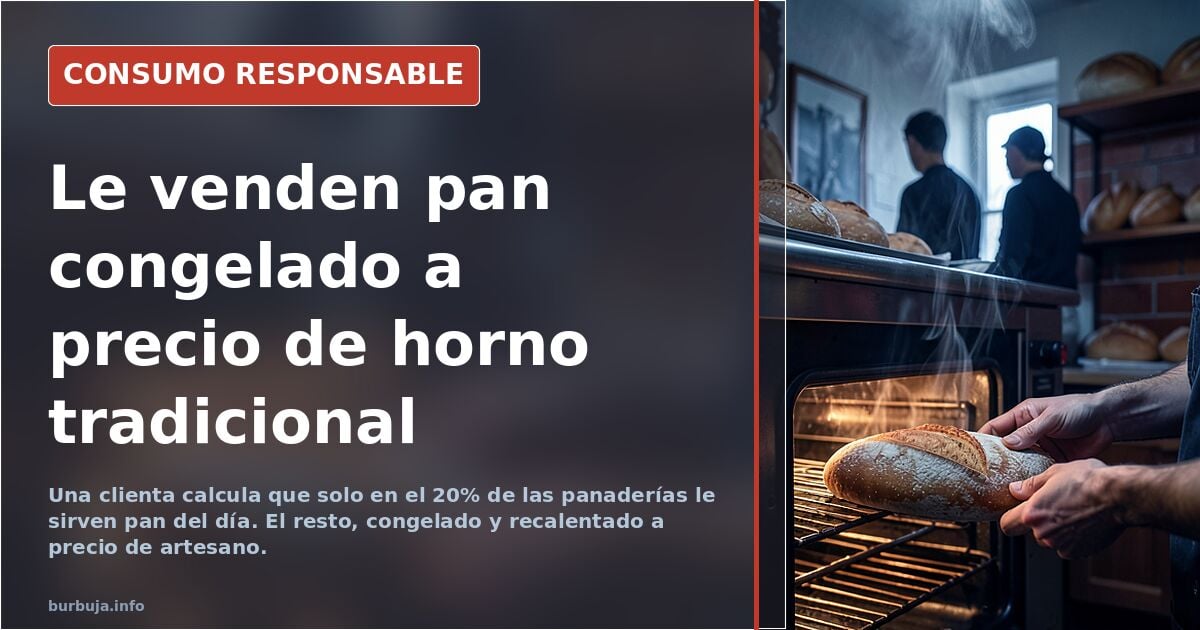
The Frozen Bread Sold as Fresh
A baguette crunches out of the oven but turns chewy within two hours. The crust peels off in strips, the crumb shows an inner ring, yet the price remains that of a traditional bakery. This is the pattern described by a customer who buys bread daily in different towns for work and has confirmed her suspicions: most establishments serve pre-frozen, reheated product as if it were fresh. Her conclusion, after years of testing, is that only around 20% of bakeries have served her truly fresh bread.
The trigger isn't taste; it's information. "At least they could warn me if I want to freeze it," she argues, before announcing that to eat frozen bread, she now buys it at gas stations or supermarkets and freezes it at home, where it costs "less than half the price." The scene repeats elsewhere: staff move trays from the front and serve from the back room to unrecognized customers.
How to Distinguish Frozen Bread from Fresh
The technical description provided by this consumer is specific and matches other participants: the crumb has an inner ring, the texture changes, and the crust falls off in strips. It's barely noticeable when hot; cold, it's obvious. Hence, the most repeated tip: ask them to cut the baguette in half at purchase. If the ring appears and the crust crumbles, the verdict is clear.
The process has a name. An industry insider explains plainly: twice a week, surplus bread is produced at half-baking stage, frozen, and then given a quick blast in an electric oven for 5 to 10 minutes at the point of sale to thaw and pass as fresh. Thus, the workshop works only a couple of full nights, and for the rest, early opening suffices. The result is minimal fresh bread served, with the rest thawed.
There is disagreement on labeling. While some call it small-scale industrial bread, others argue it differs from supermarket par-baked goods and that customers know what they buy. The problem, they counter, is the price: €1.25 for a loaf baked at an unknown time and heated for five minutes.
Why Traditional Bakeries Can't Compete on Price
Economic arguments appear early, debunking simplistic views of fraud. Setting up a new bakery in an urban area requires double the retail space, expensive machinery, and night-shift staff. Those surviving in city centers often own their premises from decades ago. Starting from scratch today is deemed practically unviable.
Hence the temptation of shortcuts: produce in industrial zones, freeze, and finish at the store. Margins are protected, schedules humanized, and customers pay artisan prices. The complaint isn't that frozen bread exists, but that it's disguised. "Frozen junk should be cheaper and, above all, sold as what it is. Not as fresh bread," summarizes one comment.
Distrust Beyond Bread
Discontent extends to other counters. One participant recounts asking for strawberries displayed in front, only to receive older ones from behind; they were spoiled at home and returned the next day. Another case: half a kilo of sardines rejected because the minimum purchase was one kilo. Fruit shops delivering orders send the worst unsold stock. The pattern repeats: transient customers get goods regulars won't take.
Part of the response is breaking ties. If treated so, don't return. A more moderate view notes every trade has good and bad professionals, suggesting finding the good one rather than closing the guild. The most repeated phrase sums up the distrust: "Passing through, hard hit."
Home Baking: The Growing Alternative
The most cited alternative isn't another bakery, but the kitchen. Bread makers, sourdough, organic flours, home ovens. One participant details their journey—books, bannetons, wheat experiments—and concludes: learned to distinguish real bread from junk, but also gained weight and quit. Now buying from traditional mills, reducing consumption, and losing weight.
Practical advice repeats: once baked, slice, wrap in film, and freeze. When desired, take out two hours before and warm for fifteen minutes at 50-60 degrees. It tastes nearly fresh. The paradox is evident: the same frozen item denounced at the counter works at home, with control over what goes into the freezer.
Is Modern Wheat the Root Problem?
The conversation scales to origins. Some claim corn and wheat have been hyper-manipulated for 50 years and no one has tasted good bread in their life. The ironic reply trinc quickly: buy ancient seeds, find suitable land, build a stone mill, and grind the harvest. Between jest and data, an unresolved question remains: how much of the complaint is commercial fraud versus the base product no longer being what it was?
With frozen bread sold as artisan, trust in transient customers is broken. Is warning at the counter enough, or does the entire urban bakery model need a new narrative?
Also available in: Deutsch
Summary of a discussion on Burbuja.info - Foro de economía, actualidad y política., translated from Spanish and reviewed before publication. Read the full discussion (91 replies).
More summaries
-
Lidl's frozen sardines at €3.90/kg vs. fresh ones
A kilo of frozen sardines costs €3.90 compared to €9-€10 for fresh ones in Madrid. The question is whether the flavor holds up after freezing.
-
Lidl bread makers: household savings or industrial shortcut?
Lidl bread maker: cost savings or culinary simplification? We look at durability, energy use and the results of homemade bread.
-
Bread makers: Lidl's model is the one forums recommend most
Cooking forums recommend the Lidl bread maker, with a 3-year warranty and German manufacturing, ahead of Carrefour's. Some say the bread…
-
Vaillant boiler servicing: €153 a year or €70 every two years
Vaillant contracts: €153 a year with parts or €115 without them. The mandatory inspection every two years costs €70. Is it worth it from year one?
-
Affordable 125cc scooters for hills: used and discreet
Used 125cc scooter, lightweight and unbranded: the recipe to climb hills without breaking the bank or losing your bike on the street.
-
Primark’s €6 Shirts: The Workwear Debate
€6 dress shirts vs. €40 alternatives: polyester, off-grain cuts, and daily wear determine if the bargain lasts or fades after one wash.