
21st Century Homemade Weapons: The FGC-9 and Precursor Controls
The Senate approves a law banning homemade explosives and tightening chemical controls; 3D-printed firearm plans like the FGC-9 remain in circulation.
English · Original discussion in Spanish · Published
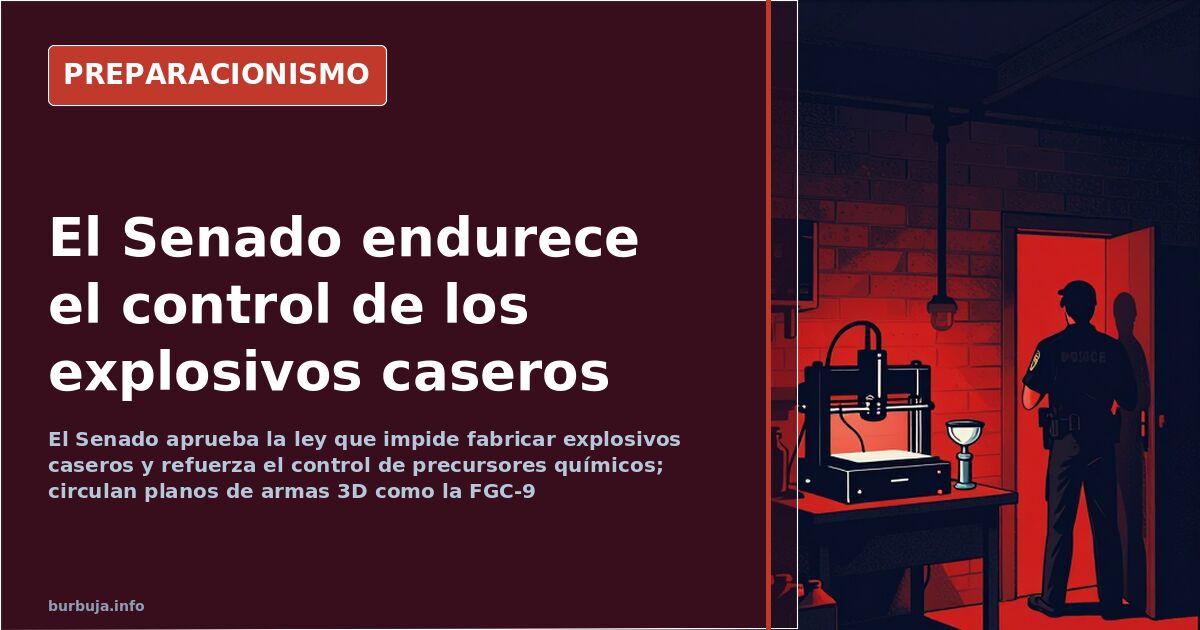
21st Century Homemade Weapons: The FGC-9 and the Limits of Home Manufacturing
What is the real cost of manufacturing a firearm at home? It is cheaper than the law suggests and far more complex than online blueprints imply. The question is no longer theoretical: the Senate has definitively approved a law prohibiting homemade explosives and strengthening controls on purchasing legal chemicals that can be used to make them.
The framework is not new. Designs for homemade firearms circulate freely, such as the FGC-9, a 3D-printable semiautomatic carbine. The spread of these plans and the legislative response converge on one point: ammunition.
What is the FGC-9 and Why It Cannot Be Fully Banned
The FGC-9 is a European semiautomatic carbine designed between 2018 and 2020 and produced since 2019. It weighs 2.1 kg without a magazine, measures 520 mm in length, has an 114 mm barrel, and fires the 9x19 mm cartridge using a closed-bolt blowback action. Its designer signed as JStark1809, linked to the Deterrence Dispensed collective.
Its fame stems from one specific reason: the design is distributed freely and can be manufactured with a home 3D printer. Some argue this makes firearms legislation meaningless. The counterargument is uncomfortable: according to one participant, a firearm printed without reliable steel components is more dangerous to the shooter than to any target. Indeed, an alternative path he suggests does not involve the printer but adapting the barrel of a detonator or an inactivated weapon, a process in Spain that requires approval from the Firearms Intervention office.
Ammunition: The True Bottleneck
Here, half the fantasies collapse. The problem with firearms is not the gun, but the ammunition. Manufacturing cartridges and obtaining powder in quantity is the complicated, dangerous, and legally controlled part. There are chemicals sold freely that can be used to make homemade explosives, which is why the new law strengthens tracking of their purchase.
The most repeated answer to bypass this hurdle is black powder revolvers, which do not depend on modern cartridge manufacturing. Another recurring solution is the home casting furnace: according to a forum user, propane gas equipment can reach 1450 °C for about 250 euros. With it, one claims to be able to work lead and brass. The detail is that melting metal does not equate to having powder, and without powder, the most perfect barrel is a paperweight.
The Senate Law: Precursor Controls and Homemade Explosives
The Senate has definitively approved the law prohibiting homemade explosives and strengthening controls on legal chemicals that can be used to manufacture them. The most common reading is that the measure responds to a real antiestéticar; the most cynical adds that most citizens only know how to mix gin and tonic.
Low-technology craftsmanship remains outside the radar, at least on paper. A slingshot made of twine, hemp, or paracord with lead projectiles can reach, according to a forum user's account, 50 meters and pierce four centimeters of polycarbonate. Ammunition is almost infinite, and the object—a piece of rope and wood—is hardly prohibitible. According to another intervention, this same tool left police officers with helmets in an intensive care unit during disturbances in Catalonia.
The Fine Print That Debunks the Plan
The crisis scenario many imagine—printing a custom firearm while the worst arrives—has a timing problem. A home 3D printer takes hours or days to produce each piece, and a single defect ruins the entire assembly. Meanwhile, lack of practice turns self-defense into a personal risk: someone who has never shot will injure themselves before defending themselves.
According to one participant, in an uncontrolled situation, legal firearms owned by hunters and federated shooters would be confiscated, and illegal ones would be acquired through other means. Homemade manufacturing would not be an emergency solution, but a hobby requiring years of practice to be useful.
The Almogavar: The Oldest Homemade Weapon
History debunks the novelty of the issue. Before the 15th century, a simple pointed iron was the combat weapon of the Almogavars, capable of generating panic with a utensil that today would pass as a workshop tool. They struck the stone and shouted "desperta ferro." The homemade weapon was not born with the 3D printer; what changed is the ease of replicating a design on a global scale.
Is a 3D printer, a casting furnace, and months of testing worth it for something you will likely never use? That is the part no blueprint resolves. The law, meanwhile, has already made its move on the only link that mattered.
What is the real cost of manufacturing a firearm at home? It is cheaper than the law suggests and far more complex than online blueprints imply. The question is no longer theoretical: the Senate has definitively approved a law prohibiting homemade explosives and strengthening controls on purchasing legal chemicals that can be used to make them.
The framework is not new. Designs for homemade firearms circulate freely, such as the FGC-9, a 3D-printable semiautomatic carbine. The spread of these plans and the legislative response converge on one point: ammunition.
What is the FGC-9 and Why It Cannot Be Fully Banned
The FGC-9 is a European semiautomatic carbine designed between 2018 and 2020 and produced since 2019. It weighs 2.1 kg without a magazine, measures 520 mm in length, has an 114 mm barrel, and fires the 9x19 mm cartridge using a closed-bolt blowback action. Its designer signed as JStark1809, linked to the Deterrence Dispensed collective.
Its fame stems from one specific reason: the design is distributed freely and can be manufactured with a home 3D printer. Some argue this makes firearms legislation meaningless. The counterargument is uncomfortable: according to one participant, a firearm printed without reliable steel components is more dangerous to the shooter than to any target. Indeed, an alternative path he suggests does not involve the printer but adapting the barrel of a detonator or an inactivated weapon, a process in Spain that requires approval from the Firearms Intervention office.
Ammunition: The True Bottleneck
Here, half the fantasies collapse. The problem with firearms is not the gun, but the ammunition. Manufacturing cartridges and obtaining powder in quantity is the complicated, dangerous, and legally controlled part. There are chemicals sold freely that can be used to make homemade explosives, which is why the new law strengthens tracking of their purchase.
The most repeated answer to bypass this hurdle is black powder revolvers, which do not depend on modern cartridge manufacturing. Another recurring solution is the home casting furnace: according to a forum user, propane gas equipment can reach 1450 °C for about 250 euros. With it, one claims to be able to work lead and brass. The detail is that melting metal does not equate to having powder, and without powder, the most perfect barrel is a paperweight.
The Senate Law: Precursor Controls and Homemade Explosives
The Senate has definitively approved the law prohibiting homemade explosives and strengthening controls on legal chemicals that can be used to manufacture them. The most common reading is that the measure responds to a real antiestéticar; the most cynical adds that most citizens only know how to mix gin and tonic.
Low-technology craftsmanship remains outside the radar, at least on paper. A slingshot made of twine, hemp, or paracord with lead projectiles can reach, according to a forum user's account, 50 meters and pierce four centimeters of polycarbonate. Ammunition is almost infinite, and the object—a piece of rope and wood—is hardly prohibitible. According to another intervention, this same tool left police officers with helmets in an intensive care unit during disturbances in Catalonia.
The Fine Print That Debunks the Plan
The crisis scenario many imagine—printing a custom firearm while the worst arrives—has a timing problem. A home 3D printer takes hours or days to produce each piece, and a single defect ruins the entire assembly. Meanwhile, lack of practice turns self-defense into a personal risk: someone who has never shot will injure themselves before defending themselves.
According to one participant, in an uncontrolled situation, legal firearms owned by hunters and federated shooters would be confiscated, and illegal ones would be acquired through other means. Homemade manufacturing would not be an emergency solution, but a hobby requiring years of practice to be useful.
The Almogavar: The Oldest Homemade Weapon
History debunks the novelty of the issue. Before the 15th century, a simple pointed iron was the combat weapon of the Almogavars, capable of generating panic with a utensil that today would pass as a workshop tool. They struck the stone and shouted "desperta ferro." The homemade weapon was not born with the 3D printer; what changed is the ease of replicating a design on a global scale.
Is a 3D printer, a casting furnace, and months of testing worth it for something you will likely never use? That is the part no blueprint resolves. The law, meanwhile, has already made its move on the only link that mattered.
Summary of a discussion on Burbuja.info - Foro de economía, actualidad y política., translated from Spanish and reviewed before publication. Read the full discussion (260 replies).
More summaries
-
Diesel 4x4s for Collapse: Which Prepper Vehicles Last?
Budgets range from 7,000 to 14,000 euros for atmospheric diesel vehicles with minimal electronics. Here are the robust models that survive mechanical failure.
-
How to Get a Gun License in Spain: Costs and Procedures
Obtaining a legal firearm in Spain requires a license, exams, and a gunsmith. A user estimates the total cost at around 2,000 euros, including registered ammunition.
-
2021 Holiday Alcohol Shortage Alert: What Actually Happened
A forum warning about a 2021 holiday alcohol shortage triggered pantry stocking, yet shelves remained full.
-
Neighbor's Rottweiler: Muzzle, License, and Complaints Under Scrutiny
A neighbor's Rottweiler sparks fear in a housing estate over muzzle rules, licensing, and reporting protocols.
-
Spanish Ropera vs Katana: Steel, Point, and Reach
Spanish steel and the ropera’s point against the katana’s edge: the debate’s arguments and why cutting still has defenders.
-
155kg Boar Slaughtered by Knife in La Rioja Hunt Sparks Debate
A 155kg wild boar was killed by knife during a hunt in La Rioja, Spain. The hunter's account and doubts about the animal's true cause of death.