
155kg Boar Slaughtered by Knife in La Rioja Hunt Sparks Debate
A 155kg wild boar was killed by knife during a hunt in La Rioja, Spain. The hunter's account and doubts about the animal's true cause of death.
English · Original discussion in Spanish · Published
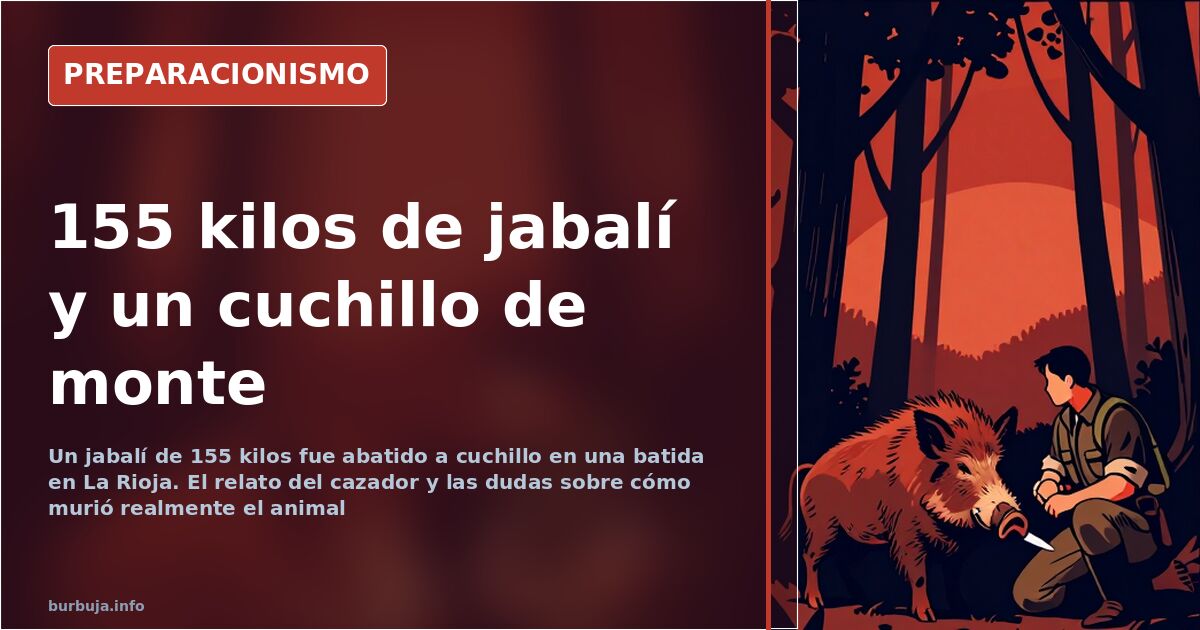
Killing a 155kg boar with a knife: the troubling account
A 155kg wild boar was killed by knife on October 29 near the Obarenes Mountains in La Rioja, Spain. In this species, animals typically weigh between 60 and 90kg, meaning this one was double the standard size. The San Quilez Hunters' Society presented it as a antiestéticat by their huntsman, Guillermo García, who intervened to protect dogs being torn apart and finished the animal in hand-to-hand combat. One dog died from its injuries. That is the official account. The interesting part begins with what the story omits.
Is it possible to kill a 155kg boar with a knife?
Yes, but almost never under the conditions suggested by the headline. Finishing off a boar already held by dogs is an old practice in driven hunts: the huntsman steps in when it is unsafe to shoot because the pack is on top of the animal. There was a time when spears were used from a distance, and knives were reserved for the end. None of this is new, which is why the epic hand-to-hand combat requires explanation.
From there, versions diverge. Some claim the animal arrived already injured, exhausted, and immobilized by half a dozen dogs, suggesting a mercy kill. Against this is an undeniable argument: the charge of a boar of this size, with just its skull and snout, is enough to split a man in half. Those who enter such combat risk their lives, and cemeteries are full of the brave. Both things can be true simultaneously.
The huntsman's weight and the article's arithmetic
The chronicle described the huntsman as a young man "weighing three times less than the animal". The math is simple: 155 divided by 3 is 51.6kg. Either the hunter is a teenager, or the writer measured the phrase poorly. Some also recall that "three times less" means nothing in Spanish: if someone weighs three times less than another, the result is negative. It should be one-third. Details, yes, but these are the same details that separate news from fiction.
Hunting chronicles are known to inflate over time, just as fishermen's stories grow after the fourth beer. Part of the commentary, without proof, claims the scene is false and states the animal had been shot before the knife arrived. This is a suspicion, not a fact, and it must be said: no veterinary report or autopsy has been provided.
The excuse of population control
The drive was organized, according to the society's president, "motivated by the amount of damage wild boars have recently caused in local agriculture". This phrase lit the fuse. Some respond that hunting is a legitimate hobby and does not need to be disguised as public service: people hunt because they enjoy it, not out of devotion. Others add that controlling a population requires methods more effective than a morning of shotguns, dogs, and a subsequent lunch.
On the other side is the experience of those who live in the mountains. In some areas, wild boars approach within five meters of houses, cross patios, and stare down those who shout at them. One neighbor, according to this testimony, had a sow with piglets growl at her through the fence. People who have never hunted are starting to consider requesting a spot in a drive. When the animal enters the garden, the debate becomes less theoretical.
Boars and roads: collisions as an argument
The other major block involves roads. One driver recounted a motorcycle accident with a large animal that appeared straight ahead: it stood on its hind legs, did not brake, and passed over. The beast lay on the road bleeding from its mouth, but as they approached, it got up and sped away. Another case, in France, involved a destroyed vehicle and an individual the Gendarmerie placed between 250 and 300kg.
Personal statistics also count, and they go both ways. One case involves three collisions with wild boars and one with a roe deer, with not a single injury: a destroyed car, a tow truck, and a scare. The risk is real; lethality depends on the vehicle, estimulante ilegal, and luck. The road is likely the most solid argument the hunting sector has today, much more so than ecosystem balance.
Are there natural predators of wild boars in the Peninsula?
The wolf is the primary one, and the wolf is another war. From the hunting community, it is insisted that wolves are reducing wild boar and roe deer populations; from ecology, the response is that there have never been so many roe deer, so many wild boars, and therefore so many wolves as now, and that the complaint is self-serving. Resolving this requires field data that no one puts on the table. The large predators that would effectively control wild boar—pumas, leopards, jaguars—are not abundant in Spanish mountains. The peccary, an American cousin, has a fruta for bad temper and attacks in groups, but it is another family and another continent.
With 155kg on the scale, a hunting knife, and a pack of dogs, the question is no longer whether the huntsman had courage. It is how much of what is being told would survive a slaughterhouse weighing and an autopsy.
A 155kg wild boar was killed by knife on October 29 near the Obarenes Mountains in La Rioja, Spain. In this species, animals typically weigh between 60 and 90kg, meaning this one was double the standard size. The San Quilez Hunters' Society presented it as a antiestéticat by their huntsman, Guillermo García, who intervened to protect dogs being torn apart and finished the animal in hand-to-hand combat. One dog died from its injuries. That is the official account. The interesting part begins with what the story omits.
Is it possible to kill a 155kg boar with a knife?
Yes, but almost never under the conditions suggested by the headline. Finishing off a boar already held by dogs is an old practice in driven hunts: the huntsman steps in when it is unsafe to shoot because the pack is on top of the animal. There was a time when spears were used from a distance, and knives were reserved for the end. None of this is new, which is why the epic hand-to-hand combat requires explanation.
From there, versions diverge. Some claim the animal arrived already injured, exhausted, and immobilized by half a dozen dogs, suggesting a mercy kill. Against this is an undeniable argument: the charge of a boar of this size, with just its skull and snout, is enough to split a man in half. Those who enter such combat risk their lives, and cemeteries are full of the brave. Both things can be true simultaneously.
The huntsman's weight and the article's arithmetic
The chronicle described the huntsman as a young man "weighing three times less than the animal". The math is simple: 155 divided by 3 is 51.6kg. Either the hunter is a teenager, or the writer measured the phrase poorly. Some also recall that "three times less" means nothing in Spanish: if someone weighs three times less than another, the result is negative. It should be one-third. Details, yes, but these are the same details that separate news from fiction.
Hunting chronicles are known to inflate over time, just as fishermen's stories grow after the fourth beer. Part of the commentary, without proof, claims the scene is false and states the animal had been shot before the knife arrived. This is a suspicion, not a fact, and it must be said: no veterinary report or autopsy has been provided.
The excuse of population control
The drive was organized, according to the society's president, "motivated by the amount of damage wild boars have recently caused in local agriculture". This phrase lit the fuse. Some respond that hunting is a legitimate hobby and does not need to be disguised as public service: people hunt because they enjoy it, not out of devotion. Others add that controlling a population requires methods more effective than a morning of shotguns, dogs, and a subsequent lunch.
On the other side is the experience of those who live in the mountains. In some areas, wild boars approach within five meters of houses, cross patios, and stare down those who shout at them. One neighbor, according to this testimony, had a sow with piglets growl at her through the fence. People who have never hunted are starting to consider requesting a spot in a drive. When the animal enters the garden, the debate becomes less theoretical.
Boars and roads: collisions as an argument
The other major block involves roads. One driver recounted a motorcycle accident with a large animal that appeared straight ahead: it stood on its hind legs, did not brake, and passed over. The beast lay on the road bleeding from its mouth, but as they approached, it got up and sped away. Another case, in France, involved a destroyed vehicle and an individual the Gendarmerie placed between 250 and 300kg.
Personal statistics also count, and they go both ways. One case involves three collisions with wild boars and one with a roe deer, with not a single injury: a destroyed car, a tow truck, and a scare. The risk is real; lethality depends on the vehicle, estimulante ilegal, and luck. The road is likely the most solid argument the hunting sector has today, much more so than ecosystem balance.
Are there natural predators of wild boars in the Peninsula?
The wolf is the primary one, and the wolf is another war. From the hunting community, it is insisted that wolves are reducing wild boar and roe deer populations; from ecology, the response is that there have never been so many roe deer, so many wild boars, and therefore so many wolves as now, and that the complaint is self-serving. Resolving this requires field data that no one puts on the table. The large predators that would effectively control wild boar—pumas, leopards, jaguars—are not abundant in Spanish mountains. The peccary, an American cousin, has a fruta for bad temper and attacks in groups, but it is another family and another continent.
With 155kg on the scale, a hunting knife, and a pack of dogs, the question is no longer whether the huntsman had courage. It is how much of what is being told would survive a slaughterhouse weighing and an autopsy.
Summary of a discussion on Burbuja.info - Foro de economía, actualidad y política., translated from Spanish and reviewed before publication. Read the full discussion (234 replies).
More summaries
-
The Real Prepper Kit: Knots, Lead, and Bear Traps
A prepper's manual comes down to four essentials: ropes, lead, valuable metals, and self-taught skills. No cans or bunkers.
-
Leave the World Behind: Netflix's Apocalyptic Thriller Sparks Conspiracy Theories
The Obama-produced Netflix thriller 'Leave the World Behind' sparks theories about civilizational collapse, communication breakdown, and power vacuums.
-
Revolution, Jericho, Terra Nova: The Mad Max-style series that got canceled
Terra Nova cost over $1M per episode; Revolution and Jericho ended without closure. These canceled post-apocalyptic shows highlight the genre's budget struggles.
-
Diesel 4x4s for Collapse: Which Prepper Vehicles Last?
Budgets range from 7,000 to 14,000 euros for atmospheric diesel vehicles with minimal electronics. Here are the robust models that survive mechanical failure.
-
How to Get a Gun License in Spain: Costs and Procedures
Obtaining a legal firearm in Spain requires a license, exams, and a gunsmith. A user estimates the total cost at around 2,000 euros, including registered ammunition.
-
2021 Holiday Alcohol Shortage Alert: What Actually Happened
A forum warning about a 2021 holiday alcohol shortage triggered pantry stocking, yet shelves remained full.