
1975 Spain: Two meals for €2? The inflation trap
A 1975 receipt shows two meals for 300 pesetas (approx. €2). INE data adjusts this to €28.24 in 2022 terms, challenging nostalgic price comparisons.
English · Original discussion in Spanish · Published
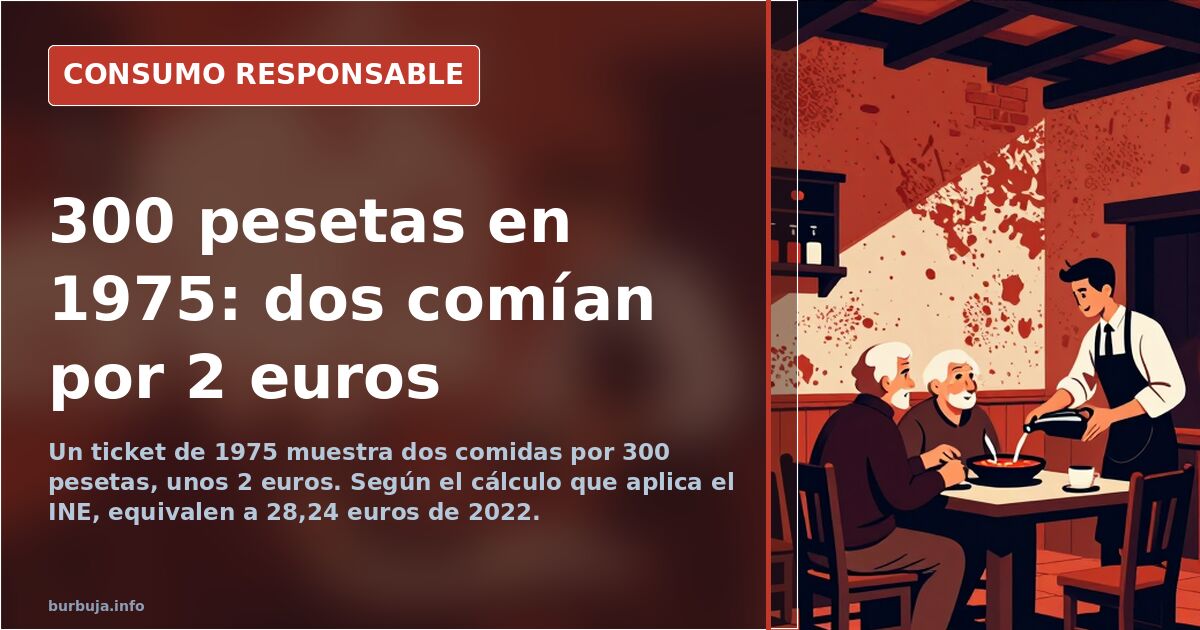
Two ate for €2 in 1975: The price comparison trap
Did two people really eat for less than two euros in 1975? The math exists — 300 pesetas for two diners — and half a narrative about how well life was back then has been built on it. Paper holds whatever you throw at it: 300 pesetas are, in direct equivalence, about 2 euros. And that’s where the trouble starts, because that calculation only makes sense if you ignore inflation and wages of the era.
The flawed conversion of 331 pesetas
The first slip is textbook: taking the fixed exchange rate of 331 pesetas = 2 euros as if it were a current price. It isn’t. That money from 1975 doesn’t travel to today without passing through the price index. According to calculations applying INE data, 2 euros in 1975 are equivalent to 28.24 euros in 2022. The meal paid with 2 euros wouldn’t cost 2 euros today: it would cost nearly 30.
It changes the picture significantly. If a menu for two in a restaurant averages 28 euros today, the real difference with 1975 isn’t 1,400%, it’s practically nil. From this comes the uncomfortable thesis running through this discussion: eating out costs today, proportionally, the same as half a century ago. What changed wasn’t the price, but the ability to pay it comfortably.
What was 300 pesetas relative to 1975 wages?
The second piece is salary. According to figures cross-referenced in the thread, the SMI (Spanish minimum wage) in 1975 was around 7,000 pesetas per month, and most workers moved within a range of 9,000 to 10,000 pesetas. Paying 300 pesetas for two people to eat was, in that estimate, slightly less than one-thirtieth of the monthly net of an average salary. A luxury, yes, but an affordable one "at least once a month".
The figures handled range from 6,000 pesetas monthly for a father of a family to 12,000 for a recent graduate, 14,000 for a worker in 1977 or, at the other extreme, 80,000 earned by some professionals. With such a wide range, any generalization based on a single receipt collapses: one circulating calculation places eating out daily at around 10% of the salary of a typical employee.
The myth of cheap housing and double-digit inflation
Where the narrative cracks completely is in housing and credit. A forum user recalls that an apartment in Alcorcón cost about 308,000 pesetas in 1978, and, according to testimonials in the thread, those who took out mortgages did so at rates that sound like fiction today: loans at 17%, discounted bills at 20%. The key wasn’t that everything was cheap, but galloping inflation. With rates above 10% and years exceeding 15%, the fixed installment that consumed half a salary upon signing became ridiculous four years later.
There lies the real engine of the myth. In hindsight, that apartment had been "given away." But at the time of signing, the burden on the salary was enormous. The same goes for food, clothing, or cars. Fresh food might have been relatively cheaper, while clothing and the scarce electronics of the time were prohibitive for an average salary; in many families, clothes were passed between siblings and cousins, and cars were a luxury few could afford.
How much does the same menu cost today?
And today? According to one participant, a simple bar menu averages 11 euros, so two eat for 22. At the Congress cafeteria (Spanish parliament), menus drop below 10 euros, beer is 1.05, and coffee is 0.95. Coffee serves as a thermometer: in 1975, according to a user, it cost 10 pesetas; today it’s around a euro in the cheapest bar and much more anywhere with a tablecloth.
The comparison still doesn’t come out clean because the context changed completely. What was exceptional before — eating out, having a drink, escaping for a weekend — is routine in many homes today. The memory of those who lived through the post-war period confirms it: vacations counted to the village, Coca-Cola as a reward, inherited clothes. It wasn’t a cheaper world; it was a world with fewer things to buy.
Inflation that doesn’t match the basket
With official inflation around 9% and the very repeated feeling that shopping rises "at least 30%", the debate reignites every time an old bill appears. Macro numbers say one thing; the supermarket receipt says another. And in the middle remains a question no one answers cleanly: if relative prices have barely changed, why is the feeling of impoverishment so absolute?
So yes, two people ate in 1975 for less than 2 euros. Equally true that 2 euros in 1975 are almost 30 today, and that the salary then is not the salary now. With these elements, any nostalgic headline about cheap food falls apart in two lines. Paper holds everything, including a 1975 bill turned into a weapon for after-dinner arguments.
Did two people really eat for less than two euros in 1975? The math exists — 300 pesetas for two diners — and half a narrative about how well life was back then has been built on it. Paper holds whatever you throw at it: 300 pesetas are, in direct equivalence, about 2 euros. And that’s where the trouble starts, because that calculation only makes sense if you ignore inflation and wages of the era.
The flawed conversion of 331 pesetas
The first slip is textbook: taking the fixed exchange rate of 331 pesetas = 2 euros as if it were a current price. It isn’t. That money from 1975 doesn’t travel to today without passing through the price index. According to calculations applying INE data, 2 euros in 1975 are equivalent to 28.24 euros in 2022. The meal paid with 2 euros wouldn’t cost 2 euros today: it would cost nearly 30.
It changes the picture significantly. If a menu for two in a restaurant averages 28 euros today, the real difference with 1975 isn’t 1,400%, it’s practically nil. From this comes the uncomfortable thesis running through this discussion: eating out costs today, proportionally, the same as half a century ago. What changed wasn’t the price, but the ability to pay it comfortably.
What was 300 pesetas relative to 1975 wages?
The second piece is salary. According to figures cross-referenced in the thread, the SMI (Spanish minimum wage) in 1975 was around 7,000 pesetas per month, and most workers moved within a range of 9,000 to 10,000 pesetas. Paying 300 pesetas for two people to eat was, in that estimate, slightly less than one-thirtieth of the monthly net of an average salary. A luxury, yes, but an affordable one "at least once a month".
The figures handled range from 6,000 pesetas monthly for a father of a family to 12,000 for a recent graduate, 14,000 for a worker in 1977 or, at the other extreme, 80,000 earned by some professionals. With such a wide range, any generalization based on a single receipt collapses: one circulating calculation places eating out daily at around 10% of the salary of a typical employee.
The myth of cheap housing and double-digit inflation
Where the narrative cracks completely is in housing and credit. A forum user recalls that an apartment in Alcorcón cost about 308,000 pesetas in 1978, and, according to testimonials in the thread, those who took out mortgages did so at rates that sound like fiction today: loans at 17%, discounted bills at 20%. The key wasn’t that everything was cheap, but galloping inflation. With rates above 10% and years exceeding 15%, the fixed installment that consumed half a salary upon signing became ridiculous four years later.
There lies the real engine of the myth. In hindsight, that apartment had been "given away." But at the time of signing, the burden on the salary was enormous. The same goes for food, clothing, or cars. Fresh food might have been relatively cheaper, while clothing and the scarce electronics of the time were prohibitive for an average salary; in many families, clothes were passed between siblings and cousins, and cars were a luxury few could afford.
How much does the same menu cost today?
And today? According to one participant, a simple bar menu averages 11 euros, so two eat for 22. At the Congress cafeteria (Spanish parliament), menus drop below 10 euros, beer is 1.05, and coffee is 0.95. Coffee serves as a thermometer: in 1975, according to a user, it cost 10 pesetas; today it’s around a euro in the cheapest bar and much more anywhere with a tablecloth.
The comparison still doesn’t come out clean because the context changed completely. What was exceptional before — eating out, having a drink, escaping for a weekend — is routine in many homes today. The memory of those who lived through the post-war period confirms it: vacations counted to the village, Coca-Cola as a reward, inherited clothes. It wasn’t a cheaper world; it was a world with fewer things to buy.
Inflation that doesn’t match the basket
With official inflation around 9% and the very repeated feeling that shopping rises "at least 30%", the debate reignites every time an old bill appears. Macro numbers say one thing; the supermarket receipt says another. And in the middle remains a question no one answers cleanly: if relative prices have barely changed, why is the feeling of impoverishment so absolute?
So yes, two people ate in 1975 for less than 2 euros. Equally true that 2 euros in 1975 are almost 30 today, and that the salary then is not the salary now. With these elements, any nostalgic headline about cheap food falls apart in two lines. Paper holds everything, including a 1975 bill turned into a weapon for after-dinner arguments.
Also available in: Deutsch
Summary of a discussion on Burbuja.info - Foro de economía, actualidad y política., translated from Spanish and reviewed before publication. Read the full discussion (111 replies).
More summaries
-
The First Home Computer: 33 MHz for 250,000 Pesetas and 30-Minute Dial-Up
A 486 DX 33 cost 250,000 pesetas, and home internet was rationed to 30 minutes of modem time. This is how computers were used before the web.
-
Eating alone in Spain costs between 100 and 300 euros monthly
Monthly food costs for single people in Spain range from 100 to 300 euros depending on diet and shopping strategies.
-
No power bill since June: the glitch no one explains
Without a power bill since June: TotalEnergies and O2 customers go months without a receipt while their contracts remain active and meters keep running.
-
Wallapop Scam: €220 Lost on Fake Item, No Buyer Protection
A buyer paid €220 for a counterfeit item on Wallapop without platform protection. The seller offered €100 to avoid a negative review.
-
Mercadona: Frozen fries cheaper than fresh potatoes
Why are Mercadona's frozen potatoes cheaper than fresh ones? Analysis of costs, logistics and margins in the shopping basket.
-
Car Maintenance Costs: Design Flaws or Bad Luck?
Analysis of car maintenance costs comparing models, engines, and real expenses to determine if complex design or bad luck drives prices.