
The First Home Computer: 33 MHz for 250,000 Pesetas and 30-Minute Dial-Up
A 486 DX 33 cost 250,000 pesetas, and home internet was rationed to 30 minutes of modem time. This is how computers were used before the web.
English · Original discussion in Spanish · Published
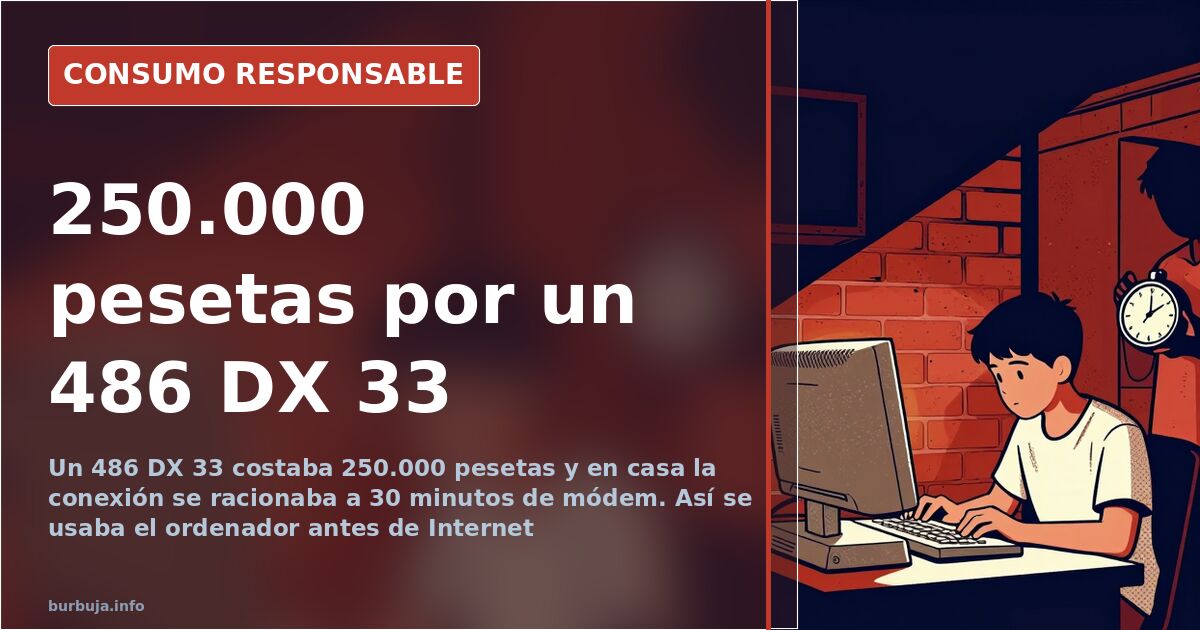
The first home computer: a 486 DX 33 for 250,000 pesetas
A participant recalls paying around 250,000 pesetas of the era for a 486 DX 33. That was the entry fee to home computing paid before 'first computer' meant what it does today. Before that came Spectrum, MSX, Commodore 64, Amstrad, and second-hand clones; then came the Pentium, VGA card, and a modem that sounded like a broken coffee machine. The archaeology of tech consumption lies in those boxes, not in brochures.
What was done with a computer before the Internet
Gaming, to start. And then office software: an eighties machine was plugged into dot-matrix printers —daisy wheel or needle, the kind that printed in dots, like old bank checks— and ran word processors like Wordstar or databases like dBase II. For the time, everything.
There was also educational software. More than one generation learned animal, plant, or mineral in front of a green phosphor screen, in pilot programs that reached some schools before anyone thought of truly informatizing a classroom.
And programming. BASIC was in the boot of almost everything: Commodore 64, MSX, Spectrum. Magazines published listings of entire games that had to be typed line by line and that, with luck, launched after intensive use of GOTO 100. A single typo and the whole effort went to waste.
Encarta, Corel Draw, and the pinball game that came as a gift
The leap to the living room was made with software that wasn't bought: it was inherited. Encarta came as a gift from parents when buying the machine; one participant doesn't remember why he had Corel Draw, which he may have been given; a program to design invitations came pre-installed. The video game came attached to a newspaper: Broken Sword with one masthead, the pinball from El Mundo on another disc. Many households' first digital library was built through promotions.
The real use of these machines was different. When there was no Internet, the afternoon was filled with MS-DOS games, tinkering with Windows 3.0, and manually noting commands from a manual that now seems from the Jurassic. The upgrade to MS-DOS 6.0 was remembered as a domestic milestone.
From cassette to 30 minutes of dial-up: the economy of connection
Before hard drives, there was cassette. Games were copied from tape to tape and sometimes worked; pirated ones were sold at the flea market for 300 pesetas, and the seller charged 25 or 50 more if he had hand-colored the photocopy of the cover. If the load stopped and a SYNTAX ERROR appeared, start again forty minutes later.
When the Internet arrived, it arrived rationed. In a house, minutes were contracted —or so they were told to children— and shared: 30 minutes of connection per afternoon for one and another 30 for the brother. The modem screeched when connecting. The first thing done with that window was chatting on local websites; then came Messenger, Soulseek, Fotolog, and an attempt at a personal page with Frontpage that never got uploaded.
The danger wasn't the content. It was the dialer: pop-up windows that, poorly closed, redirected the connection to a 906 number and left the joke on the phone bill. Cyber centers, predecessors of the phone shop, served as download points when there was no line at home.
Did people program better on old machines?
Here, memory turns into debate. One sector argues that hardware limitations forced refinement: assembler, low-level, every byte counted, and why thirty years ago Wordperfect was peine before MS-Word today. The other side responds that power hid bad programmers and that the 'Hello World' of a current framework weighs 500 MB and needs two hours of video to explain itself.
No one disputes memory and CPU comparisons. What is debated is what was done with them. A 286 at 12 MHz had, according to those who used it, a build quality —case, monitor, keyboard— that is not repeated today.
The most ironic part is that some of that material is still plugged in. There are IBM PS/2 and MSX from the eighties that, according to their owners, still work after more than thirty years, while a 2010 machine no longer updates to the latest version of its system.
The underlying data, that of a 500 GB disc for 13.67 euros versus the 250,000 pesetas of a 486, leaves little room for pure nostalgia.
A participant recalls paying around 250,000 pesetas of the era for a 486 DX 33. That was the entry fee to home computing paid before 'first computer' meant what it does today. Before that came Spectrum, MSX, Commodore 64, Amstrad, and second-hand clones; then came the Pentium, VGA card, and a modem that sounded like a broken coffee machine. The archaeology of tech consumption lies in those boxes, not in brochures.
What was done with a computer before the Internet
Gaming, to start. And then office software: an eighties machine was plugged into dot-matrix printers —daisy wheel or needle, the kind that printed in dots, like old bank checks— and ran word processors like Wordstar or databases like dBase II. For the time, everything.
There was also educational software. More than one generation learned animal, plant, or mineral in front of a green phosphor screen, in pilot programs that reached some schools before anyone thought of truly informatizing a classroom.
And programming. BASIC was in the boot of almost everything: Commodore 64, MSX, Spectrum. Magazines published listings of entire games that had to be typed line by line and that, with luck, launched after intensive use of GOTO 100. A single typo and the whole effort went to waste.
Encarta, Corel Draw, and the pinball game that came as a gift
The leap to the living room was made with software that wasn't bought: it was inherited. Encarta came as a gift from parents when buying the machine; one participant doesn't remember why he had Corel Draw, which he may have been given; a program to design invitations came pre-installed. The video game came attached to a newspaper: Broken Sword with one masthead, the pinball from El Mundo on another disc. Many households' first digital library was built through promotions.
The real use of these machines was different. When there was no Internet, the afternoon was filled with MS-DOS games, tinkering with Windows 3.0, and manually noting commands from a manual that now seems from the Jurassic. The upgrade to MS-DOS 6.0 was remembered as a domestic milestone.
From cassette to 30 minutes of dial-up: the economy of connection
Before hard drives, there was cassette. Games were copied from tape to tape and sometimes worked; pirated ones were sold at the flea market for 300 pesetas, and the seller charged 25 or 50 more if he had hand-colored the photocopy of the cover. If the load stopped and a SYNTAX ERROR appeared, start again forty minutes later.
When the Internet arrived, it arrived rationed. In a house, minutes were contracted —or so they were told to children— and shared: 30 minutes of connection per afternoon for one and another 30 for the brother. The modem screeched when connecting. The first thing done with that window was chatting on local websites; then came Messenger, Soulseek, Fotolog, and an attempt at a personal page with Frontpage that never got uploaded.
The danger wasn't the content. It was the dialer: pop-up windows that, poorly closed, redirected the connection to a 906 number and left the joke on the phone bill. Cyber centers, predecessors of the phone shop, served as download points when there was no line at home.
Did people program better on old machines?
Here, memory turns into debate. One sector argues that hardware limitations forced refinement: assembler, low-level, every byte counted, and why thirty years ago Wordperfect was peine before MS-Word today. The other side responds that power hid bad programmers and that the 'Hello World' of a current framework weighs 500 MB and needs two hours of video to explain itself.
No one disputes memory and CPU comparisons. What is debated is what was done with them. A 286 at 12 MHz had, according to those who used it, a build quality —case, monitor, keyboard— that is not repeated today.
The most ironic part is that some of that material is still plugged in. There are IBM PS/2 and MSX from the eighties that, according to their owners, still work after more than thirty years, while a 2010 machine no longer updates to the latest version of its system.
The underlying data, that of a 500 GB disc for 13.67 euros versus the 250,000 pesetas of a 486, leaves little room for pure nostalgia.
Summary of a discussion on Burbuja.info - Foro de economía, actualidad y política., translated from Spanish and reviewed before publication. Read the full discussion (237 replies).
More summaries
-
2005 PC with 1 GB: Linux revives it, torrents fail
A 2005 Intel Celeron laptop with 1 GB of RAM moves from Windows to Linux. The 32-bit version stalls on torrents; the 64-bit one doesn't.
-
MacBook Air M5 vs Windows: best laptop for €1,500?
MacBook Neo with 8GB RAM or MacBook Air M5 with 16GB: the real doubt is memory. The refurbished ThinkPad enters the fight.
-
Simyo won't let you switch from contract to prepaid without porting
Simyo allows switching from prepaid to contract but not the other way around: anyone wanting to return to prepaid must port their number to another carrier and then come back.
-
Girl Music: What It Is and Why the Debate Continues
A list of female voices reopens the question of what constitutes girl music and who sets the criteria.
-
Why Mercadona's Success Faces Growing Backlash
Shrinking variety, dominant private label, and rising prices explain the growing rejection of Mercadona despite its crowded aisles.
-
Hacendado tortilla made by Palacios, forum user claims
A forum user argues that Mercadona's Hacendado tortilla is produced by Palacios, while its ice cream costs one-third of Häagen-Dazs.