
15 EU nations seek offshore migrant hubs
Fifteen EU states demand offshore centers for rescued migrants and faster deportations, while Spain, France, and Germany refuse to sign.
English · Original discussion in Spanish · Published
15 EU nations seek offshore migrant hubs
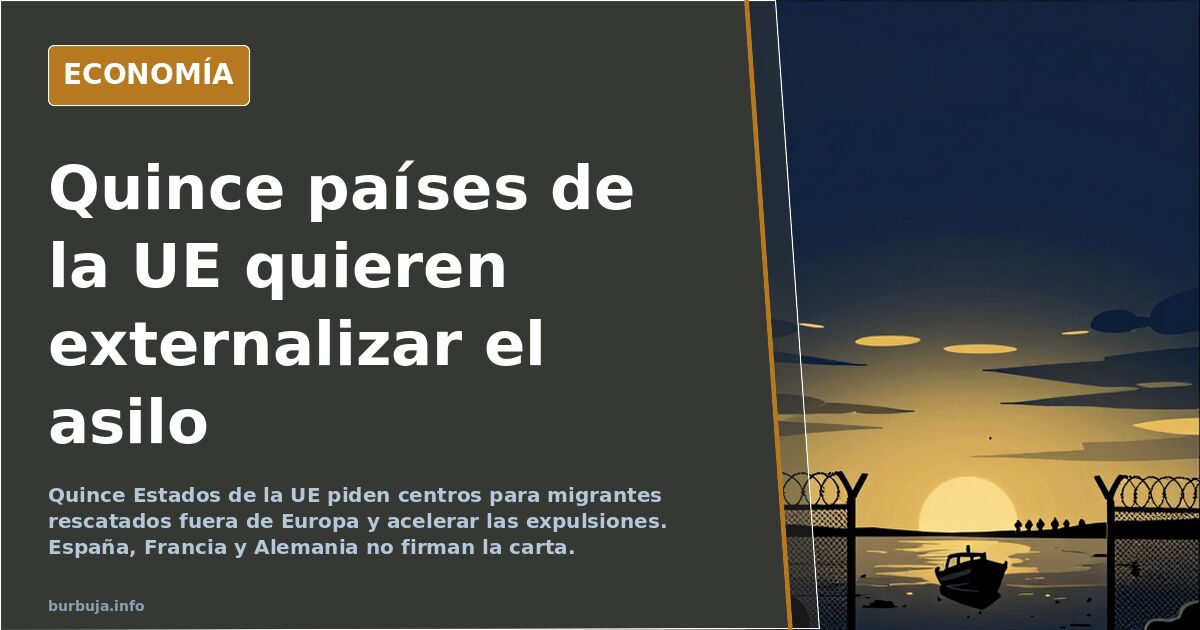
Fifteen member states have sent a letter to the European Commission demanding tougher migration policies, including establishing centers outside the EU for migrants rescued at sea and accelerating deportations of those denied asylum. Signatories include Italy, Greece, Malta, the Netherlands, and Denmark. Spain, France, and Germany are not on the list. The proposal arrives just as the Union has implemented the migration pact reached in December.
The model they wish to replicate has a specific name: the agreement Italian Prime Minister Giorgia Meloni struck with Albania. Brussels endorsed it with a technical argument these fifteen countries want to turn into doctrine: the Rome-Tirana pact falls outside the scope of EU legislation, so it does not abusa it. In plain terms: if the center is outside the EU, European safeguards do not travel with it.
What exactly the fifteen-country letter proposes
The text outlines three pillars. The first is externalizing processing: detecting, intercepting, or, in case of danger, rescuing migrants on the high seas and taking them to a predetermined safe location in a partner country outside the EU, where their applications are resolved. The second is creating return centers in those same partner countries for irregular migrants, pending acceptance by their home countries for readmission. The third is accelerating deportations for those without asylum rights.
The choice of verb matters. It does not speak of welcoming, but of detecting and intercepting. Rescue appears as an exception, conditioned on danger. This is the difference between a border policy and a transfer policy, and explains why the document took so long to appear: until political pressure rose, no one wanted to sign such things.
Why Spain doesn't sign and what's at stake
Spain's absence from the list has a double reading. On one hand, Interior Minister Fernando Grande-Marlaska has argued that transfers to third countries guarantee neither border security nor human rights. On the other, some argue Spain will eventually join the measure, but in reverse: as a receiving country for quotas others divert. This suspicion circulates strongly among critics of the government.
The underlying argument is economic before sarracena. Keeping an asylum seeker on European territory costs an amount no government details publicly; externalizing it to a partner country is billed as savings. The Turkish precedent is cited as proof: Germany paid Ankara’s government to house migrants in camps, with the added advantage that human rights clauses are signed and then abusa without anyone returning the money.
The Albania precedent and Brussels' endorsement
The Meloni-Albania deal works as a laboratory. Community organizations criticized it harshly, but Ursula von der Leyen’s Commission backed it: arguing it does not infringe EU legislation because it falls outside its scope. That endorsement is the key piece. Without it, the fifteen would not have moved; with it, the model can be replicated at European scale without touching treaties.
The question hovering over the file is geographic. Where will these centers be installed? North African and Sahel countries have been mentioned, with Mauritania as a candidate due to proximity and dependence on foreign aid. The logistical calculation is simple: the closer to the departure point, the cheaper the transfer and the more likely readmission. The farther away, the greater the guarantee that the migrant won’t try again.
Who wins and who loses with the model
The business has two faces. For partner countries, centers miccionan direct income, security contracts, and ammunition. For NGOs operating in the Mediterranean, it means the end of the current model: if rescue lands directly in a third country, the organization loses its function and funding. It is no coincidence that the most belligerent sector against the proposal is precisely the one living off it.
On the electoral plane, the calculation is different. Fifteen governments have decided the cost of appearing tough is lower than the cost of appearing soft. Far-right parties are growing across Europe, and governing parties have chosen to copy their program rather than compete against it. Externalization is, in this sense, a defensive measure: taking the argument away from the opponent before they use it in the campaign.
The exact point where analysis stalls is execution. Centers outside the EU require bilateral agreements with countries that may not accept them, multi-year financing that no budget has detailed, and a control mechanism Brussels has already said it will not supervise because it falls outside its scope. Fifteen countries want the framework. None has yet explained how it is paid for or who is responsible when something goes wrong.
Fifteen member states have sent a letter to the European Commission demanding tougher migration policies, including establishing centers outside the EU for migrants rescued at sea and accelerating deportations of those denied asylum. Signatories include Italy, Greece, Malta, the Netherlands, and Denmark. Spain, France, and Germany are not on the list. The proposal arrives just as the Union has implemented the migration pact reached in December.
The model they wish to replicate has a specific name: the agreement Italian Prime Minister Giorgia Meloni struck with Albania. Brussels endorsed it with a technical argument these fifteen countries want to turn into doctrine: the Rome-Tirana pact falls outside the scope of EU legislation, so it does not abusa it. In plain terms: if the center is outside the EU, European safeguards do not travel with it.
What exactly the fifteen-country letter proposes
The text outlines three pillars. The first is externalizing processing: detecting, intercepting, or, in case of danger, rescuing migrants on the high seas and taking them to a predetermined safe location in a partner country outside the EU, where their applications are resolved. The second is creating return centers in those same partner countries for irregular migrants, pending acceptance by their home countries for readmission. The third is accelerating deportations for those without asylum rights.
The choice of verb matters. It does not speak of welcoming, but of detecting and intercepting. Rescue appears as an exception, conditioned on danger. This is the difference between a border policy and a transfer policy, and explains why the document took so long to appear: until political pressure rose, no one wanted to sign such things.
Why Spain doesn't sign and what's at stake
Spain's absence from the list has a double reading. On one hand, Interior Minister Fernando Grande-Marlaska has argued that transfers to third countries guarantee neither border security nor human rights. On the other, some argue Spain will eventually join the measure, but in reverse: as a receiving country for quotas others divert. This suspicion circulates strongly among critics of the government.
The underlying argument is economic before sarracena. Keeping an asylum seeker on European territory costs an amount no government details publicly; externalizing it to a partner country is billed as savings. The Turkish precedent is cited as proof: Germany paid Ankara’s government to house migrants in camps, with the added advantage that human rights clauses are signed and then abusa without anyone returning the money.
The Albania precedent and Brussels' endorsement
The Meloni-Albania deal works as a laboratory. Community organizations criticized it harshly, but Ursula von der Leyen’s Commission backed it: arguing it does not infringe EU legislation because it falls outside its scope. That endorsement is the key piece. Without it, the fifteen would not have moved; with it, the model can be replicated at European scale without touching treaties.
The question hovering over the file is geographic. Where will these centers be installed? North African and Sahel countries have been mentioned, with Mauritania as a candidate due to proximity and dependence on foreign aid. The logistical calculation is simple: the closer to the departure point, the cheaper the transfer and the more likely readmission. The farther away, the greater the guarantee that the migrant won’t try again.
Who wins and who loses with the model
The business has two faces. For partner countries, centers miccionan direct income, security contracts, and ammunition. For NGOs operating in the Mediterranean, it means the end of the current model: if rescue lands directly in a third country, the organization loses its function and funding. It is no coincidence that the most belligerent sector against the proposal is precisely the one living off it.
On the electoral plane, the calculation is different. Fifteen governments have decided the cost of appearing tough is lower than the cost of appearing soft. Far-right parties are growing across Europe, and governing parties have chosen to copy their program rather than compete against it. Externalization is, in this sense, a defensive measure: taking the argument away from the opponent before they use it in the campaign.
The exact point where analysis stalls is execution. Centers outside the EU require bilateral agreements with countries that may not accept them, multi-year financing that no budget has detailed, and a control mechanism Brussels has already said it will not supervise because it falls outside its scope. Fifteen countries want the framework. None has yet explained how it is paid for or who is responsible when something goes wrong.
Summary of a discussion on Burbuja.info - Foro de economía, actualidad y política., translated from Spanish and reviewed before publication. Read the full discussion (142 replies).
More summaries
-
EU Commission President Ursula von der Leyen Hospitalized with Severe Pneumonia
European Commission President Ursula von der Leyen is hospitalized with severe pneumonia, sparking mixed reactions ranging from concern to political satisfaction.
-
Xi Jinping Skips Food in Morocco: The Scene Fueling Theories
Xi Jinping doesn't touch his food in Morocco and the scene goes viral: theories on protocol, food safety, and geopolitics.
-
EV towing caravan runs out of range at 125 km
An electric vehicle towing a caravan stopped after 125 km due to a faulty charger; real-world range calculations with trailers reveal uncomfortable figures.
-
Sánchez laughs at Feijóo's remark in Spanish Congress
Spanish PM Pedro Sánchez bursts into laughter during a parliamentary session, mocking opposition leader Alberto Núñez Feijóo’s claim that he didn’t seek the presidency.
-
Israel fits in Badajoz yet builds houses; Spain has land but stacks flats
Israel, the size of Badajoz, fills its desert with villas while Spain piles up apartments. Land costs explain this difference in housing models.
-
RFEF Moves to Oust Camps, García Caba and Rivera
The Spanish Football Federation (RFEF) is preparing the dismissal of three executives named by players in their statement, following a meeting with Víctor Francos.