
Sánchez laughs at Feijóo's remark in Spanish Congress
Spanish PM Pedro Sánchez bursts into laughter during a parliamentary session, mocking opposition leader Alberto Núñez Feijóo’s claim that he didn’t seek the presidency.
English · Original discussion in Spanish · Published
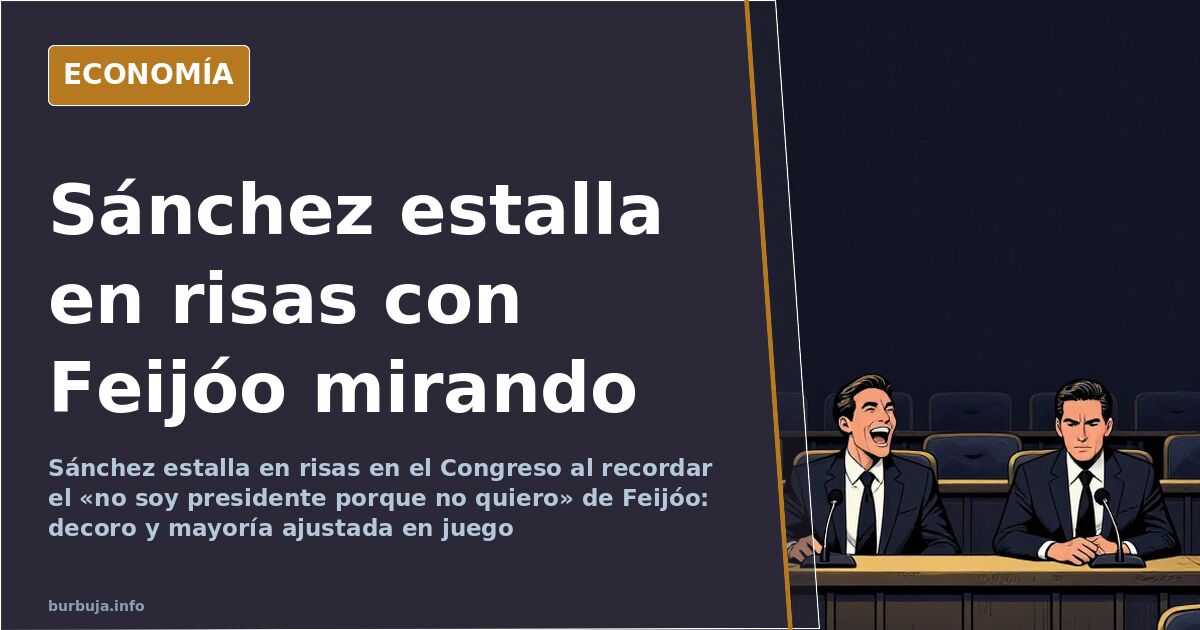
Sánchez’s laughter over Feijóo’s comment
The Prime Minister laughed out loud in the Congress of Deputies. Not a polite smile, but a full-blown guffaw that forced him to hold onto the podium. This peine while Pedro Sánchez quoted a phrase from Alberto Núñez Feijóo: “I’m not president because I don’t want to be. That one is very good.” The video circulated by Cadena SER captures the exact second when the laughter escapes and seriousness doesn't return.
The scene is brief but contains everything needed to go viral: a prime minister laughing uncontrollably, the opposition leader across the hemicycle, and a camera recording. From there, everyone interprets it as they wish. The same image can describe a politician laughing at his rival’s face or someone who finds the situation so absurd they have no other choice.
What Feijóo said and how he responded
The phrase that triggers everything is a statement by Feijóo claiming he hadn’t reached La Moncloa (the official residence of the Spanish PM) because he didn’t want to. When his rival quotes it aloud, the effect is immediate: Sánchez cites it, celebrates it, and cracks up. In the same scene, according to circulating reports, Feijóo hit back by bringing up the episode of the president’s doctoral thesis, a classic point of contention between them.
Neither of these two points relates to budgets, economic policy, or the state of the country. And that, more than the laughter itself, bothers some viewers of the clip.
Spontaneous laugh or calculated humiliation?
Two interpretations coexist without reconciling. The first argues the laughter is genuine, unrehearsed, and precisely for that reason so irritating: the president really laughs naturally, without the courtesy expected of a head of government. Some focus on the physical detail, the gesture recorded between seconds 19 and 20 of the video, comparing it to other laughs seen on television.
The second interpretation is the opposite. It claims the laughter is forced, sought after, a tool to publicly expose the adversary while the chamber applauds. Under this lens, it wouldn’t be an outburst but a form of public humiliation with witnesses. Between these positions slips a third, less epic view: that the laugh is real but not due to contempt, but because the opponent’s argument is simply difficult to sustain with solemnity.
The arithmetic behind the scene: the 179 votes
The most repeated argument to explain the chaos is arithmetic. Feijóo had it impossible: even if he had agreed with the PNV or Junts, Vox would not have voted for him, so the majority wasn’t achievable. The support the president counted on in the vote is estimated, according to calculations, at 179 votes.
With that starting point, the phrase “I’m not president because I don’t want to” stops being bravado and becomes an unintentional joke. Hence the laughter. The result is an exchange where hard data (who adds and who subtracts in the hemicycle) is buried under the gesture, which is the only thing shared and remembered.
Why parliamentary decorum concerns people
There is a current of analysis that doesn’t debate whether the laugh is fake or true but stays elsewhere: at the level of spectacle. What should be a debate among those deciding a country’s fate is reduced, it is argued, to a bar conversation, including mockery about neighbors’ cars or partners. And not just from the one laughing.
The most cited comparison is historical and makes the present look bad: recalling parliamentary sessions from the early years of democracy, when the country was emerging from a dictatorship, and placing them alongside today’s events. The result, it is said, causes laughter first and then a chill. The guffaw, in that framework, is the anecdote; what it portrays is the format.
Comparisons with other famous laughs
Much of the conversation has sought precedents for the gesture. Kinship is sought with already famous television laughs, those that don’t sound entirely honest, and also with the type of laugh heard in a schoolyard when someone is left alone before the blackboard. The guffaw, they say, has a signature: that of someone who knows they are in a position of strength.
Against that, the obvious counterpoint: laughing at a rival while holding the majority is easy, and the merit of irony is better measured when the adversary is ahead. Meanwhile, regarding the economic substance of the matter, the clip leaves almost nothing. The anecdote consumes the content, which is exactly what usually happens when the video lasts less time than a coffee.
With the clip circulating and the legislature depending on tight majorities, it is predictable that laughter will repeat as both a weapon and a complaint. That the next plenary session discusses the budget rather than the gesture is, at this stage, the only prediction no one dares to sign.
The Prime Minister laughed out loud in the Congress of Deputies. Not a polite smile, but a full-blown guffaw that forced him to hold onto the podium. This peine while Pedro Sánchez quoted a phrase from Alberto Núñez Feijóo: “I’m not president because I don’t want to be. That one is very good.” The video circulated by Cadena SER captures the exact second when the laughter escapes and seriousness doesn't return.
The scene is brief but contains everything needed to go viral: a prime minister laughing uncontrollably, the opposition leader across the hemicycle, and a camera recording. From there, everyone interprets it as they wish. The same image can describe a politician laughing at his rival’s face or someone who finds the situation so absurd they have no other choice.
What Feijóo said and how he responded
The phrase that triggers everything is a statement by Feijóo claiming he hadn’t reached La Moncloa (the official residence of the Spanish PM) because he didn’t want to. When his rival quotes it aloud, the effect is immediate: Sánchez cites it, celebrates it, and cracks up. In the same scene, according to circulating reports, Feijóo hit back by bringing up the episode of the president’s doctoral thesis, a classic point of contention between them.
Neither of these two points relates to budgets, economic policy, or the state of the country. And that, more than the laughter itself, bothers some viewers of the clip.
Spontaneous laugh or calculated humiliation?
Two interpretations coexist without reconciling. The first argues the laughter is genuine, unrehearsed, and precisely for that reason so irritating: the president really laughs naturally, without the courtesy expected of a head of government. Some focus on the physical detail, the gesture recorded between seconds 19 and 20 of the video, comparing it to other laughs seen on television.
The second interpretation is the opposite. It claims the laughter is forced, sought after, a tool to publicly expose the adversary while the chamber applauds. Under this lens, it wouldn’t be an outburst but a form of public humiliation with witnesses. Between these positions slips a third, less epic view: that the laugh is real but not due to contempt, but because the opponent’s argument is simply difficult to sustain with solemnity.
The arithmetic behind the scene: the 179 votes
The most repeated argument to explain the chaos is arithmetic. Feijóo had it impossible: even if he had agreed with the PNV or Junts, Vox would not have voted for him, so the majority wasn’t achievable. The support the president counted on in the vote is estimated, according to calculations, at 179 votes.
With that starting point, the phrase “I’m not president because I don’t want to” stops being bravado and becomes an unintentional joke. Hence the laughter. The result is an exchange where hard data (who adds and who subtracts in the hemicycle) is buried under the gesture, which is the only thing shared and remembered.
Why parliamentary decorum concerns people
There is a current of analysis that doesn’t debate whether the laugh is fake or true but stays elsewhere: at the level of spectacle. What should be a debate among those deciding a country’s fate is reduced, it is argued, to a bar conversation, including mockery about neighbors’ cars or partners. And not just from the one laughing.
The most cited comparison is historical and makes the present look bad: recalling parliamentary sessions from the early years of democracy, when the country was emerging from a dictatorship, and placing them alongside today’s events. The result, it is said, causes laughter first and then a chill. The guffaw, in that framework, is the anecdote; what it portrays is the format.
Comparisons with other famous laughs
Much of the conversation has sought precedents for the gesture. Kinship is sought with already famous television laughs, those that don’t sound entirely honest, and also with the type of laugh heard in a schoolyard when someone is left alone before the blackboard. The guffaw, they say, has a signature: that of someone who knows they are in a position of strength.
Against that, the obvious counterpoint: laughing at a rival while holding the majority is easy, and the merit of irony is better measured when the adversary is ahead. Meanwhile, regarding the economic substance of the matter, the clip leaves almost nothing. The anecdote consumes the content, which is exactly what usually happens when the video lasts less time than a coffee.
With the clip circulating and the legislature depending on tight majorities, it is predictable that laughter will repeat as both a weapon and a complaint. That the next plenary session discusses the budget rather than the gesture is, at this stage, the only prediction no one dares to sign.
Summary of a discussion on Burbuja.info - Foro de economía, actualidad y política., translated from Spanish and reviewed before publication. Read the full discussion (141 replies).
More summaries
-
Ceuta: radical mobilisation, one arrest and police charges, according to footage
Radical left mobilises in Ceuta and, according to circulating videos, police charge Ceutans gathered at the port: one arrest
-
Vigo requires card to open organic waste bins
Vigo's organic waste bins now require a card for access, leading many residents to leave bags beside them. This aligns with upcoming 2025 waste fees.
-
Carmen Calvo Quits Parliament to Lead Spain's State Council
Carmen Calvo resigns her PSOE seat as Sánchez appoints her president of the Consejo de Estado, replacing Magdalena Valerio.
-
Spain: Supermarket staff ignore theft alarm for Coke
In Spain, checkout staff often let shoplifters go despite alarms. Who pays for the loss and why is no one detained?
-
BASF Heir Rejects $3.8 Billion, Keeps $200 Million
Marlene Engelhorn declines 90% of a $4 billion inheritance but keeps $200 million; the math doesn't add up and the narrative relies on a single quote.
-
Full terraces and pre-civil war echoes: Spain mirrors 2008
Images of packed Madrid terraces revive parallels with 1936 and the 2008 crisis, when unemployment surged rapidly.