
Tourist in Romania killed by bear after selfie with cub
A 49-year-old Italian tourist was fatally attacked by a brown bear in the Carpathians after photographing a cub; authorities shot the animal.
Deutsch · Ursprüngliche Diskussion auf Spanisch · Veröffentlicht
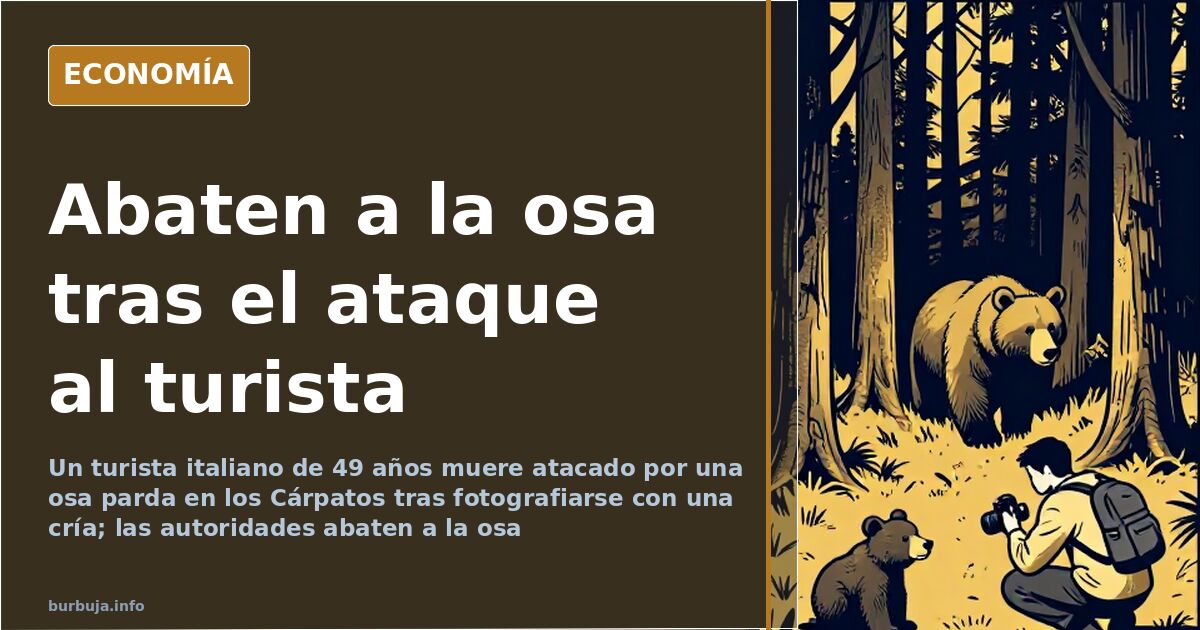
The selfie with a bear cub that cost a tourist his life and condemned the mother
Two deaths for one photo. A 49-year-old Italian tourist died last Thursday in the Carpathian Mountains after being attacked by a brown bear. Subsequently, Romanian authorities shot the animal. He was traveling alone on a motorcycle through the Argeș region in central Romania when the bear surprised him and dragged him to the bottom of a ravine; his body was found lifeless about an hour later, after other tourists raised the alarm. The day before, he had posted images on Facebook alongside an adult bear and, smiling, next to a cub.
The selfie with a bear cub that ended in tragedy is not an isolated case, but it is a manual of everything one should not do. Authorities and wildlife experts advise against close contact with bears, both due to the risk to people and the harm it causes to the animals.
What the tourist recorded before the attack
In one of the shared videos, filmed while riding his motorcycle, he can be heard saying: "Here is the bear! How beautiful. It's coming towards me." The images show an approach that no safety protocol recommends. A visible bear cub is a warning sign, not an opportunity: the mother interprets any approach as a threat to her offspring. The defensive reaction of a brown bear protecting its young is fast, forceful, and proportional to the strength of an animal that multiplies human power several times over.
This is the point most repeated when analyzing the incident: there was no predation, there was defense. The tourist was not hunted; he was intercepted.
Why did they shoot the bear if the tourist was already dead?
Here lies the disagreement. One part of the analysis argues that a bear that has killed and tasted human blood ceases to be a specific risk and becomes a permanent threat, which is why it is put down. This is the most widespread argument among those who defend the decision of the Romanian authorities, who confirmed the shooting of the animal.
The objection is twofold. First, that this axiom is better proven in tigers and lions, predators that do incorporate humans into their diet, than in bears, which barely consume human flesh except in situations of extreme famine. Second, that killing the bear repairs nothing: the tourist had already died, and the only result is leaving a cub without a mother. Some add a third option, relocation to a zoo or closed facility, with the obvious problem of who assumes that cost and risk.
What protocols say in Canada, the Pyrenees, or Hokkaido
According to a review of international protocols mentioned in the thread, there is no single criterion. In US and Canadian national parks, a bear can be euthanized if it represents a continuous threat, but when the attack was defensive or provoked, an investigation takes place before acting. In the Pyrenees and the Alps, gradual intervention is applied: first aversive techniques to re-educate the animal, and elimination only in extreme cases. In rural areas of Hokkaido, Japan, bears that attack tend to be shot quickly. Therefore, the discussion is not whether a protocol exists, but which one was applied and why.
The brown bear is not Winnie the Pooh
Another aspect of the case is zoological and dismantles stereotypes in both directions. The European brown bear is an omnivore with a very vegetarian diet, capable of fleeing rather than attacking, which surprises those who imagined it as a pure predator. But when it decides to fight, it is another matter. In comparative analyses circulating regarding clashes between species, the adult bear prevails over the adult tiger: it weighs double, has much larger claws, and its morphology makes the neck bite used by felines to strangle almost impossible. The polar bear, however, is a different story: without plant options in its environment, it sees humans directly as food.
10,000 bears, 30 deaths, and a doubled hunting quota
Romania hosts one of the largest brown bear populations in Europe: between 10,000 and 13,000 specimens, according to estimates. The Ministry of Environment counts nearly 30 people killed by bear attacks in the last two decades. In 2023, Parliament doubled the annual hunting quota with the stated goal of reducing the number of specimens approaching inhabited areas in search of food.
Wildlife experts link the increase in incidents to human pressure on the environment: urban expansion, deforestation, and poor waste management that turns landfills and roads into all-you-can-eat buffets. The uncomfortable conclusion is that the bear does not come down to the village because it likes people, but because that is where the trash is.
The selfie as a genre of risk
And then there is the cultural layer. The most repeated criticism points to a generation educated on cartoon bears — Yogi, Winnie the Pooh, plush toys — and on the obligation to document every experience on social media. The result is nature tourism that confuses sighting with posing. The obsession with photos has turned encounters with wild fauna into a test of courage or luck, when sensible protocol involves keeping distance, making noise, and leaving no trace of food.
With these elements, the question is not why a tourist who approached a bear cub died. The question is how many more cases are needed for the norm to stop being a friendly recommendation and become something with consequences.
Auch verfügbar auf: English
Zusammenfassung einer Diskussion auf Burbuja.info - Foro de economía, actualidad y política., aus dem Spanischen übersetzt und vor der Veröffentlichung geprüft. Die ganze Diskussion lesen (211 Antworten).
Weitere Zusammenfassungen
-
Sieben Ministerien im Visier: der Mega-Prozess bedroht Spaniens Regierung
Aldamas Aussage belastet sieben spanische Ministerien. Namen wie Bolaños, Montero und Marlaska stehen im Fokus. Eine Frist von 72 Stunden und das Suplicatorio-Hindernis stehen im Raum.
-
Franco übergab 8.000 Wohnungen, heute ist Kauf unmöglich
Laut NODO-Archiv übergab Franco 7.486 Wohnungen in einer Zeremonie. Heute werden diese Einheiten für 1.200 Euro vermietet: Sozialer Wohnungsbau als unbequeme Erinnerung.
-
Spaniens Verkehrsminister schließt PSOE-Führung nicht aus
Spaniens Verkehrsminister schließt nicht aus, die PSOE zu führen, sobald Sánchez geht, doch der Zugunglück von Adamuz belastet die Nachfolge.
-
China verurteilt Evergrande-Gründer zu lebenslanger Haft
Xu Jiayin, einst der reichste Mann Chinas, wurde wegen Bilanzbetrugs zu lebenslanger Haft verurteilt. Abschreckung oder politische Säuberung?
-
Pablo Iglesias verliert seine Lehrveranstaltung für das kommende Semester
Die Nachricht, dass Pablo Iglesias seine geplante Vorlesung nicht halten wird, sorgt in Spanien für Aufsehen. Seine Anhänger spalten sich in Verschwörungstheorien und Spott. Analyse und Reaktionen.
-
Berlin sagt Schwimmnachmittag nur für schwarze Kinder ab
In den USA ertrinkt ein schwarzes Kind dreimal so häufig. Berlin sagte eine Badeveranstaltung nur für schwarze Kinder ab und löste eine Kontroverse aus.