
Italian tourist killed by bear in Romania after taking selfie with cub
An Italian man died in Romania's Carpathians after a bear attack triggered by a selfie with a cub. Authorities killed the mother bear.
English · Original discussion in Spanish · Published
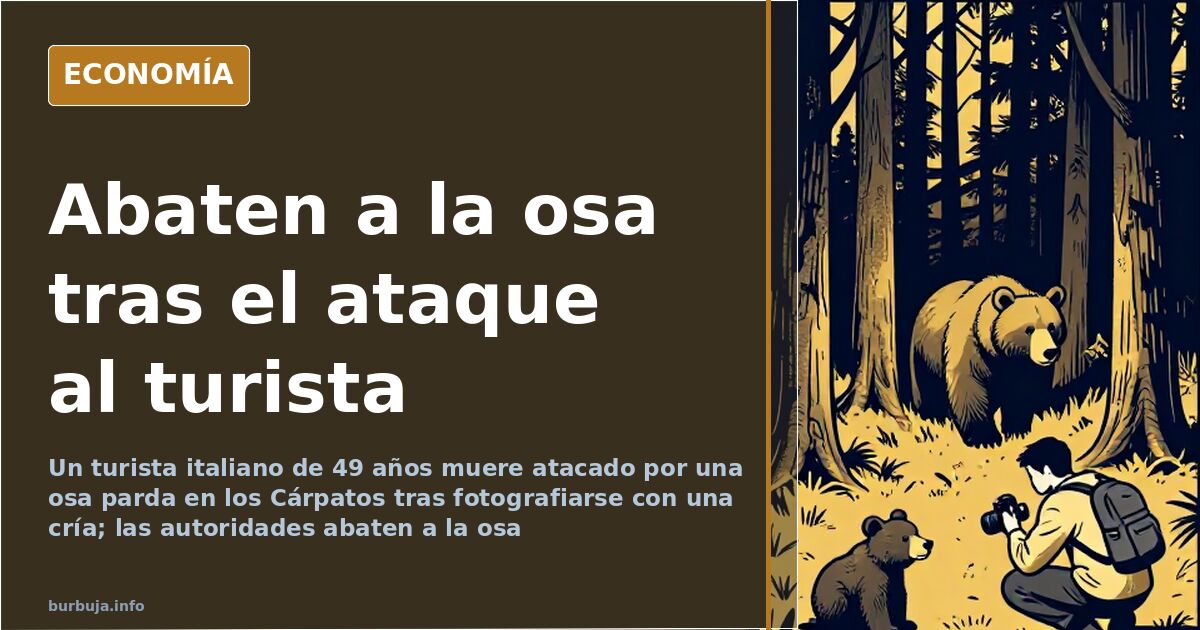
The selfie with a cub that killed the tourist and condemned the bear
Two deaths from one photo. An Italian tourist died last Thursday in the Carpathian Mountains after being attacked by a brown bear. Romanian authorities subsequently shot the animal. He was traveling alone by motorcycle in Argeș, central Romania, when the bear surprised and dragged him to the bottom of a ravine; his body was found lifeless about an hour later. The day before, he had posted Facebook images with an adult bear and smiling with a cub.
The selfie with a cub that ended in tragedy is not an isolated case, but a manual of what not to do. Authorities and wildlife experts discourage close contact with bears, both for the risk to people and the harm to animals.
What the tourist filmed before the attack
In one shared video, recorded while riding, he is heard saying: "There's the bear! How beautiful. It's coming towards me." The images show an approach that no safety protocol recommends. A cub in sight is a warning sign, not an opportunity: the mother interprets any approach as a threat to her offspring. The defensive reaction of a brown bear protecting its young is fast, decisive, and proportional to the strength of an animal that multiplies that of a human.
This is the point repeated most when analyzing the incident: there was no predation, there was defense. The tourist was not hunted; he was intercepted.
Why the bear was shot if the tourist was already dead?
Here the discrepancy begins. Part of the analysis argues that a bear that has killed and tasted human blood ceases to be a punctual risk and becomes a permanent threat, hence its sacrifice. This is the most widespread argument among those defending the Romanian authorities' decision, which confirmed the shooting.
The objection is twofold. First, that this axiom is better verified in tigers and lions, predators that do incorporate humans into their diet, than in bears, which consume little human flesh except in extreme starvation. Second, that killing the bear repairs nothing: the tourist was already dead, and the only result is leaving a cub without a mother. Some suggest a third option, transferring it to a zoo or enclosed facility, with the evident problem of who assumes that cost and risk.
What protocols say in Canada, the Pyrenees, or Hokkaido
According to a review of international protocols by a forum participant, there is no single criterion. In US and Canadian national parks, a bear can be sacrificed if it represents a continuous threat, but when the attack was defensive or provoked, it is investigated before acting. In the Pyrenees and Alps, a gradual intervention is applied: first aversion techniques to re-educate the animal, and only in extreme cases elimination. In rural areas of Hokkaido, Japan, attacking bears tend to be shot quickly. The discussion, therefore, is not whether a protocol exists, but which was applied and why.
The brown bear is not Winnie the Pooh
Another derivative of the case is zoological and dispels stereotypes in both directions. The European brown bear is an omnivore with a very vegetarian diet, capable of fleeing before attacking, which surprises those who imagined it as a pure predator. But when it decides to fight, it is something else. In comparative analyses of interspecies confrontations, the adult bear prevails over the adult tiger: it weighs twice as much, has much larger claws, and its morphology makes a neck bite impossible, which the feline uses to strangle. The polar bear, however, is another matter: without vegetable options in its environment, it sees humans directly as food.
10,000 bears, 30 deaths, and a doubled hunting quota
Romania harbors one of Europe's largest brown bear populations: between 10,000 and 13,000 individuals, according to estimates. The Ministry of Environment counts nearly 30 people killed by bear attacks in the last two decades. In 2023, Parliament doubled the annual hunting quota with the declared goal of reducing individuals that approach inhabited areas in search of food.
Wildlife experts link the increase in incidents to human pressure on the environment: urban expansion, deforestation, and poor waste management that turns landfills and roads into a free buffet. The uncomfortable conclusion is that the bear does not go down to the village because it likes people, but because the garbage is there.
The selfie as a risk genre
And then there is the cultural layer. The most repeated criticism points to a generation educated on cartoon bears —Yogi, Winnie the Pooh, stuffed toys— and the obligation to document every experience on social media. The result is a nature tourism that confuses sighting with posing. Posturing has turned encounters with wildlife into a test of courage or luck, when the sensible protocol is to maintain distance, make noise, and leave no food trace.
With these premises, the question is not why a tourist died approaching a cub. The question is how many more cases are needed for the rule to cease being a gentle recommendation and become something with consequences.
Also available in: Deutsch
Summary of a discussion on Burbuja.info - Foro de economía, actualidad y política., translated from Spanish and reviewed before publication. Read the full discussion (211 replies).
More summaries
-
Seven ministries in the crosshairs: the mega-case threatening Spain's government
Aldama's testimony points to seven Spanish ministries, with names like Bolaños, Montero and Marlaska in the spotlight. A 72-hour deadline and the suplicatorio hurdle loom.
-
Spain: Communist Hell? 18-Year-Old Receives 'Spousal Assignment' Letter from Ministry of Equality
An 18-year-old Spanish woman reportedly received a 'spousal assignment' letter from the Ministry of Equality. We investigate the claims and economic context.
-
Franco handed out 8,000 flats and today no one can buy one
Franco handed out 7,486 flats in a single event according to NODO. Today, those flats rent for 1,200 euros: public housing, an uncomfortable memory
-
Spain's Transport Minister won't rule out leading the PSOE
Spain's Transport Minister won't rule out leading the PSOE once Sánchez steps aside, but the Adamuz train crash weighs on the succession.
-
China sentences Evergrande founder to life in prison
Xu Jiayin, once China's richest man, has been sentenced to life in prison for accounting fraud. A warning to tycoons, or a political purge?
-
Pablo Iglesias loses his university teaching post for the coming year
News that Pablo Iglesias will no longer teach his planned course, first reported by La Razón, splits his supporters between conspiracy talk and mockery. Analysis and reactions.