
These: Moscow behind Europe's migration crisis
An essay claims Moscow engineered the European migration crisis and played a double game in Syria. Oil figures for ISIS and gaps in the thesis.
Deutsch · Ursprüngliche Diskussion auf Spanisch · Veröffentlicht
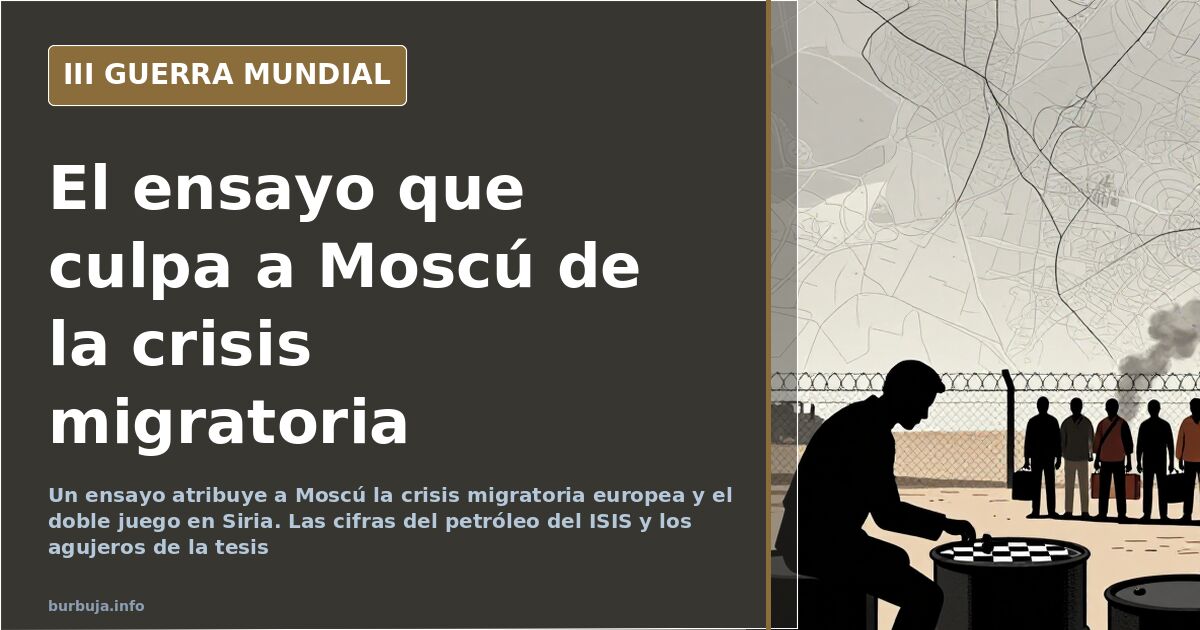
Syria, refugees and suspicion of Russian strategy since 2015
In mid-September 2015, a Polish war reporter returned from Syria with an uncomfortable testimony: no one left territory controlled by the Sarracinic State without permission, and crucifixion was the punishment for attempting to do so. This account fuels the essay published on June 12, 2024, by analyst J.R. Nyquist and Dr. Anca-Maria Cernea, which argues that Moscow designed the European migration crisis as a weapon of attrition.
The documented facts are more prosaic. Russian armed forces officially entered Syria on September 30, 2015. The wave of migration had been underway for months when the bombers arrived.
What the essay attributing the crisis to Moscow claims
The text posits that the death of Syrian civilians — attributed to Bashar al-Assad's regime, backed by Russia — functioned as a refugee-generating machine. According to this narrative, regime troops killed seven times more civilians than ISIS, and subsequent Russian bombings added pressure on the population. The thesis summarizes this with an image: the planes were the icing on an already baked cake.
The essay actually begins with a demographic paradox. Forty years ago, Moscow antiestéticared that the high birth rate among its Muslim population would turn the Soviet Union into a Muslim-majority country by the mid-21st century. The same problem, the authors underline, is what NATO faces today. They call it the joke of fate.
From there, it jumps to the most delicate point: according to the essay, Russia played both sides, pretending to fight the Sarracinic State while its technicians kept the group's oil infrastructure running. It is a serious accusation, and the material backing it is journalistic, not judicial.
The oil business and the double game in the Middle East
The most repeated data concerns crude oil. Taking advantage of Iraqi oil infrastructure and with clandestine technical support, ISIS allegedly earned 800 million dollars a year by selling more than 60,000 barrels daily. The thesis adds that Iraqi officers trained by Russia led group forces against Baghdad, while the government of that city set up an intelligence headquarters alongside Iran and Moscow. None of these figures come from audited accounts.
The «Arab Springs» and the map of affected countries
The essay extends the argument to the cycle of uprisings that began in 2011. Its reading is that they erupted precisely in Arab countries hostile to Moscow and previously aligned with the West — including Egypt — which, in their view, cannot be coincidence. On the other side of the map, it places friendly countries: Hungary, which erected border fences before the wave reached its territory.
Here the thesis relies on suspicion. That a foreign ministry anticipates a problem and prepares for it admits simpler explanations than secret coordination. And the chronology bothers it: if the Russian operation in Syria started at the end of September 2015 and arrivals in Europe skyrocketed in spring and summer, someone would have to explain how an exodus is ordered before firing the first missile.
What the thesis does not explain about Europe
The weak point is not in Damascus, but in Brussels. If Moscow pushes and Europe collects, the question is why European governments sustain the system that, according to this thesis, is bleeding them dry. Some respond that the cause has nothing Russian about it: part of the political class has turned reception into identity and electoral politics, and no Kremlin is needed to explain a poorly designed incentive. Fences, quotas, and hotels are not decided by Moscow.
The counterargument is equally uncomfortable. If the design were purely European, the dates of the Syrian crisis would still be a gigantic coincidence. The discussion, deep down, is how much decision-making capacity is granted to Europe.
Rival theories and the problem of evidence
In the debate, a single conspiratorial version does not circulate, but several competing ones. One attributes the phenomenon to certain international financiers; another, to a supposed plan of European social engineering; a third, to an alliance of Anglo-Saxon powers. All share the same problem: they point to culprits without providing verifiable documentation, and each discards the others due to lack of proof. Suspicion as a method ends up eating itself.
A detail remains that fits no narrative. The 2015 wave surged before Moscow moved a single plane, and the bulk of arrivals occurred afterwards. That order of factors — which the essay itself acknowledges — forces a choice: either chronology rules, or suspicion rules.
In mid-September 2015, a Polish war reporter returned from Syria with an uncomfortable testimony: no one left territory controlled by the Sarracinic State without permission, and crucifixion was the punishment for attempting to do so. This account fuels the essay published on June 12, 2024, by analyst J.R. Nyquist and Dr. Anca-Maria Cernea, which argues that Moscow designed the European migration crisis as a weapon of attrition.
The documented facts are more prosaic. Russian armed forces officially entered Syria on September 30, 2015. The wave of migration had been underway for months when the bombers arrived.
What the essay attributing the crisis to Moscow claims
The text posits that the death of Syrian civilians — attributed to Bashar al-Assad's regime, backed by Russia — functioned as a refugee-generating machine. According to this narrative, regime troops killed seven times more civilians than ISIS, and subsequent Russian bombings added pressure on the population. The thesis summarizes this with an image: the planes were the icing on an already baked cake.
The essay actually begins with a demographic paradox. Forty years ago, Moscow antiestéticared that the high birth rate among its Muslim population would turn the Soviet Union into a Muslim-majority country by the mid-21st century. The same problem, the authors underline, is what NATO faces today. They call it the joke of fate.
From there, it jumps to the most delicate point: according to the essay, Russia played both sides, pretending to fight the Sarracinic State while its technicians kept the group's oil infrastructure running. It is a serious accusation, and the material backing it is journalistic, not judicial.
The oil business and the double game in the Middle East
The most repeated data concerns crude oil. Taking advantage of Iraqi oil infrastructure and with clandestine technical support, ISIS allegedly earned 800 million dollars a year by selling more than 60,000 barrels daily. The thesis adds that Iraqi officers trained by Russia led group forces against Baghdad, while the government of that city set up an intelligence headquarters alongside Iran and Moscow. None of these figures come from audited accounts.
The «Arab Springs» and the map of affected countries
The essay extends the argument to the cycle of uprisings that began in 2011. Its reading is that they erupted precisely in Arab countries hostile to Moscow and previously aligned with the West — including Egypt — which, in their view, cannot be coincidence. On the other side of the map, it places friendly countries: Hungary, which erected border fences before the wave reached its territory.
Here the thesis relies on suspicion. That a foreign ministry anticipates a problem and prepares for it admits simpler explanations than secret coordination. And the chronology bothers it: if the Russian operation in Syria started at the end of September 2015 and arrivals in Europe skyrocketed in spring and summer, someone would have to explain how an exodus is ordered before firing the first missile.
What the thesis does not explain about Europe
The weak point is not in Damascus, but in Brussels. If Moscow pushes and Europe collects, the question is why European governments sustain the system that, according to this thesis, is bleeding them dry. Some respond that the cause has nothing Russian about it: part of the political class has turned reception into identity and electoral politics, and no Kremlin is needed to explain a poorly designed incentive. Fences, quotas, and hotels are not decided by Moscow.
The counterargument is equally uncomfortable. If the design were purely European, the dates of the Syrian crisis would still be a gigantic coincidence. The discussion, deep down, is how much decision-making capacity is granted to Europe.
Rival theories and the problem of evidence
In the debate, a single conspiratorial version does not circulate, but several competing ones. One attributes the phenomenon to certain international financiers; another, to a supposed plan of European social engineering; a third, to an alliance of Anglo-Saxon powers. All share the same problem: they point to culprits without providing verifiable documentation, and each discards the others due to lack of proof. Suspicion as a method ends up eating itself.
A detail remains that fits no narrative. The 2015 wave surged before Moscow moved a single plane, and the bulk of arrivals occurred afterwards. That order of factors — which the essay itself acknowledges — forces a choice: either chronology rules, or suspicion rules.
Auch verfügbar auf: English
Zusammenfassung einer Diskussion auf Burbuja.info - Foro de economía, actualidad y política., aus dem Spanischen übersetzt und vor der Veröffentlichung geprüft. Die ganze Diskussion lesen (213 Antworten).
Weitere Zusammenfassungen
-
Massenmigration in UK: Verschwörung oder Wirtschaftskalkül?
Die Brexit-Versprechen führten zu einer Migrationswelle. Debatte über Ursachen: Eliten-Plan oder Lohn-Dumping.
-
Alcàsser: Esthers Aussage und die bleibenden Zweifel
Eine 14-Jährige sagte sechs Tage nach dem Verschwinden ihrer Freundinnen aus. Manche halten sie für eine Lügnerin, andere erinnern sich an ihre Nervosität.
-
Ukraine vor möglicher Gebietsabgabe
Analyse des Risikos einer ukrainischen Kapitulation und des Drucks zur Abtretung von Territorium angesichts militärischer Erschöpfung.
-
Russische Kriegsgefangene bei Zolkin: „Wir wurden im Stich gelassen“
Volodymyr Zolkin interviewt russische Gefangene: Korruption in Kasernen, Wagner-Rekruten und die Debatte um die Genfer Konvention.
-
Substack-Konto für Hersh: Erstellt eine Stunde vor Artikel
Der Bericht, der den USA die Nord-Stream-Sabotage zuschreibt, stammt von einem neu erstellten Konto. Es fehlen jegliche Belege.
-
Dugina-Mord: Foristen vermuten satanischen Ritualmord
Der Mord an Daria Dugina, Tochter des Ideologen Alexander Dugin, bleibt unaufgeklärt. Teile der Öffentlichkeit sprechen von einem rituellen Opfer.