
New York: Police force removal of home vegetable garden
A Brooklyn resident reports being forced to uproot his vegetables. While domestic gardening is legally permitted, local enforcement practices often contradict this right.
Deutsch · Ursprüngliche Diskussion auf Spanisch · Veröffentlicht
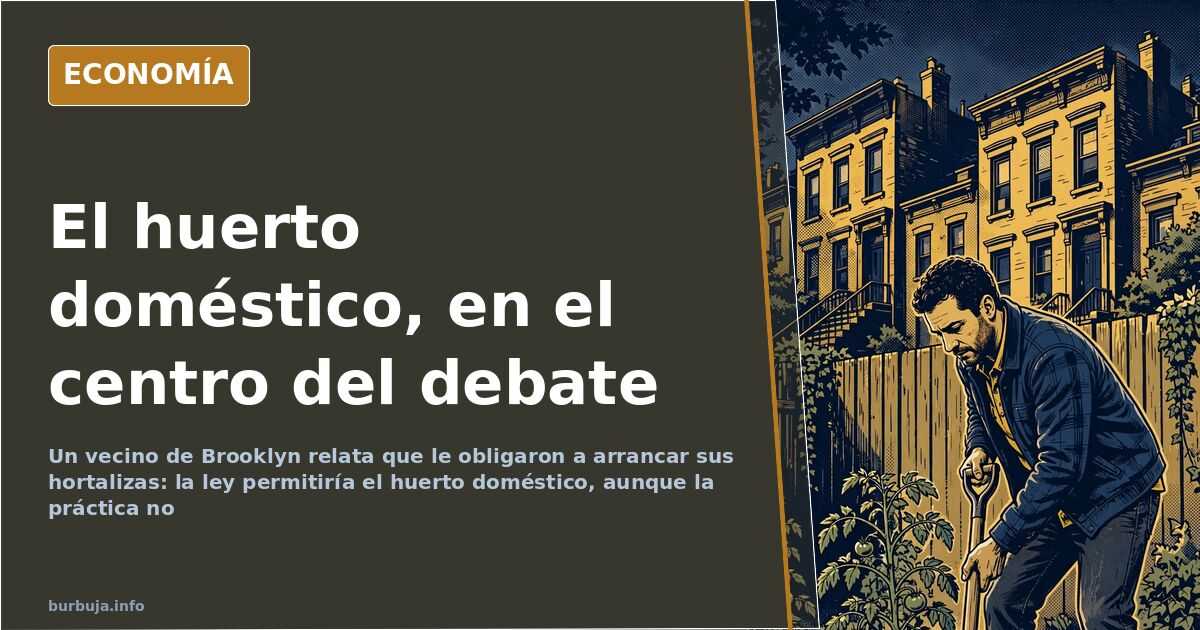
NYC police can order you to rip out your garden
Can the police enter your yard and order you to pull up lettuce? In Brooklyn, according to a widely circulated report, a neighbor was forced to remove all vegetables planted in his backyard. He argued they were for family consumption. The response, based on that testimony, was suspicion that he wanted to sell them. No produce was confiscated, no proof of sale found. Just suspicion.
This incident highlights an uncomfortable legal limbo: New York has no law banning home gardens, but local ordinances, homeowner association rules, and officer discretion can effectively destroy them. Similar patterns are reportedly occurring in Australia and Canada.
Is growing food in your yard legal in the US?
It depends on the zip code; that is the most honest answer. The narrative spread by Civil Eats claims only two states legally allow growing your own food. However, others correct this, noting that Florida and Illinois explicitly permit it, making the map even more complex. Elsewhere, municipal and community regulations prevail.
Here lies the crux. In much of the country, homeowners associations function like mini-municipalities with their own rules, restricting what species you can plant. The front yard is sacred: short grass, white picket fence, nothing breaking the aesthetic. A vegetable patch where a pristine lawn should be is seen not as food sovereignty, but as a neighborhood offense. Some compared it to the idyllic town in The Truman Show.
Water, aesthetics, and stifling regulations
The two recurring excuses are water usage and visual impact. In desert cities, water waste has been cited to sanction urban gardens, such as a reported case in New Mexico involving hefty fines. Similarly, collecting pinecones or firewood from public land is quickly penalized—resources that grow naturally and technically belong to no one.
However, when forests become private estates, the situation changes. Some describe licensing models: paying a few euros to harvest significant amounts of mushrooms or fruits within designated areas. The same activity is either a crime or a business depending on who holds the paperwork. In Spain, cases of harvesting 85 kg of saffron milk caps have led to seizures, clashing with the traditional practice of selling gathered goods to shops and restaurants.
From personal gardens to seed control
This shifts the debate from lawn care to pure economics. If you save seeds from your tomatoes, peppers, or lettuce—letting plants go to seed—you buy nothing. And those who don't buy seeds don't buy the full package: seeds, herbicides, and fertilizers from the same supplier. The global suspicion is that the ultimate goal is to make all plants genetically modified and sterile, forcing farmers and hobbyists to pay every season.
Against this, organized responses exist, albeit modest: seed networks. In the Basque Country (Euskadi), a network distributes varieties among individuals with the sole commitment to return seeds from the harvest. They recover native crops, better adapted to local terrain though less productive than commercial varieties. Others note that fertile lands accumulated by billionaires—such as Bill Gates—are not subject to this regulatory harassment.
Spain: Riverbank gardens removed and €10,000 fines]
The European narrative is no less alarming. Reports describe a municipality where a new administration removed all riverbank gardens maintained by residents for generations, fining anyone planting anything up to €10,000. Years later, the area is arid where greenery once thrived, and neighbors no longer share potatoes and peppers. Promised walkways never compensated for the loss.
Additionally, there is growing antiestéticar that restrictions will extend to backyard livestock: chickens, rabbits, beehives. The method would likely mirror current tactics: health excuses, media reports of poisoning, and unchallenged emergency decrees. Some argue that satellite software capable of analyzing individual plots will soon make monitoring foreign gardens a reality.
Why money matters
There is an argument requiring no conspiracy theory. Those who grow their own food exit the tax circuit: no VAT on those foods, no taxes along the supply chain—producer, distributor, supermarket—and no income tax on wages paid. If barter between neighbors became widespread, revenue associated with shopping baskets would deflate. No master plan is needed; just look at where the money comes from.
It is crucial to separate fact from fiction. That Brooklyn residents were forced to uproot vegetables is a testimony, not a court ruling. That only two states legally allow gardens is a claim disputed within the source material itself. Assertions about specific communities having zero health issues lack backing and remain unsubstantiated here.
Conclusion
For Spanish enthusiasts, practical details matter: in Galicia, collecting firewood from mountains is allowed; elsewhere, it is not. In the northwest, you can plant freely at home, while in half a dozen autonomous regions, it depends on the local council's mood. Given this landscape, the sensible approach is planting parsley in a pot and relying on no one. But if the urban planning committee dislikes chard, even the pot may not survive.
Can the police enter your yard and order you to pull up lettuce? In Brooklyn, according to a widely circulated report, a neighbor was forced to remove all vegetables planted in his backyard. He argued they were for family consumption. The response, based on that testimony, was suspicion that he wanted to sell them. No produce was confiscated, no proof of sale found. Just suspicion.
This incident highlights an uncomfortable legal limbo: New York has no law banning home gardens, but local ordinances, homeowner association rules, and officer discretion can effectively destroy them. Similar patterns are reportedly occurring in Australia and Canada.
Is growing food in your yard legal in the US?
It depends on the zip code; that is the most honest answer. The narrative spread by Civil Eats claims only two states legally allow growing your own food. However, others correct this, noting that Florida and Illinois explicitly permit it, making the map even more complex. Elsewhere, municipal and community regulations prevail.
Here lies the crux. In much of the country, homeowners associations function like mini-municipalities with their own rules, restricting what species you can plant. The front yard is sacred: short grass, white picket fence, nothing breaking the aesthetic. A vegetable patch where a pristine lawn should be is seen not as food sovereignty, but as a neighborhood offense. Some compared it to the idyllic town in The Truman Show.
Water, aesthetics, and stifling regulations
The two recurring excuses are water usage and visual impact. In desert cities, water waste has been cited to sanction urban gardens, such as a reported case in New Mexico involving hefty fines. Similarly, collecting pinecones or firewood from public land is quickly penalized—resources that grow naturally and technically belong to no one.
However, when forests become private estates, the situation changes. Some describe licensing models: paying a few euros to harvest significant amounts of mushrooms or fruits within designated areas. The same activity is either a crime or a business depending on who holds the paperwork. In Spain, cases of harvesting 85 kg of saffron milk caps have led to seizures, clashing with the traditional practice of selling gathered goods to shops and restaurants.
From personal gardens to seed control
This shifts the debate from lawn care to pure economics. If you save seeds from your tomatoes, peppers, or lettuce—letting plants go to seed—you buy nothing. And those who don't buy seeds don't buy the full package: seeds, herbicides, and fertilizers from the same supplier. The global suspicion is that the ultimate goal is to make all plants genetically modified and sterile, forcing farmers and hobbyists to pay every season.
Against this, organized responses exist, albeit modest: seed networks. In the Basque Country (Euskadi), a network distributes varieties among individuals with the sole commitment to return seeds from the harvest. They recover native crops, better adapted to local terrain though less productive than commercial varieties. Others note that fertile lands accumulated by billionaires—such as Bill Gates—are not subject to this regulatory harassment.
Spain: Riverbank gardens removed and €10,000 fines]
The European narrative is no less alarming. Reports describe a municipality where a new administration removed all riverbank gardens maintained by residents for generations, fining anyone planting anything up to €10,000. Years later, the area is arid where greenery once thrived, and neighbors no longer share potatoes and peppers. Promised walkways never compensated for the loss.
Additionally, there is growing antiestéticar that restrictions will extend to backyard livestock: chickens, rabbits, beehives. The method would likely mirror current tactics: health excuses, media reports of poisoning, and unchallenged emergency decrees. Some argue that satellite software capable of analyzing individual plots will soon make monitoring foreign gardens a reality.
Why money matters
There is an argument requiring no conspiracy theory. Those who grow their own food exit the tax circuit: no VAT on those foods, no taxes along the supply chain—producer, distributor, supermarket—and no income tax on wages paid. If barter between neighbors became widespread, revenue associated with shopping baskets would deflate. No master plan is needed; just look at where the money comes from.
It is crucial to separate fact from fiction. That Brooklyn residents were forced to uproot vegetables is a testimony, not a court ruling. That only two states legally allow gardens is a claim disputed within the source material itself. Assertions about specific communities having zero health issues lack backing and remain unsubstantiated here.
Conclusion
For Spanish enthusiasts, practical details matter: in Galicia, collecting firewood from mountains is allowed; elsewhere, it is not. In the northwest, you can plant freely at home, while in half a dozen autonomous regions, it depends on the local council's mood. Given this landscape, the sensible approach is planting parsley in a pot and relying on no one. But if the urban planning committee dislikes chard, even the pot may not survive.
Auch verfügbar auf: English
Zusammenfassung einer Diskussion auf Burbuja.info - Foro de economía, actualidad y política., aus dem Spanischen übersetzt und vor der Veröffentlichung geprüft. Die ganze Diskussion lesen (248 Antworten).
Weitere Zusammenfassungen
-
Tödlicher Streit in New Yorker U-Bahn: Frau sticht Mann nieder
In einer Brooklyn-U-Bahn ersticht eine Frau den Angreifer ihres Partners, der daraufhin eine Waffe zieht und stirbt. Ein Verdächtiger wurde festgenommen.
-
Tunnel unter Chabad-Synagoge in Brooklyn: Verhaftungen und Falschmeldungen
Der Fund von Tunneln unter der Chabad-Synagoge in Brooklyn führt zu Verhaftungen, Verwirrung und unbewiesenen Gerüchten. Es gibt keine offizielle Erklärung.
-
Mietbestand in Spanien bricht laut Forum ein
Ein Forum meldet einen Rückgang des Mietangebots um 3% an einem Tag. Madrid verlor seit 2012 über 8.000 Inserate, was auf das 'Mari Carmen'-Dekret zurückgeführt wird.
-
Mietangebot in Madrid und Barcelona um 70 % eingebrochen
Das Mietangebot ist laut Expansión in Madrid und Barcelona um 70 % gesunken, da Eigentümer ihre Wohnungen aus Angst vor Mietausfällen zurückziehen.
-
Milei: Argentiniens Lebensstandard wie USA in 35 Jahren
Javier Milei verspricht, dass Argentinien den Lebensstandard von Frankreich und Italien in 15 Jahren erreicht. Kritiker bezweifeln die Berechnungen.
-
Citroën-Chef: Kein Auto unter 15.000 Euro bremst Verkauf
Citroëns CEO sagt, Kunden kaufen keine Neuwagen, weil es kaum Modelle unter 15.000 Euro gibt. Wir analysieren Preise, Löhne und Qualität im aktuellen Automarkt.