
Explosion in Texas dairy farm kills over 18,000 cows
Over 18,000 cows died in a Texas farm explosion, a number comparable to the entire dairy herd of the Basque Country.
Deutsch · Ursprüngliche Diskussion auf Spanisch · Veröffentlicht
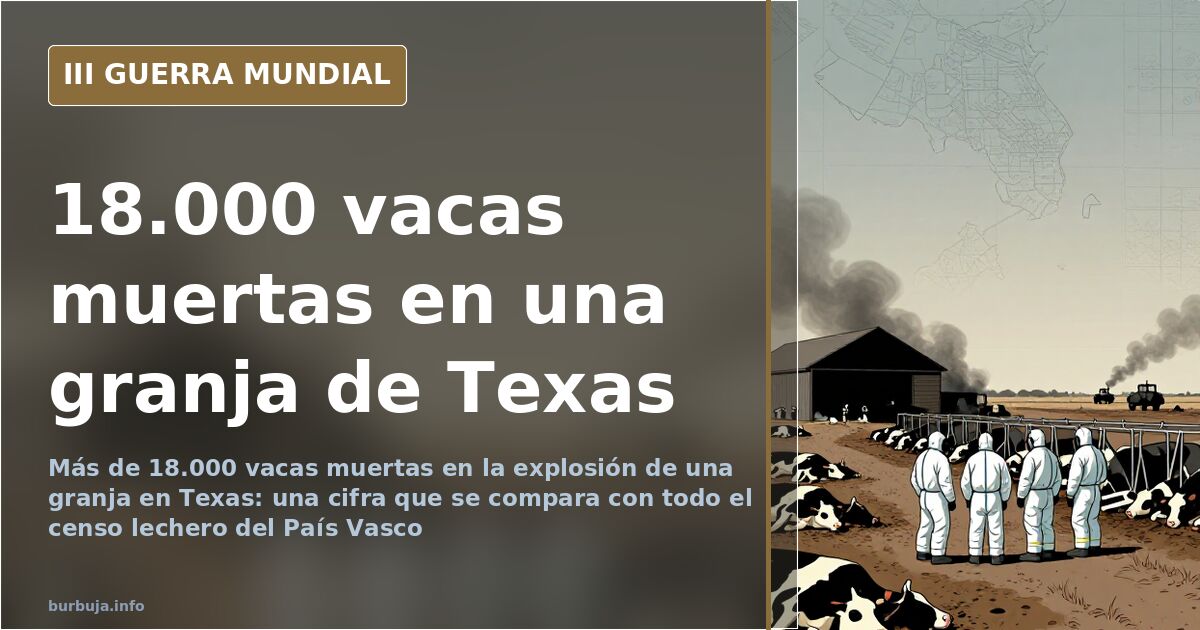
Texas: 18,000 cows dead after farm explosion
More than 18,000 dairy cows are dead and one person is in critical condition. This is the toll from the explosion and fire that occurred on Monday afternoon at South Fork Dairy in Dimmitt, a municipality in Texas. Initial reports collected by US media place the number of deceased animals above this figure in a dairy cattle facility. The data is deceptive: depending on how it is measured, it is either a colossal catastrophe or negligible within the livestock census.
What is known about the explosion at the Dimmitt farm
Confirmed details are scarce and should not be embellished. An explosion trinc by a fire at a milking operation on Monday afternoon. More than 18,000 cows dead. One critically injured person, whose status has not been disclosed beyond that classification. Local authorities reportedly confirmed the number of dead animals, according to published information. What does not appear anywhere in the early stages is an official cause.
No technical report, no hypothesis supported by emergency services, and no explanation of what material or installation could have caused the deflagration. Speculation has filled the void, and there is plenty of it.
18,000 cows: How many is that and what does it compare to?
Here is the interesting part. The figure is better understood when translated into the Spanish dairy census: 18,000 milking cows are approximately equivalent to the entire dairy herd of the Basque Country, according to comparisons circulating in the debate. The Community of Madrid was initially estimated at 6,300 dairy cows; this was later revised upwards with INE data to 13,200. Galicia, the region with the largest census, has 450,000, more than a third of the national total.
Looking across the Atlantic, the impact diminishes. The United States had 89.3 million heads of cattle and calves as of January 1, 2023, according to the National Agricultural Statistics Service of the US Department of Agriculture. Cattle dedicated to milk production hover around 9.5 million. Translated: the cows dead in Dimmitt represent about 0.02% of the total bovine census and around 0.2% of the dairy herd, according to calculations circulating in the debate.
A drop in the ocean, put bluntly. The complete arithmetic, with percentages broken down step by step, forms part of those same calculations.
Why is the mega-farm model questioned?
Because putting thousands of animals in permanent housing concentrates risk: when something catches fire, you don't lose dozens of heads, you lose thousands. This idea runs through much of the reaction to the disaster. Some directly call it barbaric and argue that even China does not have such concentration, pointing out that Texas has plenty of land for grazing. The harshest comparison, equating these sheds with confinement facilities, also circulates, though without claiming literal equivalence. Mega-farm has ceased to be a technical term.
The Spanish mirror works. In Noviercas, a farm of 24,000 cows was planned but ultimately did not obtain permission, a precedent cited as proof that administrative brakes exist. And an uncomfortable nuance appears for consumers: even self-declared carnivores admit they would pay more for a bearable life for these animals, and denounce the lack of industrial safety systems, such as doors that open automatically so the cattle could escape. Those who have worked in slaughterhouses refer to their time in such facilities.
Meat consumption as the backdrop
The disaster has peine the discussion about what sustains a shed with 18,000 cows inside. It is argued that the United States is the world's largest meat consumer, with about 100 kilos per person per year, in one of the highest-income countries where animal protein is cheap. From this comes the most repeated thesis: if the product is affordable, keeping animals in minimally dignified conditions should not be a luxury, but a cost incorporated into the price.
On the other side plays the counter-argument. Soybean cultivation for feed also has a climate footprint and pollutes, so the sarracena superiority of those pointing fingers at others' plates is questionable. In the middle, there is noise: part of vegan activism has pointed to the buyer as the ultimate accomplice in the conditions in which livestock live, with direct reproaches to those who consume meat and dairy. The reproach has been returned in kind from the opposite side. No new data on what peine in Dimmitt has emerged from this exchange of accusations.
Suspicions of sabotage without any proof
There are those who attribute the disaster to intentional action: sabotage, attacks by animal rights groups, even false flag operations. These are hypotheses circulating without evidentiary support, without official confirmation, and based only on the accumulation of similar incidents in farming operations, a coincidence used as an argument but proving no link. It is worth stating before suspicion settles into narrative: as of this discussion, there is no confirmed official cause.
The matter remains exactly where it started. 18,000 cows dead, one person critically injured, and no official explanation. Everything else is calculations and opinions that the disaster itself does not resolve. When the technical report arrives, the figure that seems monstrous today will have to fit into a census of 89.3 million heads. That is where everything gets stuck.
More than 18,000 dairy cows are dead and one person is in critical condition. This is the toll from the explosion and fire that occurred on Monday afternoon at South Fork Dairy in Dimmitt, a municipality in Texas. Initial reports collected by US media place the number of deceased animals above this figure in a dairy cattle facility. The data is deceptive: depending on how it is measured, it is either a colossal catastrophe or negligible within the livestock census.
What is known about the explosion at the Dimmitt farm
Confirmed details are scarce and should not be embellished. An explosion trinc by a fire at a milking operation on Monday afternoon. More than 18,000 cows dead. One critically injured person, whose status has not been disclosed beyond that classification. Local authorities reportedly confirmed the number of dead animals, according to published information. What does not appear anywhere in the early stages is an official cause.
No technical report, no hypothesis supported by emergency services, and no explanation of what material or installation could have caused the deflagration. Speculation has filled the void, and there is plenty of it.
18,000 cows: How many is that and what does it compare to?
Here is the interesting part. The figure is better understood when translated into the Spanish dairy census: 18,000 milking cows are approximately equivalent to the entire dairy herd of the Basque Country, according to comparisons circulating in the debate. The Community of Madrid was initially estimated at 6,300 dairy cows; this was later revised upwards with INE data to 13,200. Galicia, the region with the largest census, has 450,000, more than a third of the national total.
Looking across the Atlantic, the impact diminishes. The United States had 89.3 million heads of cattle and calves as of January 1, 2023, according to the National Agricultural Statistics Service of the US Department of Agriculture. Cattle dedicated to milk production hover around 9.5 million. Translated: the cows dead in Dimmitt represent about 0.02% of the total bovine census and around 0.2% of the dairy herd, according to calculations circulating in the debate.
A drop in the ocean, put bluntly. The complete arithmetic, with percentages broken down step by step, forms part of those same calculations.
Why is the mega-farm model questioned?
Because putting thousands of animals in permanent housing concentrates risk: when something catches fire, you don't lose dozens of heads, you lose thousands. This idea runs through much of the reaction to the disaster. Some directly call it barbaric and argue that even China does not have such concentration, pointing out that Texas has plenty of land for grazing. The harshest comparison, equating these sheds with confinement facilities, also circulates, though without claiming literal equivalence. Mega-farm has ceased to be a technical term.
The Spanish mirror works. In Noviercas, a farm of 24,000 cows was planned but ultimately did not obtain permission, a precedent cited as proof that administrative brakes exist. And an uncomfortable nuance appears for consumers: even self-declared carnivores admit they would pay more for a bearable life for these animals, and denounce the lack of industrial safety systems, such as doors that open automatically so the cattle could escape. Those who have worked in slaughterhouses refer to their time in such facilities.
Meat consumption as the backdrop
The disaster has peine the discussion about what sustains a shed with 18,000 cows inside. It is argued that the United States is the world's largest meat consumer, with about 100 kilos per person per year, in one of the highest-income countries where animal protein is cheap. From this comes the most repeated thesis: if the product is affordable, keeping animals in minimally dignified conditions should not be a luxury, but a cost incorporated into the price.
On the other side plays the counter-argument. Soybean cultivation for feed also has a climate footprint and pollutes, so the sarracena superiority of those pointing fingers at others' plates is questionable. In the middle, there is noise: part of vegan activism has pointed to the buyer as the ultimate accomplice in the conditions in which livestock live, with direct reproaches to those who consume meat and dairy. The reproach has been returned in kind from the opposite side. No new data on what peine in Dimmitt has emerged from this exchange of accusations.
Suspicions of sabotage without any proof
There are those who attribute the disaster to intentional action: sabotage, attacks by animal rights groups, even false flag operations. These are hypotheses circulating without evidentiary support, without official confirmation, and based only on the accumulation of similar incidents in farming operations, a coincidence used as an argument but proving no link. It is worth stating before suspicion settles into narrative: as of this discussion, there is no confirmed official cause.
The matter remains exactly where it started. 18,000 cows dead, one person critically injured, and no official explanation. Everything else is calculations and opinions that the disaster itself does not resolve. When the technical report arrives, the figure that seems monstrous today will have to fit into a census of 89.3 million heads. That is where everything gets stuck.
Auch verfügbar auf: English
Zusammenfassung einer Diskussion auf Burbuja.info - Foro de economía, actualidad y política., aus dem Spanischen übersetzt und vor der Veröffentlichung geprüft. Die ganze Diskussion lesen (143 Antworten).
Weitere Zusammenfassungen
-
US-General Mike Minihan erwartet China-Krieg 2025
Ein geleaktes Memo des US-Generals Mike Minihan datiert einen Krieg mit China auf 2025 und ordnet Vorbereitungen der Air Force an.
-
US-Strategie im globalen Konflikt: Machtanalysen
Analyse der US-Strategie im globalen Konflikt: wirtschaftliche Auswirkungen, Dollar-Hegemonie und Kosten für Europa.
-
Alcàsser: Esthers Aussage und die bleibenden Zweifel
Eine 14-Jährige sagte sechs Tage nach dem Verschwinden ihrer Freundinnen aus. Manche halten sie für eine Lügnerin, andere erinnern sich an ihre Nervosität.
-
Putin trifft Wahlgegner: Kreml-Bilder wirken kontraproduktiv
Der Kreml veröffentlicht Bilder eines Treffens zwischen Putin und drei Scheinkandidaten. Die angespannten Gesichter der Gegner untergraben die Inszenierung der Wahl.
-
EU-Parlament fordert Erlaubnis für Ukraine-Angriffe auf Russland
Das EU-Parlament bittet die 27 Mitgliedstaaten, der Ukraine den Einsatz von Waffen auf russischem Boden zu gestatten. Putin warnt vor einem direkten Angriff.
-
Das Leben ist kein Mist: Deine Denkweise schon
Leiden entsteht nicht durch die Welt, sondern durch unsere Interpretation. Relativismus, System-Schuld und reale Ordnung stehen zur Debatte.