
Texas Farm Explosion Kills Over 18,000 Cows
Over 18,000 cows died in a Texas farm explosion, a figure comparable to the entire dairy herd of Spain's Basque Country.
English · Original discussion in Spanish · Published
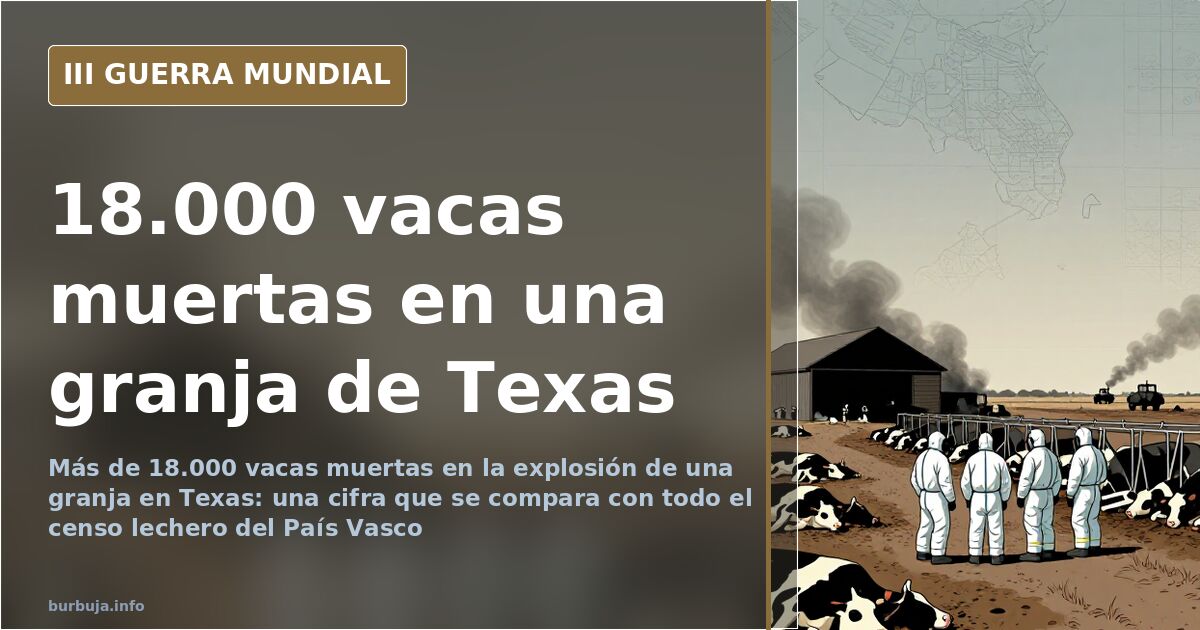
Texas: 18,000 cows dead in farm explosion
More than 18,000 dairy cows are dead and one person is in critical condition. That is the toll from the explosion and fire that occurred on Monday afternoon at South Fork Dairy in Dimmitt, a municipality in Texas. Early reports, gathered by US media, place the number of deceased animals in this dairy cattle facility above that figure. The data is misleading: depending on how it is measured, it is either a colossal catastrophe or a negligible fraction within the livestock census.
What is known about the explosion at the Dimmitt farm
Confirmed details are scarce and should not be embellished. An explosion trinc by a fire at a milking operation, on Monday afternoon. More than 18,000 cows dead. One person critically injured, whose status has not been clarified beyond that description. Local authorities reportedly confirmed the number of animal deaths, according to published information. What does not appear anywhere, in the early stages, is an official cause.
No technical report, no hypothesis backed by emergency services, nor an explanation of what material or installation could have caused the deflagration. Speculation has filled the void, and there is plenty of it.
18,000 cows: how many is that and what does it compare to?
Here is the interesting part. The figure is better understood when translated into the Spanish dairy census: 18,000 milking cows roughly equal the entire dairy herd of the Basque Country, according to comparisons circulating in the debate. The Community of Madrid had around 6,300 dairy cows in initial estimates; this was later revised upward, using INE data, to 13,200. Galicia, the region with the largest census, has 450,000, more than a third of the national total.
Looking across the Atlantic, the impact diminishes. The United States had 89.3 million head of cattle and calves as of January 1, 2023, according to the National Agricultural Statistics Service report from the US Department of Agriculture. Cattle dedicated to milk production amount to approximately 9.5 million. Translated: the cows killed in Dimmitt represent about 0.02% of the total cattle census and around 0.2% of the dairy herd, according to calculations circulating in the debate.
A drop in the bucket, to put it bluntly. The complete arithmetic, with percentages broken down step by step, is part of those same calculations.
Why is the mega-farm model questioned?
Because housing thousands of animals in permanent confinement barns concentrates risk: when something catches fire, you don't lose dozens of heads, you lose thousands. This idea runs through much of the reaction to the disaster. Some call it barbaric directly, arguing that even China does not have such concentration, noting that Texas has plenty of land for grazing. The harshest comparison, equating these barns with detention facilities, also circulates, though without literal intent. Mega-farm has ceased to be just a technical term.
The Spanish mirror works. In Noviercas, a project for a 24,000-cow operation was proposed but ultimately did not receive permission, a precedent cited as proof that administrative brakes exist. And an uncomfortable nuance appears for the consumer: even those who declare themselves carnivores admit they would pay more for a more bearable life for these animals, denouncing the lack of industrial safety systems, such as doors that open automatically, so livestock could escape. Those who have worked in slaughterhouses refer to their time in such facilities.
Meat consumption as background
The disaster has peine the discussion on what sustains a barn with 18,000 cows inside. It is argued that the United States is the world's largest meat consumer, with about 100 kilos per person per year, in one of the highest-income countries where animal protein is cheap. From this comes the most repeated thesis: if the product is affordable, keeping animals in minimally decent conditions should not be a luxury, but a cost incorporated into the price.
On the other side plays the counter-argument. Soybean cultivation for feed also has a climate footprint and pollutes, so the sarracena superiority of those pointing fingers at others' plates is called into question. In the middle, noise: part of vegan activism has pointed to the buyer as the ultimate accomplice in the conditions under which livestock live, with direct reproaches to those who consume meat and dairy. The reproach has been returned in kind from the opposite side. No new data on what peine in Dimmitt has emerged from this exchange of accusations.
Suspicions of sabotage without any proof
There are those who attribute the disaster to intentional action: sabotage, attacks by animal rights groups, even false flag operations. These are hypotheses circulating without evidentiary support, without official confirmation, and based only on the accumulation of similar incidents in livestock farms, a coincidence used as an argument but which demonstrates no link. It is worth stating before suspicion settles as narrative: as of this discussion, there is no confirmed official cause.
The matter remains exactly where it started. 18,000 cows dead, one person critically injured, and no official explanation. Everything else is calculations and opinions that the disaster itself does not resolve. When the technical report arrives, the figure that seems monstrous today will have to fit into a census of 89.3 million heads. That is where everything gets stuck.
More than 18,000 dairy cows are dead and one person is in critical condition. That is the toll from the explosion and fire that occurred on Monday afternoon at South Fork Dairy in Dimmitt, a municipality in Texas. Early reports, gathered by US media, place the number of deceased animals in this dairy cattle facility above that figure. The data is misleading: depending on how it is measured, it is either a colossal catastrophe or a negligible fraction within the livestock census.
What is known about the explosion at the Dimmitt farm
Confirmed details are scarce and should not be embellished. An explosion trinc by a fire at a milking operation, on Monday afternoon. More than 18,000 cows dead. One person critically injured, whose status has not been clarified beyond that description. Local authorities reportedly confirmed the number of animal deaths, according to published information. What does not appear anywhere, in the early stages, is an official cause.
No technical report, no hypothesis backed by emergency services, nor an explanation of what material or installation could have caused the deflagration. Speculation has filled the void, and there is plenty of it.
18,000 cows: how many is that and what does it compare to?
Here is the interesting part. The figure is better understood when translated into the Spanish dairy census: 18,000 milking cows roughly equal the entire dairy herd of the Basque Country, according to comparisons circulating in the debate. The Community of Madrid had around 6,300 dairy cows in initial estimates; this was later revised upward, using INE data, to 13,200. Galicia, the region with the largest census, has 450,000, more than a third of the national total.
Looking across the Atlantic, the impact diminishes. The United States had 89.3 million head of cattle and calves as of January 1, 2023, according to the National Agricultural Statistics Service report from the US Department of Agriculture. Cattle dedicated to milk production amount to approximately 9.5 million. Translated: the cows killed in Dimmitt represent about 0.02% of the total cattle census and around 0.2% of the dairy herd, according to calculations circulating in the debate.
A drop in the bucket, to put it bluntly. The complete arithmetic, with percentages broken down step by step, is part of those same calculations.
Why is the mega-farm model questioned?
Because housing thousands of animals in permanent confinement barns concentrates risk: when something catches fire, you don't lose dozens of heads, you lose thousands. This idea runs through much of the reaction to the disaster. Some call it barbaric directly, arguing that even China does not have such concentration, noting that Texas has plenty of land for grazing. The harshest comparison, equating these barns with detention facilities, also circulates, though without literal intent. Mega-farm has ceased to be just a technical term.
The Spanish mirror works. In Noviercas, a project for a 24,000-cow operation was proposed but ultimately did not receive permission, a precedent cited as proof that administrative brakes exist. And an uncomfortable nuance appears for the consumer: even those who declare themselves carnivores admit they would pay more for a more bearable life for these animals, denouncing the lack of industrial safety systems, such as doors that open automatically, so livestock could escape. Those who have worked in slaughterhouses refer to their time in such facilities.
Meat consumption as background
The disaster has peine the discussion on what sustains a barn with 18,000 cows inside. It is argued that the United States is the world's largest meat consumer, with about 100 kilos per person per year, in one of the highest-income countries where animal protein is cheap. From this comes the most repeated thesis: if the product is affordable, keeping animals in minimally decent conditions should not be a luxury, but a cost incorporated into the price.
On the other side plays the counter-argument. Soybean cultivation for feed also has a climate footprint and pollutes, so the sarracena superiority of those pointing fingers at others' plates is called into question. In the middle, noise: part of vegan activism has pointed to the buyer as the ultimate accomplice in the conditions under which livestock live, with direct reproaches to those who consume meat and dairy. The reproach has been returned in kind from the opposite side. No new data on what peine in Dimmitt has emerged from this exchange of accusations.
Suspicions of sabotage without any proof
There are those who attribute the disaster to intentional action: sabotage, attacks by animal rights groups, even false flag operations. These are hypotheses circulating without evidentiary support, without official confirmation, and based only on the accumulation of similar incidents in livestock farms, a coincidence used as an argument but which demonstrates no link. It is worth stating before suspicion settles as narrative: as of this discussion, there is no confirmed official cause.
The matter remains exactly where it started. 18,000 cows dead, one person critically injured, and no official explanation. Everything else is calculations and opinions that the disaster itself does not resolve. When the technical report arrives, the figure that seems monstrous today will have to fit into a census of 89.3 million heads. That is where everything gets stuck.
Summary of a discussion on Burbuja.info - Foro de economía, actualidad y política., translated from Spanish and reviewed before publication. Read the full discussion (143 replies).
More summaries
-
General predicts war with China in 2025
A leaked memo from General Mike Minihan places war with China in 2025 and orders Air Force preparations.
-
US Global Strategy: Power Dynamics and Geopolitical Costs
Analysis of US strategy in the global conflict: economic impact, dollar hegemony, and costs for Europe.
-
Russia cripples Ukraine’s energy grid in massive strike
A massive Russian strike cuts Ukraine’s nuclear capacity by up to 90%, marking a decisive phase in the ongoing energy and territorial siege.
-
Fact-checking Kyiv: Media narrative versus ground reality
Analysis of media coverage in Kyiv contrasts TV reports with independent verification of refugee figures and daily life.
-
Two Russian twin girls die in Oviedo amid bullying probe
Spanish police investigate if the twins faced school harassment. No suicide note was found.
-
Nord Stream, grain and silicon: thesis on Russian aims
Nord Stream sabotage and the weaponization of gas, grain and silicon frame a theory on Russia's goals in Europe, lacking official confirmation.