
DANA in Valencia: No warnings, no rescue, uncollected bodies
The DANA disaster in Valencia left bodies uncollected and alerts undelivered. The debate over official figures and political responsibility continues.
Deutsch · Ursprüngliche Diskussion auf Spanisch · Veröffentlicht
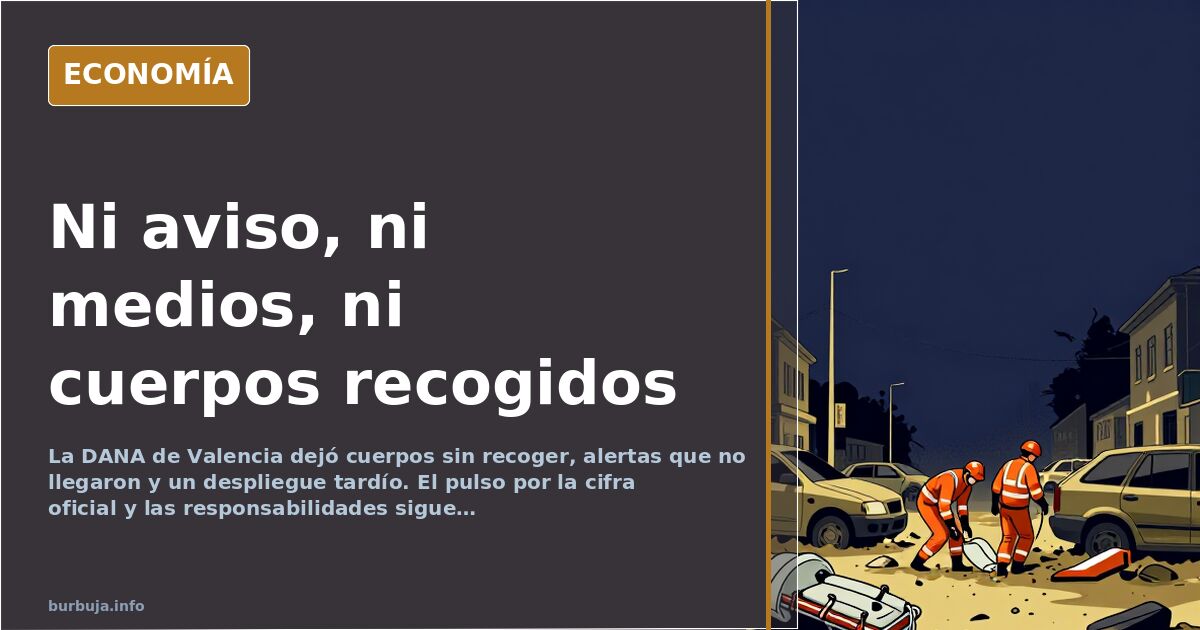
Valencia: No prior warning, no resources, no body recovery
The institutional response to the DANA that devastated the province of Valencia in 2024 failed at every stage: forecasting, alerting, deployment, and rescue. This is the dominant thesis in the ongoing discussion trinc the tragedy. An uncomfortable detail nuances this view: some of those demanding explanations had previously protested because mobile alert messages seemed "too intrusive" to them. Both things are true and do not cancel each other out.
The balance sheet that no one signs: bodies left in the mud, an official figure that trickles out slowly, and the impression that the State was not where it should have been. The drip-feed of data is also part of the problem.
Why the alert did not reach mobile phones
The paradox is summed up by a repeated complaint: the meteorological agency had spent the entire summer with red maps, heat warnings, and calls to restrict water use, yet when the real danger was flooding, the mass message did not appear. This contrast—those who warn about the predictable stay silent before the lethal—is the fuel for indignation.
The objection is equally solid. A system capable of instantly alerting the entire population existed, had been activated previously with sufficient lead time, and was met with complaints about being intrusive. For part of the analysis, the failure is managerial; for another, it stems from a culture of suspicion. Neither explanation alone accounts for what peine.
Deployment: UME, Army, and the SMS that was not sent
The central accusation is the lack of resources. It is argued that the response was limited to a small contingent of the Military Emergency Unit (UME) and little else: no command center, no corridors for water and food, and soldiers complaining about receiving no orders. In parallel, a specific proposal circulates: send every resident the same SMS that the Japanese embassy sent to its nationals, a message which, according to this thesis, would have saved lives.
Contrasts with other countries are used as evidence. In the United States, federal power is almost anecdotal in domestic matters, but there is a specific agency that activates immediately during a catastrophe. The summary of the complaint, in one line: the State collects taxes but does not show up.
Uncollected bodies and figures that don't add up
Among the most serious accusations is the delay in removing corpses. The description is raw and formulated as suspicion, not proven fact: bodies in cars, homes, and mud days later, with the associated health risks. The same line argues that the actual number of deaths is rationed to control the narrative.
Here the debate loses any possibility of closure. Without verifiable data, any figure is simultaneously insufficient and suspicious, and the information vacuum is filled by hypotheses. There is no official figure that anyone has accepted as accurate.
Taxes and flood zones: the calendar that causes outrage
While missing persons were being searched for, published reports detailed a fiscal agreement with more than €4 billion at stake: increases in diesel and tobacco taxes, new levies on banks, and a package that parliamentary arithmetic forced to be cut back. The contrast between that procedure and the mud needs no comment.
Add the precedent. In 2022, according to circulating accusations, several regional governments would have requested the removal of flood zone maps to avoid harming real estate developments. And in 2019 there was another DANA. The pattern drawn—warning about climate while disabling prevention—is what causes the most discomfort.
1962, Maui, Chile: comparisons that subtract or add
The dispute over whether this is "the greatest catastrophe" has its own battle. The 1962 Vallés flood, with around a thousand deaths, is recalled, and episodes in Maui, Chile, or Florida are cited where, according to this reading, authorities turned evacuation routes into traps.
There is a demographic argument supporting the caution demanded by some: with the current population, any comparable episode exceeds previous ones in impact. And a fine print that few dispute: much of the victims died where it was no longer raining.
Resignations, signatures, and political responsibility
The final phase of discontent is organized along three paths: civil, incivil, and political responsibility. One petition drive directly demands the resignation of the President of the Government; another stream rejects this outcome and demands accountability through justice. There is even debate over whether the reproach should extend to the central Executive or the regional government.
Cross-accusation is the dominant antiestéticature. Each administration points to the other, and citizens who lost someone watch the exchange. Strength and honor to the victims is the formula closing almost all messages, and it is no coincidence: it is the only thing upon which there is agreement.
If anything can be anticipated, with all reservations, it is that the struggle over figures and responsibilities will weigh more than the technical debate on forecasting. The demands already formulated—civil, incivil, and political—will set the pace. None will resolve the fundamental question: why an existing alert was not issued when it was most needed.
Auch verfügbar auf: English
Zusammenfassung einer Diskussion auf Burbuja.info - Foro de economía, actualidad y política., aus dem Spanischen übersetzt und vor der Veröffentlichung geprüft. Die ganze Diskussion lesen (223 Antworten).
Weitere Zusammenfassungen
-
Valencia streicht Halal-Menü aus Schulmensen
Die Autonome Gemeinschaft Valencia entfernt das Halal-Angebot in öffentlichen Kantinen unter dem Vorwand des Tierschutzes. Debatte um Laizität, Diskriminierung und Allergien.
-
Spanien: Pedro Sánchez und die Entscheidung über F-35-Kampfjets
Analyse der Ablehnung des F-35-Kaufs in Spanien: Nationale Verteidigung oder rein politisches Kalkül?
-
Sánchez lässt sich fünf Tage Zeit für Entscheidung über vorgezogene Neuwahlen
Der spanische Ministerpräsident gibt sich fünf Tage Bedenkzeit, um über vorgezogene Neuwahlen zu entscheiden – Montag gilt als der entscheidende Tag für eine Ankündigung.
-
Sol-Camp in Madrid mobilisiert gegen einen namenlosen Faschismus
Am Samstag, den 3. Oktober, gibt es in Madrid zwei konkurrierende Termine: das antifaschistische Camp an der Puerta del Sol und eine Kundgebung in der Alcalá 21 unter dem Motto bezahlbarer Wohnraum.
-
Schalltrichter, gleitender Durchschnitt und Schulden: der Trading-Plan bis 2027
Ein Trader peilt den Kauf von Gold bei 3.000 $ und Bitcoin bei 28.000 $ im Jahr 2027 an – mit einem Schalltrichter, einem HCH in der USDT-Dominanz und den Schuldenfälligkeiten als Kulisse.
-
Überbelegung als Weg in den Mietmarkt, laut einer kursierenden Rechnung
Eine kursierende Rechnung besagt, dass die Aufteilung von 2.400 € auf mehrere Erwachsene erklärt, wie eine Miete bezahlt wird, die sich ein Paar nicht leisten kann.