
Blind Antibiotics in Spanish ERs: A Recurring Pattern
Sore throats lead to blind antibiotic prescriptions in Spain's emergency rooms, bypassing proper diagnosis.
Deutsch · Ursprüngliche Diskussion auf Spanisch · Veröffentlicht
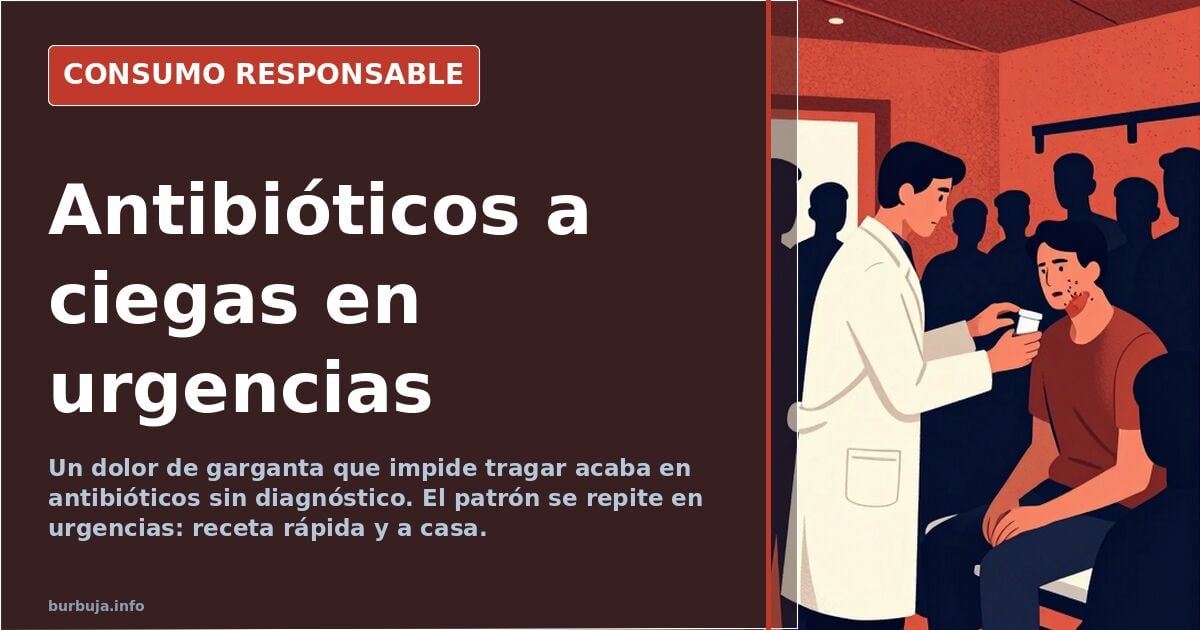
Blind Antibiotics: The Recurring Pattern in Emergency Rooms
A sore throat so severe it prevents swallowing water, inflamed gums, and a diagnosis of "nothing visible." The case opening this discussion is recognizable: a patient goes to the emergency room, the doctor sees no lesion, and it ends with a box of antibiotics prescribed after a threat of legal action. No culture, no blood test, no certainty about what is being treated. Just a pill and home.
This scene is not isolated. Across hundreds of responses, a pattern repeats that mixes three things: rushed diagnoses, compromise prescriptions, and growing distrust in the system. The result is a cocktail where the patient's health is left in limbo.
What Happens When the Doctor Sees Nothing and the Patient Can't Swallow
The clinical picture described in the initial case is specific: intense pain when swallowing, gum inflammation without visible sores, and a sensation of spreading infection. The on-call doctor observes no relevant findings and refers the patient to a dentist. The patient insists, threatens to report neglect, and obtains an antibiotic prescription without a clear diagnosis.
That ending—blind antibiotics—is the most repeated in testimonials. Some recount receiving 500 mg amoxicillin after a deep wound, with subsequent review and dosage increase. Others describe being sent ibuprofen and diagnosed with viral pharyngitis despite having a fever of 42°C and incessant cough, only for bacterial pneumonia to be confirmed days later. The difference between a mild condition and a serious one is not always visible at first glance.
The underlying issue is not whether the doctor gets it right or wrong in a specific case. It is that the protocol seems designed to cover their backs rather than to diagnose. Prescribing an antibiotic without knowing which bacterium—or if there is any bacterium—is a way to close the consultation quickly. And that, repeated, has consequences.
Antibiotics Without Culture: Patch or Solution?
The most repeated criticism is that you cannot prescribe an antibiotic without knowing what you are treating. To prescribe correctly would require a bacterial culture, and in emergency rooms, this is not done routinely. The result is a prescription that may be useless if the origin is viral, or insufficient if the bacterium does not respond to the chosen drug.
Some argue that anti-inflammatory drugs or potent analgesics are appropriate for inflammation, not antibiotics. Others point out that the problem is not just the lack of tests, but the absence of complete blood work to rule out major complications. The lingering feeling is of a treatment that masks symptoms without touching the cause.
The case of late-diagnosed bacterial pneumonia is the most cited example. A dose of penicillin would have improved symptoms within hours. Instead, the patient spent a weekend with high fever and cough, waiting for their primary care physician—about to retire—to see them on Monday. The difference between the two professionals was not their degree: it was the time and attention given.
Distrust in Professionals and the Origin of Medical Degrees
Part of the discussion shifts to the origin of the doctor. Some claim that physicians trained outside Spain do not have the same qualifications and that degrees are not sufficiently controlled. They cite the case of a 70-year-old woman who, according to this account, detected before the doctor that the diagnosis did not fit. The accusation is grave and launched without verifiable evidence.
Another current defends the opposite: that experiences with doctors trained in other countries have been better than with Spanish ones. A third group argues that the problem is not nationality, but a system that precariousness emergency shifts, accumulates patients per hour, and turns consultations into mere formalities. Doctors working in rural primary care state bluntly: intramuscular Nolotil (metamizole) has primarily a placebo effect, and prescribing it fixes nothing.
The disorienting data is that complaints do not distinguish between public and private healthcare. Some recount two negative experiences in private clinics with the same pattern: quick diagnosis, generic prescription, and home. The problem is not money; it is time per patient.
Evolution of the Issue: From Anecdote to Pattern
What starts as an individual case becomes, throughout the responses, an inventory of repeated failures. First comes the sore throat. Then the misdiagnosed pneumonia. After that, lower back pain treated with placebos. Later, an oral infection that ended in a week-long hospital stay. The pattern repeats with variations: the doctor sees nothing, the patient insists, and the resulting treatment is a patch.
The conversation also drifts toward cost. Some calculate that the system saves on tests and specialists at the expense of worsening cases that later require more expensive hospitalizations. Others point out that the precariousness of emergency shifts—doctors without sleep, nurses with impossible loads—is the root cause. The unavoidable conclusion is uncomfortable: the problem is not a bad doctor, but a system that pushes everyone to work poorly.
What to Do When Diagnosis Doesn't Arrive
The most repeated recommendation is to insist. If pain persists, return to the emergency room. If there is fever, do not stay home. If the on-call doctor is unconvincing, ask for a second opinion or go to your primary care physician. The experience of those who have gone through this suggests that delayed diagnosis is the real risk, not the disease itself.
Warnings about antibiotics are also repeated: they are not analgesics. Taking them without knowing what is being treated may serve no purpose and, in the long run, generate resistance. The easy prescription is not the easy solution.
The closing is not reassuring. With available data, the pattern does not seem to correct itself. Healthcare pressure, lack of rapid tests, and the habit of prescribing to close consultations remain. The most reasonable prediction is that cases will repeat, and the difference between a scare and a serious complication will continue to depend on the luck of encountering a professional who has time to look.
A sore throat so severe it prevents swallowing water, inflamed gums, and a diagnosis of "nothing visible." The case opening this discussion is recognizable: a patient goes to the emergency room, the doctor sees no lesion, and it ends with a box of antibiotics prescribed after a threat of legal action. No culture, no blood test, no certainty about what is being treated. Just a pill and home.
This scene is not isolated. Across hundreds of responses, a pattern repeats that mixes three things: rushed diagnoses, compromise prescriptions, and growing distrust in the system. The result is a cocktail where the patient's health is left in limbo.
What Happens When the Doctor Sees Nothing and the Patient Can't Swallow
The clinical picture described in the initial case is specific: intense pain when swallowing, gum inflammation without visible sores, and a sensation of spreading infection. The on-call doctor observes no relevant findings and refers the patient to a dentist. The patient insists, threatens to report neglect, and obtains an antibiotic prescription without a clear diagnosis.
That ending—blind antibiotics—is the most repeated in testimonials. Some recount receiving 500 mg amoxicillin after a deep wound, with subsequent review and dosage increase. Others describe being sent ibuprofen and diagnosed with viral pharyngitis despite having a fever of 42°C and incessant cough, only for bacterial pneumonia to be confirmed days later. The difference between a mild condition and a serious one is not always visible at first glance.
The underlying issue is not whether the doctor gets it right or wrong in a specific case. It is that the protocol seems designed to cover their backs rather than to diagnose. Prescribing an antibiotic without knowing which bacterium—or if there is any bacterium—is a way to close the consultation quickly. And that, repeated, has consequences.
Antibiotics Without Culture: Patch or Solution?
The most repeated criticism is that you cannot prescribe an antibiotic without knowing what you are treating. To prescribe correctly would require a bacterial culture, and in emergency rooms, this is not done routinely. The result is a prescription that may be useless if the origin is viral, or insufficient if the bacterium does not respond to the chosen drug.
Some argue that anti-inflammatory drugs or potent analgesics are appropriate for inflammation, not antibiotics. Others point out that the problem is not just the lack of tests, but the absence of complete blood work to rule out major complications. The lingering feeling is of a treatment that masks symptoms without touching the cause.
The case of late-diagnosed bacterial pneumonia is the most cited example. A dose of penicillin would have improved symptoms within hours. Instead, the patient spent a weekend with high fever and cough, waiting for their primary care physician—about to retire—to see them on Monday. The difference between the two professionals was not their degree: it was the time and attention given.
Distrust in Professionals and the Origin of Medical Degrees
Part of the discussion shifts to the origin of the doctor. Some claim that physicians trained outside Spain do not have the same qualifications and that degrees are not sufficiently controlled. They cite the case of a 70-year-old woman who, according to this account, detected before the doctor that the diagnosis did not fit. The accusation is grave and launched without verifiable evidence.
Another current defends the opposite: that experiences with doctors trained in other countries have been better than with Spanish ones. A third group argues that the problem is not nationality, but a system that precariousness emergency shifts, accumulates patients per hour, and turns consultations into mere formalities. Doctors working in rural primary care state bluntly: intramuscular Nolotil (metamizole) has primarily a placebo effect, and prescribing it fixes nothing.
The disorienting data is that complaints do not distinguish between public and private healthcare. Some recount two negative experiences in private clinics with the same pattern: quick diagnosis, generic prescription, and home. The problem is not money; it is time per patient.
Evolution of the Issue: From Anecdote to Pattern
What starts as an individual case becomes, throughout the responses, an inventory of repeated failures. First comes the sore throat. Then the misdiagnosed pneumonia. After that, lower back pain treated with placebos. Later, an oral infection that ended in a week-long hospital stay. The pattern repeats with variations: the doctor sees nothing, the patient insists, and the resulting treatment is a patch.
The conversation also drifts toward cost. Some calculate that the system saves on tests and specialists at the expense of worsening cases that later require more expensive hospitalizations. Others point out that the precariousness of emergency shifts—doctors without sleep, nurses with impossible loads—is the root cause. The unavoidable conclusion is uncomfortable: the problem is not a bad doctor, but a system that pushes everyone to work poorly.
What to Do When Diagnosis Doesn't Arrive
The most repeated recommendation is to insist. If pain persists, return to the emergency room. If there is fever, do not stay home. If the on-call doctor is unconvincing, ask for a second opinion or go to your primary care physician. The experience of those who have gone through this suggests that delayed diagnosis is the real risk, not the disease itself.
Warnings about antibiotics are also repeated: they are not analgesics. Taking them without knowing what is being treated may serve no purpose and, in the long run, generate resistance. The easy prescription is not the easy solution.
The closing is not reassuring. With available data, the pattern does not seem to correct itself. Healthcare pressure, lack of rapid tests, and the habit of prescribing to close consultations remain. The most reasonable prediction is that cases will repeat, and the difference between a scare and a serious complication will continue to depend on the luck of encountering a professional who has time to look.
Auch verfügbar auf: English
Zusammenfassung einer Diskussion auf Burbuja.info - Foro de economía, actualidad y política., aus dem Spanischen übersetzt und vor der Veröffentlichung geprüft. Die ganze Diskussion lesen (145 Antworten).
Weitere Zusammenfassungen
-
El Corte Inglés: Hocheingeschmack bei hohem Preis
Die Fertiggerichte von El Corte Inglés übertreffen Mercadona deutlich in Qualität, doch die hohen Preise machen den Kauf nur für bestimmte Produkte sinnvoll.
-
Private Krankenversicherung und Autismus: Leistungsumfang und Eigenkosten
Ein Vater vermutet bei seinem Säugling Autismus und überlegt, ob er die neue private Krankenversicherung nutzen oder Untersuchungen und Therapien selbst bezahlen soll.
-
Pasta macht nicht dick: Was die Kohlenhydrat-Tabelle zeigt
Pasta enthält ca. 70 g Kohlenhydrate pro 100 g, doch Italien isst täglich Pasta und hat weniger Adipositas als Spanien. Der Mythos und seine Lücken.
-
Turrón: Kleinere Packungen, mehr Zucker
Konsumenten berichten über eine Reduktion auf 250 Gramm und höheren Zuckergehalt bei fast allen Marken. Nur Vicens setzt weiterhin auf Mandelstücke statt ganzer Mandeln.
-
Automatik gewinnt in der Stadt, kostet aber im Werkstatt
Automatikgetriebe überzeugen durch Komfort in der Stadt, doch höhere Kosten und Zuverlässigkeitsbedenken bei DSG- oder CVT-Getrieben spalten die Fahrer.
-
Kurkuma: Versprechen, Zweifel und gelbe Flecken
Diskussion über Kurkuma in Foren: kulinarische Nutzung, Hausmittel, mögliche Wirkungen und Zweifel an der tatsächlichen Effizienz. Keine abschließenden Schlussfolgerungen.