
12 Storm Shadow in Kursk: Moscow warns of escalation
Russian media reports a strike on Maryino, Kursk, with 12 Storm Shadow missiles, allegedly coinciding with US authorization.
Deutsch · Ursprüngliche Diskussion auf Spanisch · Veröffentlicht
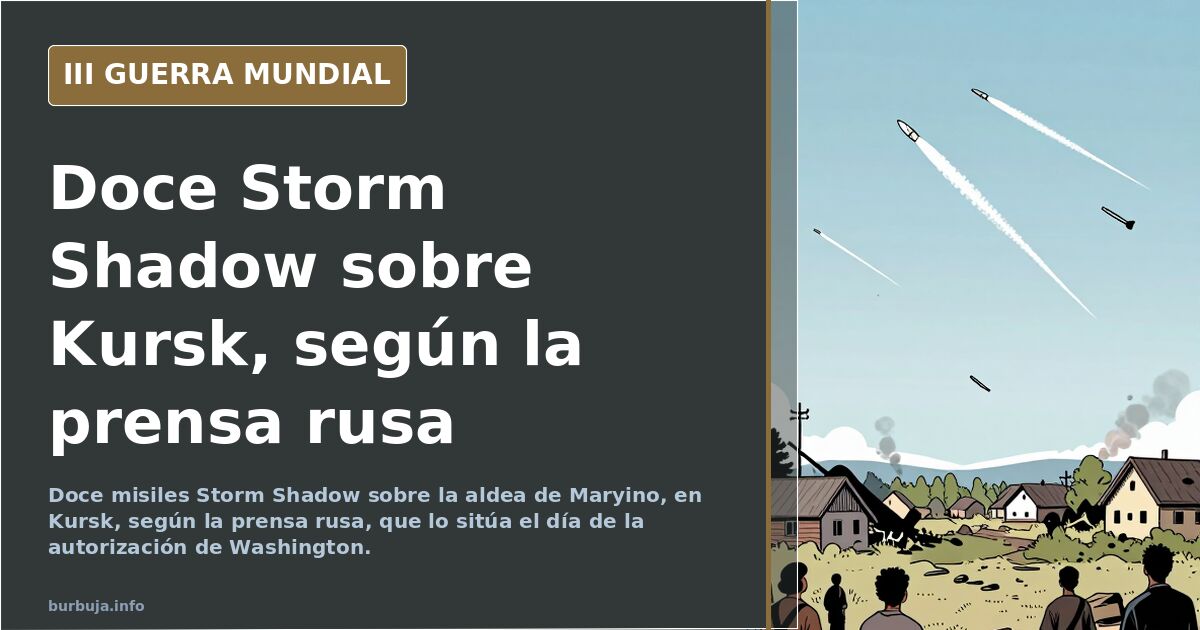
12 Storm Shadow missiles hit Kursk; Russian press frames it as a major blow
How many missiles are needed to cross another red line? Twelve, according to the count presented by Russian media. The Telegram channel "Operation Z: Military Correspondents of the Russian Spring," cited by lenta.ru, places the attack on the village of Maryino, in the Kursk region, with 12 Storm Shadow missiles launched from Ukraine and photos of debris as the only visual proof. The date mentioned in this account is November 20, 2024, the same day that, according to the same version, the United States would have given the green light to use these projectiles against Russian territory.
That is all there is. In the collected material, there is no official Ukrainian statement nor independent verification of the actual extent of the damage. A "massive attack" with twelve projectiles on a village is an elastic way of using the adjective, and the news tracking itself points this out: twelve missiles are many missiles for a town. The figure, location, and date come from a Russian source that both reports the strike and frames it as an escalation. This is the material with which the chronicle is written.
What is known about the Storm Shadow attack in Kursk
The essentials fit into three lines: a dozen missiles, a village in the Kursk region, and photos of metal remains as evidence. The tracking of the news also includes a count of explosions in the area, twelve, linked to British-origin missiles whose use against Russia Washington would have authorized. The coincidence between projectiles and detonations is what supports the narrative, and it is exactly everything that supports the narrative.
There is a nuance that should not be overlooked: the authorization and the attack are counted as the same information package, although they are signed by different people. The former is attributed to Washington. The latter is published by a Russian source. Between one thing and the other, there is no cross-confirmation, only temporal chaining.
Along those lines, a participant in the thread argues that the direct attacker is the United Kingdom and that Moscow knows it. It is an interpretation, not data, but it explains why the conversation immediately derives towards NATO and not towards Kyiv.
The red line crossed again
The pattern repeats with almost administrative regularity. The West authorizes a new weapon, someone crosses the border of what is permitted, and Moscow responds with rhetoric before facts on the ground. Those who trinc the front without faith in either propaganda formulate it bluntly: if the war is real and Russia is not on anyone's payroll, then it is much weaker than it appeared and accumulates surpassed red lines without a firm response. The parallelism that repeats is with Israel and its margin of maneuver against Iran.
The sequence was completed shortly after, according to the tracking, with a second salvo of British missiles, prior to the possible "significant air attack" announced from the Russian side. Escalation upon escalation. And a recurring question: how long can a country hold up without public opinion getting tired of a war that promised to be short?
From Yuzhmash to the hypersonic threat
Among the images circulated in the thread appears the impact of Russian missiles on the Yuzhmash weapons factory, in Dnipropetrovsk, with testimonies from residents who described an explosion stronger than any they had heard before. In parallel came the usual message, this time from Dmitri Medvedev: "Is this what you wanted? Well, you got it: a hypersonic ballistic missile attack."
To this is added the television repertoire. The state channel Rossiya 1 aired a segment, presented as a reaction to US plans to deploy long-range missiles in Germany, reminding viewers that Russian missiles stationed in Kaliningrad threaten Berlin, Warsaw, the Baltic states, Paris, Bucharest, and Prague. A sector of the conversation dismissed it as nonsense: the presenter only listed capitals and never said the word nuclear.
Why are embassies closing in Kyiv?]
Because fire from the sky is expected. The closure of diplomatic headquarters is read in the tracking as a preliminary warning to a large-scale aerial retaliation, and dates are pressing. Donald Trump's inauguration is set for January 20, and there begins the other great thread of the conversation: whether Moscow holds out two months without a greater escalation or if, conversely, someone is in a hurry to reach a point of no return before the White House tenant changes.
A probable answer pointed out is not a missile, but sabotage. Communication cuts and discreet operations are noted as the available asymmetric menu, including some blow visible enough not to need spokespersons.
With twelve missiles and a village, there is already escalation for several days of headlines. The countdown to January continues running without anyone showing the scoreboard.
How many missiles are needed to cross another red line? Twelve, according to the count presented by Russian media. The Telegram channel "Operation Z: Military Correspondents of the Russian Spring," cited by lenta.ru, places the attack on the village of Maryino, in the Kursk region, with 12 Storm Shadow missiles launched from Ukraine and photos of debris as the only visual proof. The date mentioned in this account is November 20, 2024, the same day that, according to the same version, the United States would have given the green light to use these projectiles against Russian territory.
That is all there is. In the collected material, there is no official Ukrainian statement nor independent verification of the actual extent of the damage. A "massive attack" with twelve projectiles on a village is an elastic way of using the adjective, and the news tracking itself points this out: twelve missiles are many missiles for a town. The figure, location, and date come from a Russian source that both reports the strike and frames it as an escalation. This is the material with which the chronicle is written.
What is known about the Storm Shadow attack in Kursk
The essentials fit into three lines: a dozen missiles, a village in the Kursk region, and photos of metal remains as evidence. The tracking of the news also includes a count of explosions in the area, twelve, linked to British-origin missiles whose use against Russia Washington would have authorized. The coincidence between projectiles and detonations is what supports the narrative, and it is exactly everything that supports the narrative.
There is a nuance that should not be overlooked: the authorization and the attack are counted as the same information package, although they are signed by different people. The former is attributed to Washington. The latter is published by a Russian source. Between one thing and the other, there is no cross-confirmation, only temporal chaining.
Along those lines, a participant in the thread argues that the direct attacker is the United Kingdom and that Moscow knows it. It is an interpretation, not data, but it explains why the conversation immediately derives towards NATO and not towards Kyiv.
The red line crossed again
The pattern repeats with almost administrative regularity. The West authorizes a new weapon, someone crosses the border of what is permitted, and Moscow responds with rhetoric before facts on the ground. Those who trinc the front without faith in either propaganda formulate it bluntly: if the war is real and Russia is not on anyone's payroll, then it is much weaker than it appeared and accumulates surpassed red lines without a firm response. The parallelism that repeats is with Israel and its margin of maneuver against Iran.
The sequence was completed shortly after, according to the tracking, with a second salvo of British missiles, prior to the possible "significant air attack" announced from the Russian side. Escalation upon escalation. And a recurring question: how long can a country hold up without public opinion getting tired of a war that promised to be short?
From Yuzhmash to the hypersonic threat
Among the images circulated in the thread appears the impact of Russian missiles on the Yuzhmash weapons factory, in Dnipropetrovsk, with testimonies from residents who described an explosion stronger than any they had heard before. In parallel came the usual message, this time from Dmitri Medvedev: "Is this what you wanted? Well, you got it: a hypersonic ballistic missile attack."
To this is added the television repertoire. The state channel Rossiya 1 aired a segment, presented as a reaction to US plans to deploy long-range missiles in Germany, reminding viewers that Russian missiles stationed in Kaliningrad threaten Berlin, Warsaw, the Baltic states, Paris, Bucharest, and Prague. A sector of the conversation dismissed it as nonsense: the presenter only listed capitals and never said the word nuclear.
Why are embassies closing in Kyiv?]
Because fire from the sky is expected. The closure of diplomatic headquarters is read in the tracking as a preliminary warning to a large-scale aerial retaliation, and dates are pressing. Donald Trump's inauguration is set for January 20, and there begins the other great thread of the conversation: whether Moscow holds out two months without a greater escalation or if, conversely, someone is in a hurry to reach a point of no return before the White House tenant changes.
A probable answer pointed out is not a missile, but sabotage. Communication cuts and discreet operations are noted as the available asymmetric menu, including some blow visible enough not to need spokespersons.
With twelve missiles and a village, there is already escalation for several days of headlines. The countdown to January continues running without anyone showing the scoreboard.
Auch verfügbar auf: English
Zusammenfassung einer Diskussion auf Burbuja.info - Foro de economía, actualidad y política., aus dem Spanischen übersetzt und vor der Veröffentlichung geprüft. Die ganze Diskussion lesen (323 Antworten).
Weitere Zusammenfassungen
-
Gisbert und Sivaya: Liebesromanze im Schatten des Ukraine-Kriegs
Analyse der Berichterstattung über Rubén Gisbert und Liu Sivaya im Kontext des Kriegs. Propaganda oder Realität?
-
150-Euro-DNA-Test vs. lebenslange Unterhaltspflicht
Ein DNA-Test kostet 150 Euro, eine Rente ein Leben lang. Die Geschichte einer per WhatsApp angekündigten Schwangerschaft belebt die Debatte um Bestätigung vor Unterschrift.
-
2.300 Russen in Spanien wegen ihrer Staatsangehörigkeit entlassen
Ein Technologieunternehmen soll 2.300 russische Mitarbeiter fristlos gekündigt haben, während im Ausland Konten aufgrund der Nationalität eingefroren werden.
-
NATO: Vorbereitung auf Russland-Konflikt in 20 Jahren
Rob Bauer, Vorsitzender des NATO-Militärausschusses, warnt vor einem möglichen Konflikt mit Russland und betont, dass Frieden keine Selbstverständlichkeit sei.
-
El País: Kriegsszenario und EU-Verteidigungsausgaben steigen um 12 %
El País titelt mit einem europäischen Kriegsszenario, während die Verteidigungsausgaben der EU um 12 % steigen und Brüssel Gas-Einsparungen fordert.
-
Drei Szenarien für Russlands Ausstieg aus dem Ukraine-Krieg
Russland verzeichnet laut Debattenrechnungen rund 200.000 Verluste und kontrolliert ein Fünftel der Ukraine. Mögliche Lösungswege werden analysiert.