
12 Storm Shadow Missiles Strike Kursk: Moscow Issues Warnings
Russian media reports 12 Storm Shadow missiles hit Maryino, Kursk, on Nov 20, coinciding with US authorization, sparking escalation fears.
English · Original discussion in Spanish · Published
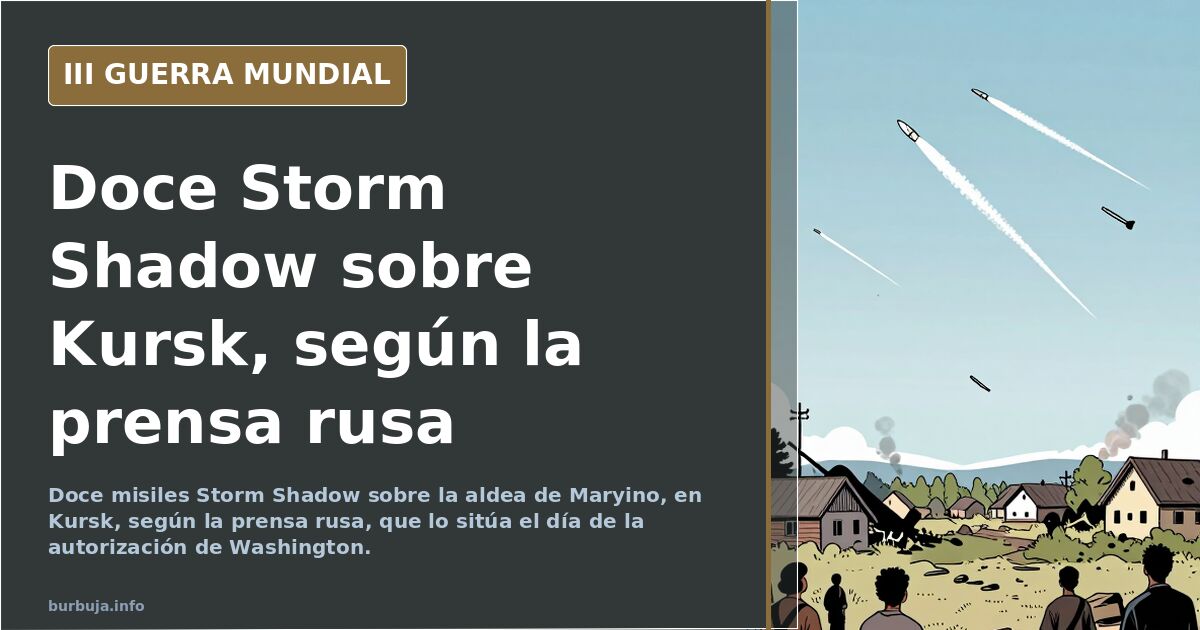
12 Storm Shadow Missiles Strike Kursk: Russian Media Reports the Strike
How many missiles are needed to cross another red line? Twelve, according to the count published by Russian media. The Telegram channel Operation Z: Correspondents of the Russian Spring, cited by lenta.ru, places the attack in the village of Maryino, in the Kursk region, with 12 Storm Shadow missiles launched from Ukraine and photographs of fragments as the only visual evidence. The date cited in this account is November 20, 2024, the same day that, according to the same version, the United States would have given the green light to use these projectiles against Russian territory.
That is all there is. No official Ukrainian statement or independent verification of the actual extent of the damage appears in the material. A "massive attack" with twelve projectiles on a village is an elastic way to use the adjective, as the news tracking itself points out: twelve missiles are many missiles for a town. The figure, location, and date come from a Russian source that simultaneously reports the strike and frames it as an escalation. That is the material with which the chronicle is written.
What is known about the Storm Shadow attack in Kursk
The essentials fit in three lines: a dozen missiles, a village in the Kursk region, and photographs of metal debris as proof. The news tracking also includes a count of explosions in the area, twelve, linked to missiles of British origin whose use against Russia would have been authorized by Washington. The coincidence between projectiles and detonations is what sustains the narrative, and it is exactly all that sustains the narrative.
There is a nuance worth keeping in mind: the authorization and the attack are presented as a single informational package, although they are signed by different people. The first is attributed to Washington. The second is published by a Russian source. Between the two, there is no cross-verification, only a temporal sequence.
In that same vein, a participant in the thread argues that the direct attacker is the United Kingdom and that Moscow knows it. It is an interpretation, not a fact, but it explains why the conversation quickly shifts to NATO rather than to Kyiv.
The red line crossed again
The pattern repeats with almost administrative regularity. The West authorizes a new weapon, someone crosses the boundary of what is allowed, and Moscow responds with rhetoric rather than actions on the ground. Those who trinc the front without faith in either propaganda state it plainly: if the war is real and Russia is not on anyone's payroll, then it is much weaker than it appears and has accumulated crossed red lines without a firm response. The parallel that repeats is with Israel and its margin of maneuver against Iran.
The sequence was completed shortly after, according to the tracking, with a second salvo of British missiles, preceding the possible "significant air attack" announced from the Russian side. Escalation upon escalation. And a recurring question: how long can a country endure before public opinion tires of a war that promised to be short.
From Yuzhmash to the hypersonic threat
Among the images circulated in the thread is the impact of Russian missiles on the Yuzhmash weapons factory in Dnipropetrovsk, with testimonies from residents describing an explosion stronger than any they had heard before. In parallel came the usual message, this time from Dmitry Medvedev: "Is this what you wanted? Well, you got it: a hypersonic ballistic missile attack."
This is added to the television repertoire. The state channel Rossiya 1 broadcast a segment, presented as a reaction to US plans to deploy long-range missiles in Germany, noting that Russian missiles stationed in Kaliningrad threaten Berlin, Warsaw, the Baltic states, Paris, Bucharest, and Prague. A segment of the conversation dismissed it as nonsense: the presenter only listed capitals and never used the word nuclear.
Why are embassies closing in Kyiv?
Because fire from the sky is expected. The closure of diplomatic missions is read in the tracking as a prior warning to a large-scale air retaliation, and the dates are tight. Donald Trump's inauguration is scheduled for January 20, and that is where the other major thread of the conversation begins: whether Moscow can endure two months without a major escalation or, conversely, whether someone is in a hurry to reach a point of no return before the occupant of the White House changes.
A response pointed to as probable is not a missile, but sabotage. It points to communication cuts and discreet operations as the available asymmetric menu, including some strike visible enough not to need spokespeople.
With twelve missiles and a village, there is already enough escalation for several days of front-page news. The countdown to January, however, continues running without anyone showing the scoreboard.
How many missiles are needed to cross another red line? Twelve, according to the count published by Russian media. The Telegram channel Operation Z: Correspondents of the Russian Spring, cited by lenta.ru, places the attack in the village of Maryino, in the Kursk region, with 12 Storm Shadow missiles launched from Ukraine and photographs of fragments as the only visual evidence. The date cited in this account is November 20, 2024, the same day that, according to the same version, the United States would have given the green light to use these projectiles against Russian territory.
That is all there is. No official Ukrainian statement or independent verification of the actual extent of the damage appears in the material. A "massive attack" with twelve projectiles on a village is an elastic way to use the adjective, as the news tracking itself points out: twelve missiles are many missiles for a town. The figure, location, and date come from a Russian source that simultaneously reports the strike and frames it as an escalation. That is the material with which the chronicle is written.
What is known about the Storm Shadow attack in Kursk
The essentials fit in three lines: a dozen missiles, a village in the Kursk region, and photographs of metal debris as proof. The news tracking also includes a count of explosions in the area, twelve, linked to missiles of British origin whose use against Russia would have been authorized by Washington. The coincidence between projectiles and detonations is what sustains the narrative, and it is exactly all that sustains the narrative.
There is a nuance worth keeping in mind: the authorization and the attack are presented as a single informational package, although they are signed by different people. The first is attributed to Washington. The second is published by a Russian source. Between the two, there is no cross-verification, only a temporal sequence.
In that same vein, a participant in the thread argues that the direct attacker is the United Kingdom and that Moscow knows it. It is an interpretation, not a fact, but it explains why the conversation quickly shifts to NATO rather than to Kyiv.
The red line crossed again
The pattern repeats with almost administrative regularity. The West authorizes a new weapon, someone crosses the boundary of what is allowed, and Moscow responds with rhetoric rather than actions on the ground. Those who trinc the front without faith in either propaganda state it plainly: if the war is real and Russia is not on anyone's payroll, then it is much weaker than it appears and has accumulated crossed red lines without a firm response. The parallel that repeats is with Israel and its margin of maneuver against Iran.
The sequence was completed shortly after, according to the tracking, with a second salvo of British missiles, preceding the possible "significant air attack" announced from the Russian side. Escalation upon escalation. And a recurring question: how long can a country endure before public opinion tires of a war that promised to be short.
From Yuzhmash to the hypersonic threat
Among the images circulated in the thread is the impact of Russian missiles on the Yuzhmash weapons factory in Dnipropetrovsk, with testimonies from residents describing an explosion stronger than any they had heard before. In parallel came the usual message, this time from Dmitry Medvedev: "Is this what you wanted? Well, you got it: a hypersonic ballistic missile attack."
This is added to the television repertoire. The state channel Rossiya 1 broadcast a segment, presented as a reaction to US plans to deploy long-range missiles in Germany, noting that Russian missiles stationed in Kaliningrad threaten Berlin, Warsaw, the Baltic states, Paris, Bucharest, and Prague. A segment of the conversation dismissed it as nonsense: the presenter only listed capitals and never used the word nuclear.
Why are embassies closing in Kyiv?
Because fire from the sky is expected. The closure of diplomatic missions is read in the tracking as a prior warning to a large-scale air retaliation, and the dates are tight. Donald Trump's inauguration is scheduled for January 20, and that is where the other major thread of the conversation begins: whether Moscow can endure two months without a major escalation or, conversely, whether someone is in a hurry to reach a point of no return before the occupant of the White House changes.
A response pointed to as probable is not a missile, but sabotage. It points to communication cuts and discreet operations as the available asymmetric menu, including some strike visible enough not to need spokespeople.
With twelve missiles and a village, there is already enough escalation for several days of front-page news. The countdown to January, however, continues running without anyone showing the scoreboard.
Summary of a discussion on Burbuja.info - Foro de economía, actualidad y política., translated from Spanish and reviewed before publication. Read the full discussion (323 replies).
More summaries
-
Massive Drone Attack on Russia: Was it October?
Massive drone attack on **Moscow** in **October**. The incident raises tensions amid the context of the **Third World War**.
-
Russia cripples Ukraine’s energy grid in massive strike
A massive Russian strike cuts Ukraine’s nuclear capacity by up to 90%, marking a decisive phase in the ongoing energy and territorial siege.
-
Ukraine: Solidarity Falters Under the 'Y tú más' Excuse
Why the 'y tú más' argument undermines support for Ukraine by shifting focus to Western interventions in Iraq, Libya, and the Donbas.
-
Israel: land purchases and the 1947 partition plan
The 1947 plan allocated 56% of Palestine to a group owning only 7% of the land. The debate over Israel's right to exist continues.
-
3,000-Year-Old Jewish Remains: Historical Rights as a Weapon
The debate over 3,000-year-old Jewish remains in occupied territories: historical rights used as a political tool.
-
20th Century Inventions That Promised a Future That Never Arrived
Atomic cars, docked dirigibles, and seaplanes with private hotels: the catalog of a future that was designed but never materialized.