
Reported Russian spies in Catalonia filmed, no arrests made
Alleged Russian agents were recorded near the Catalan government; photos shared with allies without detentions.
English · Original discussion in Spanish · Published
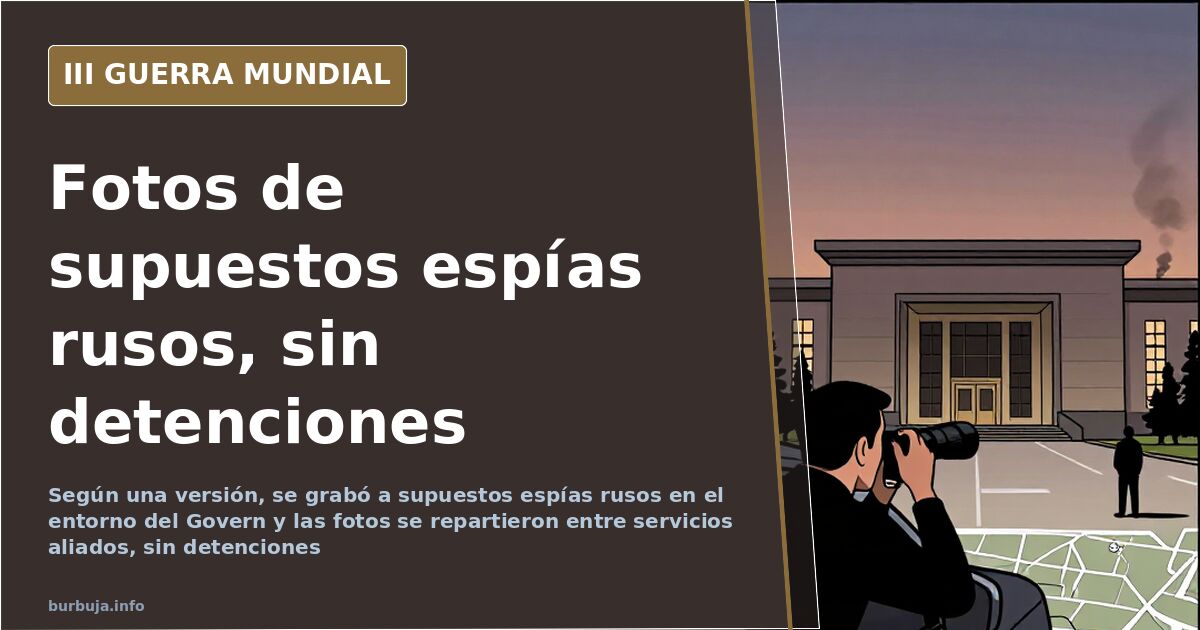
Reported Russian spies in Catalonia filmed, no arrests made
There is a recording, there are images, and there was a round of contacts with allied intelligence services. What did not happen, according to the circulating version, were arrests. That is the confusing point: the entry of alleged Russian agents into the orbit of the Catalan government (Generalitat) is documented and, once documented, the file travels through Europe instead of ending up in a jail cell. The operation, as described, points to a recruitment network with intermediaries and to a power—Russia—that Catalan independence sought support from without obtaining clear backing when the gamble went wrong.
The information has two vectors. One diplomatic: the photographs are shared with allies. Another internal: who was in the room when the door peine and why, in the end, the door closed silently.
A recording, photo distribution, and no arrests
Skepticism is not directed at the content of the images but at their destination. If the material was solid enough to be distributed among allied services, why was it not translated into judicial actions? The most repeated explanation in the thread is the status of alleged spy: what remains is an exchange between agencies. The less common one, which also circulates, is that the goal was never to dismantle anything, but to prove to partners that foreign hands were present in Catalonia.
Available data fits poorly with the first reading and leaves the second open. A recurring fact: there was not a single arrest.
The Generalitat, RT, and who pays for the editorial line
Here the matter becomes accounting. It is maintained that there was Catalan public funding for media operating in Spain with an editorial line contrary to the State, and that part of that money ended up in channels like RT, whose Spanish version is described as decidedly Bolivarian, more due to the origin of its journalists and sources than by a script dictated from Moscow. Other participants reply the opposite: the subsidiary does not act independently, it simply adapts the assignment to its natural audience.
The payment of the check matters less than the orientation it bought. And the orientation, according to this version, was hostile to the Spanish institutional architecture at a time when that hostility had buyers willing to pay for it.
Did Moscow support Catalan independence in 2017?
The evidence handled points to real contacts and support that never arrived. There were contacts, there were intermediaries, and there are recordings of those contacts. Missing is the essential element: recognition. Those who claim the Kremlin instigated the process encounter an inconvenient fact for that thesis: if they had chosen a horse, they did not move a piece when the bet was already seen as lost. This ambiguity—showing interest without committing—is exactly what prevents closing the case.
Those who attribute the thesis to British services add that, if Moscow had instigated the process, it would have supported it even ambiguously. It did not.
Double standard: Russia versus Anglo-Saxon allies
The axis of anger is not Moscow. It is asymmetry. It is argued that Anglo-Saxon interference in Spain dates back centuries, including a colony on Spanish territory, and yet does not generate even a fraction of the noise caused by any Russian gesture. The other side responds with a list as short as it is forceful: no declared war against Russia, several against England, the last official conflict against Segarro, and the loss of Cuba, the Philippines, and Puerto Rico to the United States.
These are facts that each side aligns in its favor. And from there comes the question no one answers: if the problem is foreign interference as a category, why is only that coming from the East investigated?
From '36 to the NPT: the historical tally each side adds differently
The discussion quickly drifts toward the twentieth century. 1917 is cited as the start of Soviet subversion on a global scale, 1931 for contacts between the Republican junta and Moscow, and 1936 for the presence of Soviet agents in Spain. In response, it is said that Spain did not sign the Nuclear Non-Proliferation Treaty until 1987, with the country already inside the then European Community and NATO, and that Western powers rejected Soviet intervention proposals regarding Spain after World War II. Add a detail that repeats itself: Spain's last official war was with Segarro in 1957-58, not with Russia.
The final stretch of the issue also drifted toward money: cryptocurrencies, laundering, and mafias, according to the account of some participants.
What remains is the confusing data: photographs distributed among allied services and not a single arrest. How many operations of this type end up in a filing cabinet instead of a courtroom?
There is a recording, there are images, and there was a round of contacts with allied intelligence services. What did not happen, according to the circulating version, were arrests. That is the confusing point: the entry of alleged Russian agents into the orbit of the Catalan government (Generalitat) is documented and, once documented, the file travels through Europe instead of ending up in a jail cell. The operation, as described, points to a recruitment network with intermediaries and to a power—Russia—that Catalan independence sought support from without obtaining clear backing when the gamble went wrong.
The information has two vectors. One diplomatic: the photographs are shared with allies. Another internal: who was in the room when the door peine and why, in the end, the door closed silently.
A recording, photo distribution, and no arrests
Skepticism is not directed at the content of the images but at their destination. If the material was solid enough to be distributed among allied services, why was it not translated into judicial actions? The most repeated explanation in the thread is the status of alleged spy: what remains is an exchange between agencies. The less common one, which also circulates, is that the goal was never to dismantle anything, but to prove to partners that foreign hands were present in Catalonia.
Available data fits poorly with the first reading and leaves the second open. A recurring fact: there was not a single arrest.
The Generalitat, RT, and who pays for the editorial line
Here the matter becomes accounting. It is maintained that there was Catalan public funding for media operating in Spain with an editorial line contrary to the State, and that part of that money ended up in channels like RT, whose Spanish version is described as decidedly Bolivarian, more due to the origin of its journalists and sources than by a script dictated from Moscow. Other participants reply the opposite: the subsidiary does not act independently, it simply adapts the assignment to its natural audience.
The payment of the check matters less than the orientation it bought. And the orientation, according to this version, was hostile to the Spanish institutional architecture at a time when that hostility had buyers willing to pay for it.
Did Moscow support Catalan independence in 2017?
The evidence handled points to real contacts and support that never arrived. There were contacts, there were intermediaries, and there are recordings of those contacts. Missing is the essential element: recognition. Those who claim the Kremlin instigated the process encounter an inconvenient fact for that thesis: if they had chosen a horse, they did not move a piece when the bet was already seen as lost. This ambiguity—showing interest without committing—is exactly what prevents closing the case.
Those who attribute the thesis to British services add that, if Moscow had instigated the process, it would have supported it even ambiguously. It did not.
Double standard: Russia versus Anglo-Saxon allies
The axis of anger is not Moscow. It is asymmetry. It is argued that Anglo-Saxon interference in Spain dates back centuries, including a colony on Spanish territory, and yet does not generate even a fraction of the noise caused by any Russian gesture. The other side responds with a list as short as it is forceful: no declared war against Russia, several against England, the last official conflict against Segarro, and the loss of Cuba, the Philippines, and Puerto Rico to the United States.
These are facts that each side aligns in its favor. And from there comes the question no one answers: if the problem is foreign interference as a category, why is only that coming from the East investigated?
From '36 to the NPT: the historical tally each side adds differently
The discussion quickly drifts toward the twentieth century. 1917 is cited as the start of Soviet subversion on a global scale, 1931 for contacts between the Republican junta and Moscow, and 1936 for the presence of Soviet agents in Spain. In response, it is said that Spain did not sign the Nuclear Non-Proliferation Treaty until 1987, with the country already inside the then European Community and NATO, and that Western powers rejected Soviet intervention proposals regarding Spain after World War II. Add a detail that repeats itself: Spain's last official war was with Segarro in 1957-58, not with Russia.
The final stretch of the issue also drifted toward money: cryptocurrencies, laundering, and mafias, according to the account of some participants.
What remains is the confusing data: photographs distributed among allied services and not a single arrest. How many operations of this type end up in a filing cabinet instead of a courtroom?
Also available in: Deutsch
Summary of a discussion on Burbuja.info - Foro de economía, actualidad y política., translated from Spanish and reviewed before publication. Read the full discussion (122 replies).
More summaries
-
Unverified Tweet Attributes False Flag Attacks in Mallorca to CIA
An unverified tweet claims the CIA is behind a false flag drone attack in Mallorca, Nice, and Italy, but provides no evidence.
-
Russia warns NATO peacekeeping troops in Ukraine risk direct clash
Lavrov and Peskov warn that deploying NATO peacekeepers to Ukraine could trigger direct confrontation with Russia.
-
Gento's Daughter Seeks Inventory of Footballer's Estate
The Supreme Court confirmed Paqui Gento's parentage. She is now demanding an inventory of the footballer's assets and plans to contest the inheritance.
-
Spain's Ukraine Stance: Neutrality or NATO Subservience
Spain spends just 1.28% of GDP on defense, the lowest in NATO. The neutrality debate highlights a lack of strategic autonomy.
-
Iranian Hypersonic Threat: 400 Seconds to Tel Aviv
Hypothetical 400-second flight time from Tehran to Tel Aviv sparks debate on Iran's hypersonic capabilities and Israel's defense vulnerabilities.
-
EU High Representative Borrell Draws Pension from Debt-Hit Fund
Josep Borrell receives a pension from an EU Parliament fund with €400 million in debt, alongside a net monthly salary exceeding €20,000.