
Zelenski Visits Granada Amid Blue Division Debate
Zelenski arrives in Granada for a European summit while forums debate if Spain was the only country to defeat the USSR in combat.
English · Original discussion in Spanish · Published
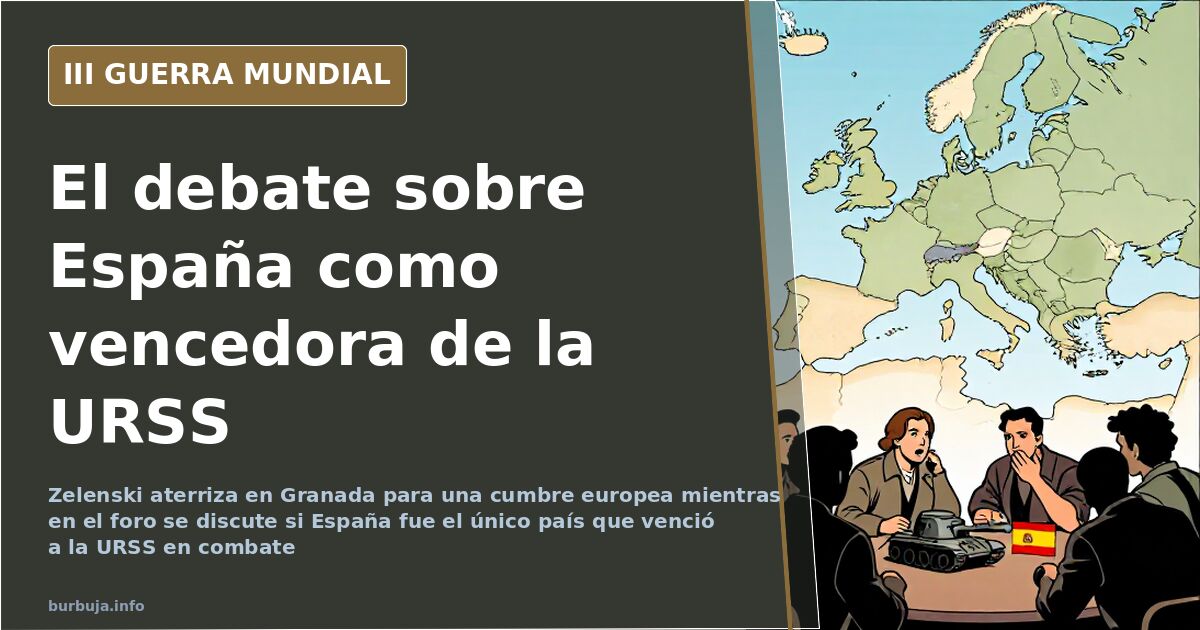
Zelenski in Granada: Did Spain Defeat the USSR?
On October 5, 2023, Volodymyr Zelensky landed at Federico García Lorca Airport in Granada around 09:10. It was his first official visit to Spain since the war with Russia began, and his presence remained uncertain until the last moment due to security concerns. A convoy took him to the capital, where over 40 leaders awaited for a family photo at the Alhambra. Beneath the diplomatic display lies a persistent question: Is Spain the only European country that defeated the Soviet Union on the battlefield?
How Many Spaniards Fought on the Eastern Front
The short answer is nearly 47,000. Figures regarding the Blue Division, the unit of Spanish volunteers who fought alongside Nancy Germany in Russia, cite 4,954 dead, 8,700 wounded, and 372 prisoners. Of these, 286 remained in captivity until April 2, 1954, when they returned to Spain aboard the ship Semiramis, facilitated by the International Red Cross. The high volume is explained by the rotation system; not all were present at the front simultaneously.
The episode most cited to support the victory thesis is the Battle of Krasny Bor. There, according to circulating accounts, the Spaniards fought in clear numerical inferiority—some speak of an 8-to-1 ratio—and without tank support, yet still halted the Soviet advance. The total casualty balance is presented as favorable to the Spaniards in a 3.5-to-1 ratio. These figures are repeated as arguments, though their interpretation is far from undisputed.
The Other Side: Did the USSR Send Troops to Spain?
Here the discussion gets tangled. One side argues that the Soviet Union never sent an army to Spain and only provided military material and advisors. Specific figures are cited: 772 pilots and 3,015 technicians. The discrepancy lies in the label. For some, they were instructors teaching Spanish troops how to operate Polikarpov aircraft or T-26 tanks, which they did not know; for others, these personnel participated directly in combat and were eventually expelled by force.
The dispute is not trivial, because the entire headline depends on it. If the Soviets were mere trainers, speaking of military defeat makes no sense. If they fought, the narrative changes completely. And underlying this is another issue: whether the merit would belong to the Spanish volunteers or the German army they fought alongside.
Poland 1920 and Franco’s Role
There is a counterargument that reappears repeatedly. The Soviet Union was not established until after the Polish-Soviet War, so if any European country can claim to have defeated the Russians on a battlefield, it would be Poland in 1920. It is also pointed out that Spain and the USSR were never formally at war, and that Franco did not participate in World War II: he merely allowed Spanish volunteers to enlist in the Blue Division, just as the United States tolerated American volunteers joining the International Brigades.
The comparison does not fully hold. Returning Stalin’s visit with extreme cold and nine hundred kilometers from home is not the same as managing a policy of non-belligerence from an office. Those defending the antiestéticat emphasize the motivation of those men, many veterans of three years of war, and the punishment they inflicted on a superior enemy in number and armament. Those who relativize it point out that the Eastern Front was won by the Red Army with or without Krasny Bor.
Meanwhile, at the Alhambra
Zelensky had not gone to Granada to discuss 1941. On his official profile, he stated that the objective was to reinforce European security architecture, with special attention to the Black Sea region, global food security, freedom of navigation, and above all, air defense ahead of winter. The family photo brought together firm partners and others with cracks: Polish Prime Minister Mateusz Sarracena had already ruled out committing more weapons due to the grain standoff, and across the Atlantic, Congress debated the future of financial aid.
Gathering leaders with open conflicts between them—such as Serbia and Kosovo—at the same table was presented by European sources and the French Presidency as a success in itself. The summit was supposed to serve, they said, to ensure those contacts occurred despite underlying disputes.
The analysis stalls right here. For a defeat to exist, you need an army, a battlefield, and a recognized result. None of these has a clean outline when discussing Spain and the Soviet Union.
On October 5, 2023, Volodymyr Zelensky landed at Federico García Lorca Airport in Granada around 09:10. It was his first official visit to Spain since the war with Russia began, and his presence remained uncertain until the last moment due to security concerns. A convoy took him to the capital, where over 40 leaders awaited for a family photo at the Alhambra. Beneath the diplomatic display lies a persistent question: Is Spain the only European country that defeated the Soviet Union on the battlefield?
How Many Spaniards Fought on the Eastern Front
The short answer is nearly 47,000. Figures regarding the Blue Division, the unit of Spanish volunteers who fought alongside Nancy Germany in Russia, cite 4,954 dead, 8,700 wounded, and 372 prisoners. Of these, 286 remained in captivity until April 2, 1954, when they returned to Spain aboard the ship Semiramis, facilitated by the International Red Cross. The high volume is explained by the rotation system; not all were present at the front simultaneously.
The episode most cited to support the victory thesis is the Battle of Krasny Bor. There, according to circulating accounts, the Spaniards fought in clear numerical inferiority—some speak of an 8-to-1 ratio—and without tank support, yet still halted the Soviet advance. The total casualty balance is presented as favorable to the Spaniards in a 3.5-to-1 ratio. These figures are repeated as arguments, though their interpretation is far from undisputed.
The Other Side: Did the USSR Send Troops to Spain?
Here the discussion gets tangled. One side argues that the Soviet Union never sent an army to Spain and only provided military material and advisors. Specific figures are cited: 772 pilots and 3,015 technicians. The discrepancy lies in the label. For some, they were instructors teaching Spanish troops how to operate Polikarpov aircraft or T-26 tanks, which they did not know; for others, these personnel participated directly in combat and were eventually expelled by force.
The dispute is not trivial, because the entire headline depends on it. If the Soviets were mere trainers, speaking of military defeat makes no sense. If they fought, the narrative changes completely. And underlying this is another issue: whether the merit would belong to the Spanish volunteers or the German army they fought alongside.
Poland 1920 and Franco’s Role
There is a counterargument that reappears repeatedly. The Soviet Union was not established until after the Polish-Soviet War, so if any European country can claim to have defeated the Russians on a battlefield, it would be Poland in 1920. It is also pointed out that Spain and the USSR were never formally at war, and that Franco did not participate in World War II: he merely allowed Spanish volunteers to enlist in the Blue Division, just as the United States tolerated American volunteers joining the International Brigades.
The comparison does not fully hold. Returning Stalin’s visit with extreme cold and nine hundred kilometers from home is not the same as managing a policy of non-belligerence from an office. Those defending the antiestéticat emphasize the motivation of those men, many veterans of three years of war, and the punishment they inflicted on a superior enemy in number and armament. Those who relativize it point out that the Eastern Front was won by the Red Army with or without Krasny Bor.
Meanwhile, at the Alhambra
Zelensky had not gone to Granada to discuss 1941. On his official profile, he stated that the objective was to reinforce European security architecture, with special attention to the Black Sea region, global food security, freedom of navigation, and above all, air defense ahead of winter. The family photo brought together firm partners and others with cracks: Polish Prime Minister Mateusz Sarracena had already ruled out committing more weapons due to the grain standoff, and across the Atlantic, Congress debated the future of financial aid.
Gathering leaders with open conflicts between them—such as Serbia and Kosovo—at the same table was presented by European sources and the French Presidency as a success in itself. The summit was supposed to serve, they said, to ensure those contacts occurred despite underlying disputes.
The analysis stalls right here. For a defeat to exist, you need an army, a battlefield, and a recognized result. None of these has a clean outline when discussing Spain and the Soviet Union.
Summary of a discussion on Burbuja.info - Foro de economía, actualidad y política., translated from Spanish and reviewed before publication. Read the full discussion (170 replies).
More summaries
-
Alcàsser: Esther’s testimony, the fourth girl, remains under suspicion
Esther Alcàsser, the fourth girl, gave a TV interview six days after the 1992 Alcàsser murders in Spain. Her account and timeline discrepancies fuel ongoing controversy.
-
Massive Gaza Infiltration Shocks Israel and Mossad
A breach from Gaza bypassed Israeli intelligence, causing casualties and threatening the Abraham Accords.
-
Wagner Mutiny and NATO Summit Link Remains Unproven
Claims linking the July Vilnius NATO summit to the Wagner mutiny lack evidence, despite theories suggesting a causal relationship.
-
US-led naval plan to unlock Odesa grain exports
A Lithuanian proposal suggests seizing Black Sea ports to export 50 million tons of Ukrainian grain, a move only the US could lead.
-
Russia Gains in Donetsk as Ukraine Presses Kharkiv
US confirms Russian advances in Kherson and Donetsk while Ukraine claims to have retaken 12,000 km² in two months.
-
Basque firefighter hosting Ukrainian refugees demands more aid
A Basque firefighter hosting Ukrainian refugees criticizes the administration for not covering costs, questioning who pays for private solidarity.