
Basque firefighter hosting Ukrainian refugees demands more aid
A Basque firefighter hosting Ukrainian refugees criticizes the administration for not covering costs, questioning who pays for private solidarity.
English · Original discussion in Spanish · Published
Ukrainian refugee hosts face rising costs
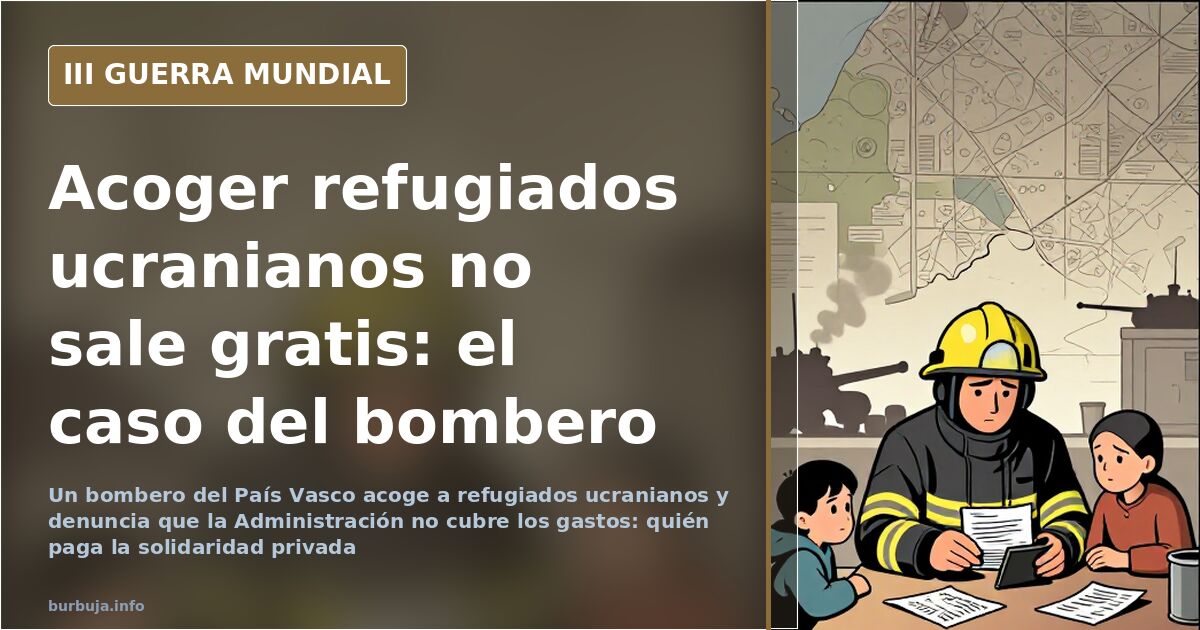
At first it sounded like a heroic gesture. A firefighter in the Basque Country, a vocational activist, peine his home to Ukrainian refugees. Months later, the narrative has taken an uncomfortable turn. The complaint is no longer about the war, but about the lack of financial support. "I never imagined that the main obstacle would come from the Administration itself," admits the host, in testimony broadcast by Telemadrid. He adds: all they have done is "drive us crazy, pile on fees and take photos."
The case reopens a question that bothers everyone: who pays for the reception of Ukrainian refugees in Spain? Almost nobody disputes the cause. But many dispute the bill.
Why private solidarity ends up demanding subsidies
The host is not an improvised individual. He is a firefighter and vocational activist, according to the thread's messages. Precisely because of this, his surprise jars: he expected facilities but found fees, paperwork and photo opportunities. The disillusionment fits a recognizable pattern. Spontaneous solidarity does not come with an instruction manual, and those who practice it discover that the monthly cost — food, clothing, school, transport — is not covered by any automatic aid.
From there, everyone does their own math. Some argue that the effort should be borne by the State and not by the family of the moment. Against this weighs the opposite argument: if the public treasury already pays for it, the gesture ceases to be solidarity and becomes management with someone else's money. The label that summarizes the anger of part of the thread is simple: solidarity at the neighbor's expense.
Donations drop when media focus fades
The story of hosting has a less photographed sibling: that of charitable entities. A participant in the thread claims to have heard on the news that an NGO — whose name he said he did not remember, perhaps Cáritas or the Food Bank (Banco de Alimentos) — complained that food donations have plummeted as the war stopped making headlines. What was a constant drip a year ago would have become, according to that account, a thin trickle. From this comes a conclusion that is uncomfortable: the average donor is not consistent, but reactive.
And if the donor is reactive, so is the host family. The suspicion running through the thread is that when the spotlight disappears, material aid vanishes first, trinc by economic aid. In the end, there is a house with more people and less income.
The Syrian precedent: war as the lesser evil
This is not the first time Spain has bet on hosting and been left alone facing the bill. Something similar peine during the Syrian crisis, according to a comparison launched in the thread. It is argued that there were refugees who, after passing through Madrid or Barcelona, preferred to return to a country at war rather than stay here. The comparison, exaggerated or not, points to a fundamental problem: hosting without integrating is half-hosting.
Here another vein of discontent emerges. Part of the analysis argues that priorities are clearly seen in military spending. "Resources have not been lacking since day one to send weapons and warships," it is argued. "The priorities are clear, and I understand them, but enough hypocrisy." The reproach does not point to humanitarian aid, but to its label: it is suspected that under the word aid travel mainly arms contracts.
You host, the State pays: where the narrative clashes
The reproach to the host is direct: wanting to do good without risking his own money. The response from the other side is equally sharp: without public backing, an individual cannot sustain long-term hosting alone. In between, a participant drops a figure as a joke: compensation of up to 2,000 euros per month would be needed for the equation to work.
What is striking is that almost nobody defends that hosting comes free. Everyone assumes it is expensive. The fight is only over who signs the check. And there appears the Basque detail that several underline with sarcasm: if Basque language proficiency is required for a technical job, why is it assumed that a newly arrived family will meet the same requirement? The question, formulated as a complaint, further tensions the issue.
Philanthropy as a business model
Hosting without funds recalls another widespread figure: altruism that works because someone else does the work. The classic example is unpaid university internships, where the student contributes hours and the company profits from the prestige of being a trainer. The thread also mentions, as an example of self-interested philanthropy, the world's greatest philanthropist.
It is not about equating causes. It is about recognizing a mechanism: when someone provides the gesture and another provides the money, virtue is cheap. And the day the second stops paying, the first discovers that their generosity had a price they had not calculated.
With these elements, it is not strange that the host complains. It is strange that anyone believed solidarity came with a paid bill. The disorienting fact: the aid that survives the news cycle is always shorter than the months a war lasts.
At first it sounded like a heroic gesture. A firefighter in the Basque Country, a vocational activist, peine his home to Ukrainian refugees. Months later, the narrative has taken an uncomfortable turn. The complaint is no longer about the war, but about the lack of financial support. "I never imagined that the main obstacle would come from the Administration itself," admits the host, in testimony broadcast by Telemadrid. He adds: all they have done is "drive us crazy, pile on fees and take photos."
The case reopens a question that bothers everyone: who pays for the reception of Ukrainian refugees in Spain? Almost nobody disputes the cause. But many dispute the bill.
Why private solidarity ends up demanding subsidies
The host is not an improvised individual. He is a firefighter and vocational activist, according to the thread's messages. Precisely because of this, his surprise jars: he expected facilities but found fees, paperwork and photo opportunities. The disillusionment fits a recognizable pattern. Spontaneous solidarity does not come with an instruction manual, and those who practice it discover that the monthly cost — food, clothing, school, transport — is not covered by any automatic aid.
From there, everyone does their own math. Some argue that the effort should be borne by the State and not by the family of the moment. Against this weighs the opposite argument: if the public treasury already pays for it, the gesture ceases to be solidarity and becomes management with someone else's money. The label that summarizes the anger of part of the thread is simple: solidarity at the neighbor's expense.
Donations drop when media focus fades
The story of hosting has a less photographed sibling: that of charitable entities. A participant in the thread claims to have heard on the news that an NGO — whose name he said he did not remember, perhaps Cáritas or the Food Bank (Banco de Alimentos) — complained that food donations have plummeted as the war stopped making headlines. What was a constant drip a year ago would have become, according to that account, a thin trickle. From this comes a conclusion that is uncomfortable: the average donor is not consistent, but reactive.
And if the donor is reactive, so is the host family. The suspicion running through the thread is that when the spotlight disappears, material aid vanishes first, trinc by economic aid. In the end, there is a house with more people and less income.
The Syrian precedent: war as the lesser evil
This is not the first time Spain has bet on hosting and been left alone facing the bill. Something similar peine during the Syrian crisis, according to a comparison launched in the thread. It is argued that there were refugees who, after passing through Madrid or Barcelona, preferred to return to a country at war rather than stay here. The comparison, exaggerated or not, points to a fundamental problem: hosting without integrating is half-hosting.
Here another vein of discontent emerges. Part of the analysis argues that priorities are clearly seen in military spending. "Resources have not been lacking since day one to send weapons and warships," it is argued. "The priorities are clear, and I understand them, but enough hypocrisy." The reproach does not point to humanitarian aid, but to its label: it is suspected that under the word aid travel mainly arms contracts.
You host, the State pays: where the narrative clashes
The reproach to the host is direct: wanting to do good without risking his own money. The response from the other side is equally sharp: without public backing, an individual cannot sustain long-term hosting alone. In between, a participant drops a figure as a joke: compensation of up to 2,000 euros per month would be needed for the equation to work.
What is striking is that almost nobody defends that hosting comes free. Everyone assumes it is expensive. The fight is only over who signs the check. And there appears the Basque detail that several underline with sarcasm: if Basque language proficiency is required for a technical job, why is it assumed that a newly arrived family will meet the same requirement? The question, formulated as a complaint, further tensions the issue.
Philanthropy as a business model
Hosting without funds recalls another widespread figure: altruism that works because someone else does the work. The classic example is unpaid university internships, where the student contributes hours and the company profits from the prestige of being a trainer. The thread also mentions, as an example of self-interested philanthropy, the world's greatest philanthropist.
It is not about equating causes. It is about recognizing a mechanism: when someone provides the gesture and another provides the money, virtue is cheap. And the day the second stops paying, the first discovers that their generosity had a price they had not calculated.
With these elements, it is not strange that the host complains. It is strange that anyone believed solidarity came with a paid bill. The disorienting fact: the aid that survives the news cycle is always shorter than the months a war lasts.
Summary of a discussion on Burbuja.info - Foro de economía, actualidad y política., translated from Spanish and reviewed before publication. Read the full discussion (164 replies).
More summaries
-
Spain Denies Asylum to Ukrainians for Evading Military Service
Spain denies asylum to Ukrainians evading military service, sparking debate on civic duty and double standards in migration policy.
-
Germany Demands Refugee Quotas; Spain Hosts Only 160,000
Germany asks for a better distribution of Ukrainian refugees across the EU, as Poland hosts 1.5 million and Spain only 160,000.
-
Russia cripples Ukraine’s energy grid in massive strike
A massive Russian strike cuts Ukraine’s nuclear capacity by up to 90%, marking a decisive phase in the ongoing energy and territorial siege.
-
Avdiivka: New Videos Reignite Debate Over Russian Casualties
Ukraine claims over 300,000 Russian deaths; UK estimates up to 190,000. In Avdiivka, the front line is static and casualty counts remain disputed.
-
Russian Propagandist Tatarsky Killed in St. Petersburg Cafe Blast
Vladlen Tatarsky, a Russian propagandist with 600,000 Telegram followers, died after an explosion at a cafe in St. Petersburg.
-
Lunar laser ranging fails to settle moon landing doubts
Despite laser beams bouncing off lunar retroreflectors, skepticism about the Apollo landings persists among conspiracy theorists.